


July 05, 2026 – Fresh CryptoQuant data shows each Bitcoin cycle now demands far more money for far smaller gains. The next parabolic move may hinge on institutions.
In Summary
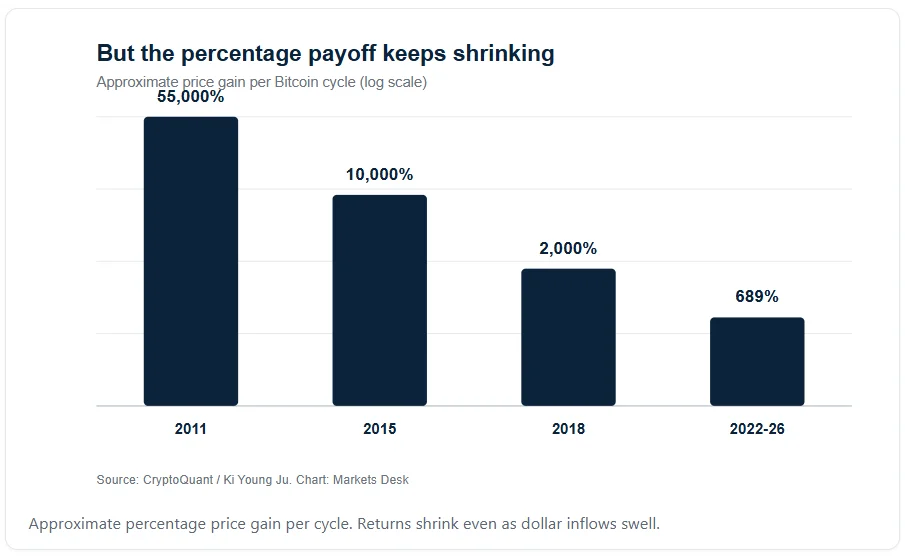
About $697 billion in new capital drove only a 689% gain this cycle, on a realized-cap basis.
Each past cycle needed far less money for vastly bigger percentage returns.
CryptoQuant’s Ki Young Ju says another parabolic run needs over $1 trillion in fresh capital.
U.S. spot ETFs bled a record $4.06 billion in June, even as whales bought aggressively.
The next Bitcoin bull run may need $1 trillion in fresh capital. That striking claim comes from the analytics firm CryptoQuant. Moreover, it reframes how traders should size their expectations for the years ahead.
Bitcoin now returns far less per dollar invested. Indeed, its capital efficiency has fallen sharply across successive cycles. Each new rally, therefore, demands more money for a smaller percentage gain. This trend matters because it changes the market’s entire logic. Furthermore, it explains why patient capital now dominates the debate.
The Numbers Behind Bitcoin’s Fading Efficiency
CryptoQuant founder Ki Young Ju published the underlying data on July 1. His figures track realized capitalization rather than the spot price. This metric values each coin at the price it last moved. Therefore, it gauges how much real money has entered the asset. It also filters out the noise of short-term volatility. As such, analysts treat it as committed money rather than paper value.
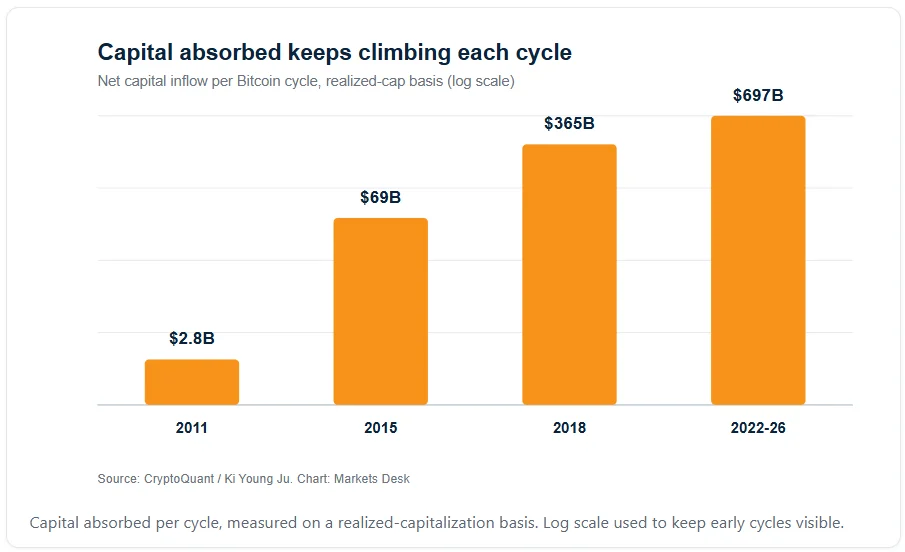
The contrast across cycles looks dramatic. In 2011, roughly $2.8 billion drove a rally of nearly 55,000%. The 2015 cycle then took about $69 billion for close to 10,000%. Meanwhile, the 2018 run needed about $365 billion for roughly 2,000%. This cycle has absorbed about $697 billion since 2022. Yet it has returned just 689% so far. Put simply, the ratio of dollars to gains has compressed about 80 times. Consequently, the arithmetic of past bull runs no longer applies cleanly.
Why Doubling Bitcoin Keeps Getting Harder
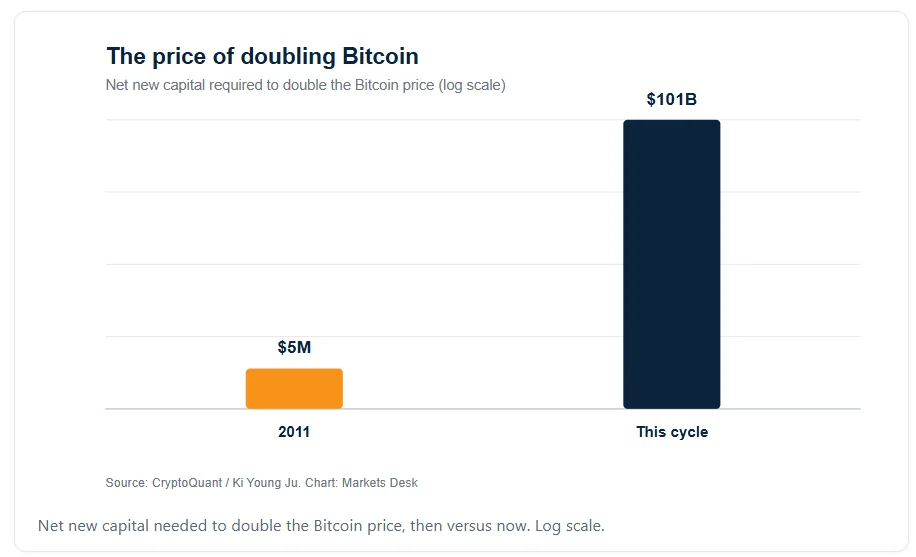
The same pattern holds at every scale. Back in 2011, about $5 million could double the Bitcoin price. Today, doing exactly that takes roughly $101 billion. Consequently, the cost has climbed by a factor of thousands.
This shift reflects Bitcoin’s sheer size today. The asset now carries a market value near $1.2 trillion. A decade ago, it held only a few billion dollars. Naturally, a much larger base moves less in percentage terms. As a result, explosive early returns have become far harder to repeat.
What the Next Bitcoin Bull Run Requires
Ki Young Ju frames the trend as maturation, not exhaustion. He argues Bitcoin must become a core macro asset. Furthermore, he still expects one more parabolic rally ahead. However, that run needs Bitcoin to absorb over $1 trillion. Such flows would require institutional adoption well beyond today’s level.
The bullish case points to plenty of headroom. Gold carries a market value near $27 trillion worldwide. Therefore, big institutions could still allocate far more toward Bitcoin. In that reading, weaker efficiency simply signals a maturing asset. Slower growth, after all, tends to follow every asset that scales. Yet reaching gold’s scale would still take years of steady inflows. Meanwhile, adoption remains uneven across funds, treasuries, and sovereign buyers.
Awkward Timing as ETF Money Exits
Still, the thesis lands at an awkward moment for bulls. U.S. spot Bitcoin ETFs bled a record $4.06 billion in June. That figure topped the previous monthly record from February 2025. BlackRock’s flagship IBIT fund drove much of that selling pressure. As a result, these funds were negative overall for 2026.
Bitcoin itself slipped below $60,000 during the same stretch. Prices touched 21-month lows before a modest July bounce. On July 3, the ETFs then logged a small $221 million inflow. That single green day, though, hardly reverses a brutal month. Indeed, one session cannot undo ten straight days of outflows.
Large holders, meanwhile, moved firmly in the other direction. These whales bought more than 270,000 BTC in two weeks. That haul equals roughly $16.7 billion at recent prices. Analysts note this split often appears near past cycle lows. In those windows, long-term buyers quietly absorb supply from nervous sellers. Notably, that absorption kept prices from falling much further.
What Investors Should Watch Next
The skeptical read stays refreshingly simple. Falling returns per dollar happen to any asset as it grows. Moreover, nothing guarantees that institutions will reach the necessary scale. A trillion dollars is an enormous bar to clear. Historically, no single quarter has ever delivered flows near that size.
For now, the two forces pull in opposite directions. Institutions are trimming risk through the familiar ETF wrapper. Meanwhile, whales continue to absorb spot supply directly on-chain. The next U.S. inflation reading could tip this fragile balance.
Investors should therefore track capital flows, not just the headline price. A sustained return of ETF demand would signal genuine conviction. Additionally, a rise in realized capitalization would confirm that fresh money is being committed. Until then, the $1 trillion question stays wide open.
The math itself carries no verdict on direction. Instead, it sets the admission price for the next surge. Bulls read a maturing asset with vast room to grow. Bears see a heavy market that struggles to move. Both sides, notably, agree on one basic point. Bitcoin will never again rise the way it once did.