


May 02, 2026 – From Deepseek to Gemini, leading AI systems all expect a Bitcoin recovery. None predicts a new all-time high. The $34,000 spread between them tells its own story.
In Summary
Eleven AI models projected BTC between $84,500 and $118,400 by December 31, 2026.
Polymarket assigns an 87% probability that Bitcoin surpasses $80,000 this year.
All models agree on recovery. None predicts a new all-time high or a fresh crash.
Eleven leading AI models now agree on one thing. Bitcoin will recover in 2026. But the extent of that recovery remains disputed. Projections from platforms including Grok, Gemini, and Copilot span a $34,000 range. The gap reveals how differently each system weighs the same market data. We break down the full picture and what it means for investors watching BTC’s path to year-end.
Where Bitcoin Stands Today

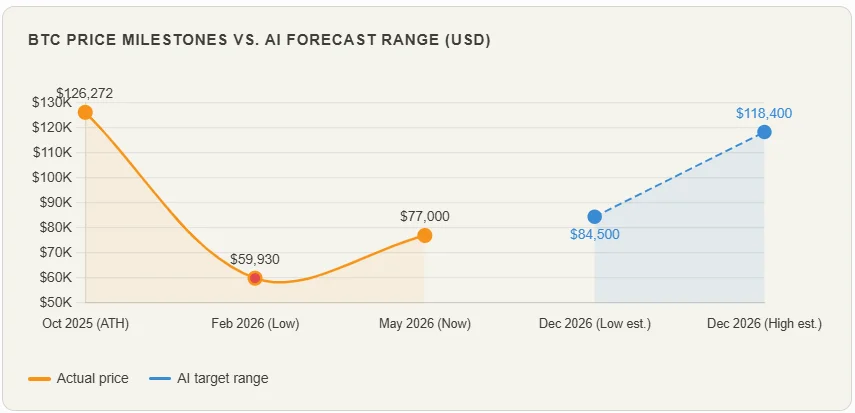
Bitcoin peaked at $126,272 in October 2025. That record remains untested today. By February 5, 2026, BTC had collapsed to $59,930. It has since rebounded steadily. As of early May, BTC trades near $76,000–$77,000. The recovery is real. But the pace is deliberate.
This correction fits the historical pattern precisely. Each Bitcoin halving cycle produces a sharp rally, then a meaningful pullback. The 2026 drawdown closely mirrors prior cycles. That context shaped how every AI model interpreted current dynamics.
What the AI Models Predicted
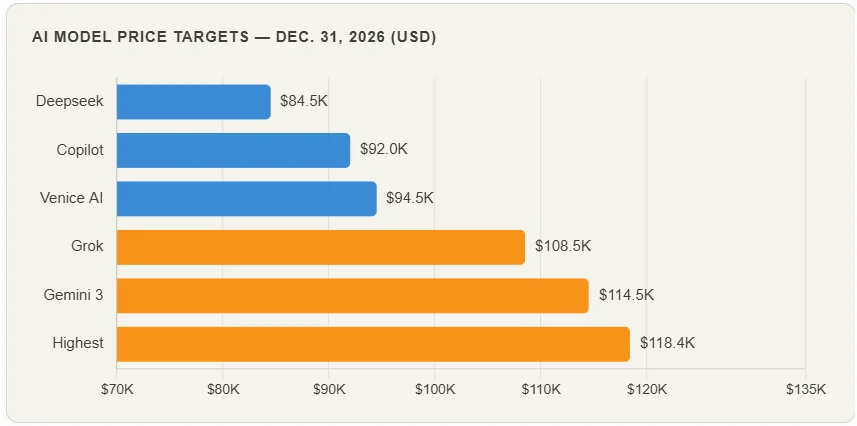
The models were asked a single question. What will Bitcoin’s closing price be on December 31, 2026? Each system received the same prompt, the same data, and no guidance on weighting.
Deepseek gave the most conservative answer at $84,500. It cited moderate institutional accumulation and a bottoming pattern. Copilot landed at $92,000, pointing to cautious sentiment and wide-range options pricing. Venice AI forecast $94,500, leaning on halving-cycle timelines and improving regulatory clarity.
Grok predicted $108,500. It described 2026 as a “grind-up year” fuelled by ETF inflows, which turned positive again in April. Gemini 3 Fast projected $114,500, citing expected monetary easing and Bitcoin’s maturation as a macro asset. The highest single forecast reached $118,400. No model predicted a new all-time high. None called for a retest of the February lows.
“The convergence around recovery rather than collapse is itself a meaningful signal from eleven independent systems.”
Prediction Markets Also Lean Bullish
AI models are not the only forecasters weighing in. Polymarket data shows an 87% probability that BTC exceeds $80,000 before 2027. The odds of a $100,000 close currently sit at 40%. Both figures have remained stable for two consecutive weeks. The market consensus is cautiously bullish. But significant uncertainty remains priced in.
Three Drivers That Will Decide the Outcome

Every AI model pointed to the same three drivers. ETF flows changed the market structure in 2024. Institutional participation now absorbs the selling pressure that miners once created. BlackRock’s IBIT alone has drawn billions in capital from traditional finance. Inflows resuming is the clearest near-term bullish signal.
Macro liquidity conditions represent the biggest wildcard. The Federal Reserve’s rate trajectory will heavily influence risk asset appetite. Models projecting the most aggressive recovery assume easing arrives in H2 2026. A delayed or cancelled easing cycle materially changes the math.
Post-halving supply dynamics remain the structural tailwind. The April 2024 halving cut daily BTC issuance in half. Fewer new supplies hitting the market means buyers have more pricing power. If institutional demand holds, the supply argument alone supports a year-end above $90,000.
Bitcoin Price Cycle: 2025–2026
The Bottom Line
AI models are analytical tools, not oracles. Their forecasts carry no guaranteed accuracy. But the convergence across eleven systems is meaningful. All chose recovery over collapse. All chose restraint over euphoria. The $34,000 spread from $84,500 to $118,400 reflects genuine uncertainty about macro timing.
The most likely outcome, based on model clustering, sits between $94,000 and $115,000. That is a meaningful recovery from current levels. It is also well below the October 2025 peak. That gap matters. It tells you where we are in the cycle past the blow-off top, grinding toward a new equilibrium.
Where Bitcoin actually lands on December 31 depends on the same three forces that every model has identified. ETF inflows, Fed policy, and post-halving supply dynamics. Track those variables closely. They will determine who is right.