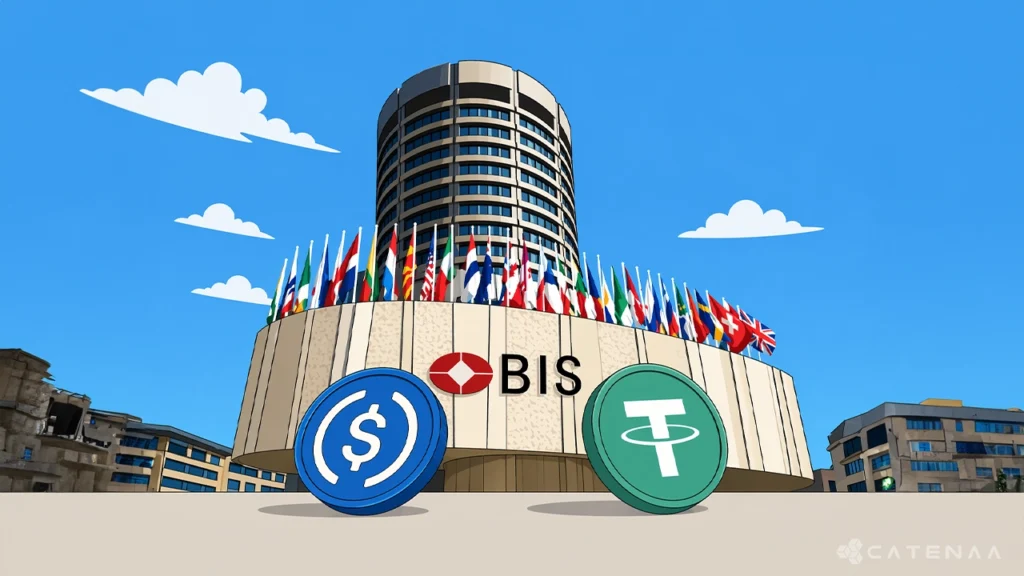


Catenaa, Friday, April 24, 2026- The Bank for International Settlements has warned that stablecoins function more like investment products than traditional money, renewing calls for global coordination as the market surpasses 300 billion dollars in circulation and regulatory debates intensify across major economies, a news report published by Reuters News Agency said.
The institution said stablecoins, particularly those pegged to the US dollar, show structural features closer to exchange-traded funds than payment instruments.
The assessment comes as two issuers, Tether and Circle, dominate the market with roughly 85% of global supply, raising concerns about concentration risk, redemption pressure, and financial stability.
The comments reflect growing concern among central bankers that rapid stablecoin expansion could fragment global financial regulation if countries continue developing separate and inconsistent frameworks.
The Bank for International Settlements argued that stablecoins do not consistently behave like money due to pricing fluctuations and redemption frictions. Officials said these assets often trade close to their peg but still experience deviations that resemble fund-like market instruments rather than stable payment tools.
The institution also warned that stablecoins could create stress in financial systems during periods of rapid withdrawal, particularly if confidence in reserves declines. Large-scale redemptions, it said, could transmit volatility into broader markets and affect liquidity conditions beyond the crypto sector.
Central bankers also raised concerns that stablecoins may weaken the effectiveness of monetary and fiscal policy if adoption continues to expand without coordinated oversight. The institution said inconsistent national rules could lead to regulatory arbitrage, where issuers and users shift activity to jurisdictions with weaker requirements.
Global regulators push for unified framework
The warning comes as governments in the United States, Europe, and Asia accelerate efforts to define legal frameworks for stablecoins. However, progress has been uneven, with some regions advancing structured licensing regimes while others continue to debate classification standards.
BIS officials emphasized that without coordinated rules, the global stablecoin market could become fragmented, with different standards for reserves, disclosure, and redemption rights across jurisdictions. This fragmentation, they warned, could increase systemic risk and complicate cross-border payments.
The institution also pointed to the potential need for stronger safeguards, including mechanisms similar to deposit insurance or central bank liquidity support, to manage large-scale redemptions in stress scenarios.
Debate over classification intensifies
A central issue in the regulatory debate is whether stablecoins should be treated as securities or as money. The BIS noted that current market behavior places them closer to investment vehicles due to yield dynamics, redemption mechanics, and market pricing behavior.
If classified as securities, issuers would face stricter disclosure requirements and regulatory oversight. If treated as money, stablecoins could expand more rapidly into payments and savings products, but with reduced regulatory constraints.
Industry participants continue to push for recognition of stablecoins as payment instruments, arguing that strict classification as securities could limit innovation and adoption in digital payments systems.
Stablecoin circulation has expanded rapidly in recent years, surpassing 300 billion dollars globally. Dollar-linked tokens dominate the sector, with Tether’s USDT leading at roughly 186 billion dollars in circulation, followed by Circle’s USDC at about 78 billion dollars.
Surveys and industry studies suggest growing adoption across payments, freelance work, and cross-border transfers. Some reports indicate that stablecoin users in emerging markets increasingly rely on digital dollar tokens for income settlement and international transactions.
At the same time, policymakers have raised concerns about dollar dominance in digital assets. European officials have expressed interest in expanding euro-denominated stablecoins, while some industry executives have suggested that other major currencies, including the yuan, could eventually enter the market through regulated channels.
Central bankers have also highlighted risks linked to sudden capital flows driven by stablecoins. They warned that widespread adoption could increase capital flight from emerging economies during periods of economic stress, while also accelerating inflows during periods of market optimism.
The BIS noted that such behavior could amplify financial cycles and reduce the effectiveness of local monetary policy in certain jurisdictions. It also warned that stablecoin usage could make it easier to move funds across borders outside traditional banking systems, raising oversight challenges.
Another concern involves the potential for rapid market withdrawals. Officials said that if confidence in reserve backing weakens, users could quickly redeem large volumes of stablecoins, creating liquidity pressure on issuers and broader markets.
Stablecoin issuers and crypto firms argue that existing market mechanisms already provide transparency and resilience. They point to reserve disclosures and short settlement times as evidence that stablecoins function effectively in payments and trading environments.
However, regulators remain divided on how far the sector should be integrated into the traditional financial system. Some policymakers support tighter integration with banking infrastructure, while others favor a more independent framework for digital assets.
The divergence in policy approaches has increased concerns about uneven global standards, particularly as stablecoins become more widely used in cross-border transactions and decentralized finance platforms.
The BIS warning underscores growing pressure on global regulators to align their approaches to stablecoin oversight. While adoption continues to expand across retail and institutional use cases, central banks are increasingly focused on managing systemic risks tied to scale, liquidity, and cross-border capital movement.
Future regulatory outcomes are expected to shape whether stablecoins evolve into fully integrated components of the global financial system or remain partially segmented within alternative digital markets.