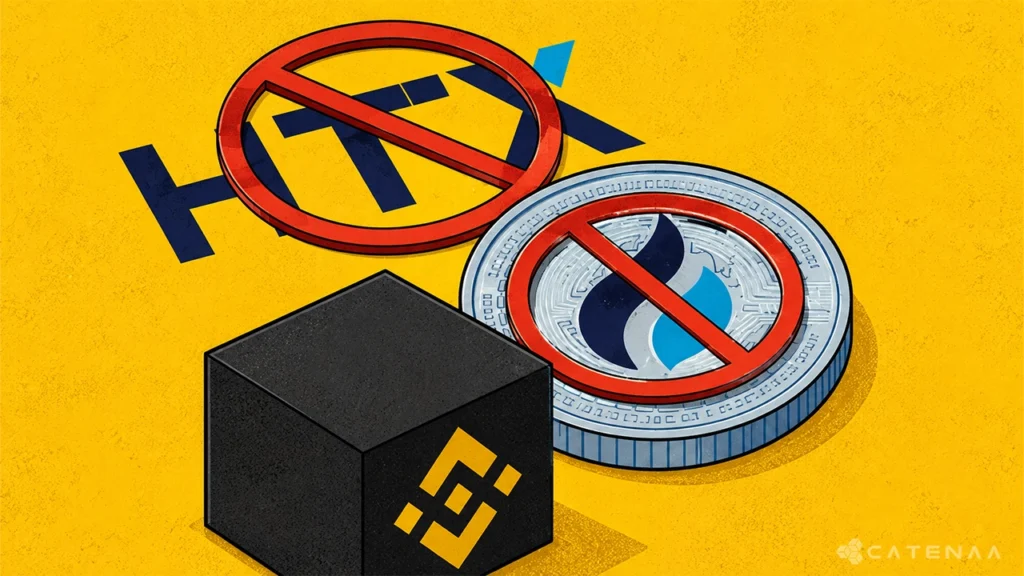


Catenaa, Friday, August 21, 2026- Binance will stop processing transactions involving HTX, EXMO and nine other crypto platforms from Aug. 23, extending sanctions compliance directly into exchange-to-exchange digital asset transfers.
The restrictions form the largest phase of a three-stage Binance compliance action affecting 16 crypto platforms.
Binance already restricted transactions involving Shelbit and Aban Tether Exchange from Aug. 7.
Restrictions covering A7 Nigeria, A7 Africa and PilotFinance Ltd. took effect Aug. 13.
From Aug. 23, Binance will add HTX, formerly Huobi, EXMO, Rapira, Aifory Pro, ABCeX, WhiteBird, NoOnecrypto, Tradex, Monease, BitPapa and Exnode/Exnode Pay.
The action does not amount to delisting cryptocurrencies associated with the platforms.
Instead, Binance users will no longer be able to send or receive funds through Binance when the transaction involves one of the restricted counterparties after its applicable cutoff date.
Transactions attempted after those dates could trigger compliance reviews and restrictions on affected wallets.
The August restrictions closely follow the European Union’s 21st sanctions package against Russia, adopted July 23.
The package expanded EU restrictions on crypto services accused of helping Russia bypass financial sanctions imposed after its invasion of Ukraine.
The European Council said the measures extended transaction bans to 14 crypto-related service platforms based across several jurisdictions.
EU officials said the package was designed to target financial networks used to frustrate existing restrictions and introduced powers allowing broader bans against third-country crypto providers used by Russia.
Most of the platforms in Binance’s later restrictions appear in the EU measures.
HTX stands out because it is a globally recognized centralized cryptocurrency exchange rather than a small regional service.
The EU linked Huobi Global SA to financial services involving A7 LLC, part of a Russia-linked cross-border payments network.
The United Kingdom had already moved against Huobi Global SA in May.
UK authorities designated the company under sanctions targeting Russia’s financial sector and sanctions-evasion networks.
The UK’s Office of Financial Sanctions Implementation subsequently clarified that the designation also applies to the HTX cryptocurrency exchange because of its ownership relationship with Huobi Global SA.
HTX-linked figure Justin Sun has disputed the practical reach of the restrictions.
Sun said the Binance action concerns users in the UK and EU and argued that HTX does not conduct business in those jurisdictions.
He also said settlement discussions with UK and EU regulators were underway.
The regulatory position in Britain, however, is clear. UK authorities consider HTX subject to the sanctions imposed on Huobi.
Not every platform affected by Binance’s action is tied to Russia.
Shelbit and Aban Tether Exchange were sanctioned by the U.S. Treasury’s Office of Foreign Assets Control on Aug. 7 over alleged connections to Iranian financial networks.
The Treasury accused the exchanges of helping Iranian actors maintain access to international financial systems and move cryptocurrency connected with sanctions evasion.
Those restrictions took effect on Binance the same day.
The result is a single exchange compliance system responding to sanctions imposed across multiple jurisdictions and involving different geopolitical conflicts.
The measures illustrate how sanctions enforcement is evolving as digital assets move between centralized exchanges.
A blockchain does not ordinarily stop a sanctioned wallet from sending cryptocurrency.
Centralized exchanges can.
They control customer accounts, identify users and screen deposit and withdrawal addresses against sanctions databases and internal risk systems.
That turns major exchanges into practical enforcement points between open blockchain networks and regulated financial markets.
Binance’s action means users interacting with listed platforms could face compliance checks even when the underlying cryptocurrency itself remains unrestricted.
Bitcoin, Ether and stablecoins can continue circulating on their respective networks.
The restriction instead follows the counterparty.
Catenaa View
The Binance decision shows that crypto sanctions are moving beyond blacklists of individual wallet addresses.
Regulators are increasingly targeting the infrastructure through which digital assets move.
That includes exchanges, payment firms, cross-border settlement networks and other crypto service providers.
The EU’s latest Russia package makes that approach explicit by allowing restrictions against third-country crypto providers accused of helping Russia evade sanctions.
For large exchanges, compliance increasingly requires understanding where cryptocurrency came from and where it is going, not merely identifying the account holder.
That creates a new layer of friction in crypto transfers.
A user may control perfectly legitimate Bitcoin but still encounter restrictions if the sending or receiving platform is sanctioned.
The distinction between permissionless blockchain networks and permissioned exchange infrastructure is therefore becoming more visible.
Crypto can move freely at the protocol level while becoming increasingly restricted at regulated entry and exit points.
HTX makes the development especially notable.
The inclusion of a major international exchange shows sanctions tools are no longer limited to obscure services operating at the fringes of the digital asset market.
Large platforms can also become isolated from major counterparties if regulators determine that their corporate entities fall within sanctions regimes.
The consequences could extend beyond Binance.
Other regulated exchanges, custodians, payment firms and financial institutions operating in Europe may have to apply similar controls where sanctions rules require them.
That could reduce liquidity between affected platforms and larger global exchanges.
It could also make moving funds from a sanctioned service increasingly difficult even when users attempt transfers through intermediary wallets.
Blockchain analytics firms can trace transaction histories across multiple addresses, allowing compliance teams to examine whether funds originated from a restricted platform.
Sanctions enforcement in crypto is therefore becoming less dependent on stopping a blockchain transaction itself.
Instead, authorities can pressure the regulated businesses that connect blockchains to conventional financial markets.
Western governments have increasingly incorporated cryptocurrency businesses into sanctions programs targeting Russia, Iran and other restricted networks. The EU’s 21st Russia sanctions package expanded transaction bans against financial institutions and crypto service providers accused of supporting sanctions circumvention. The UK separately designated Huobi Global SA and later clarified that its restrictions apply to HTX. The U.S. Treasury has also sanctioned crypto exchanges accused of facilitating Iranian illicit finance. Binance says it must comply with regulatory requirements in the jurisdictions where it operates and has introduced staggered restrictions covering 16 platforms.