


July 09, 2026 – Coinbase’s layer-2 network edged past Ethereum in Visa’s adjusted stablecoin volume data for June. The narrow lead points to a deeper shift in where tokenized dollars settle.

In Summary
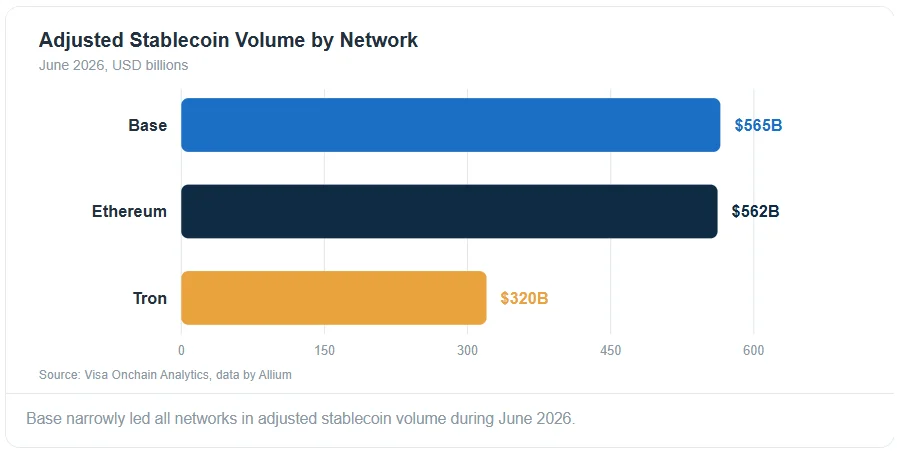
Base led all networks with about $565 billion in adjusted June stablecoin volume, just ahead of Ethereum’s $562 billion.
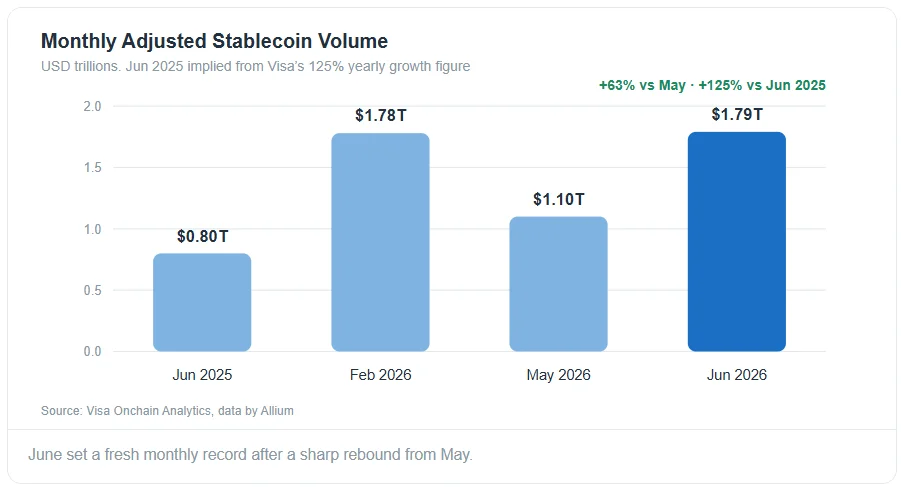
Total adjusted volume hit a record $1.79 trillion, up 63% from May and 125% from a year earlier.
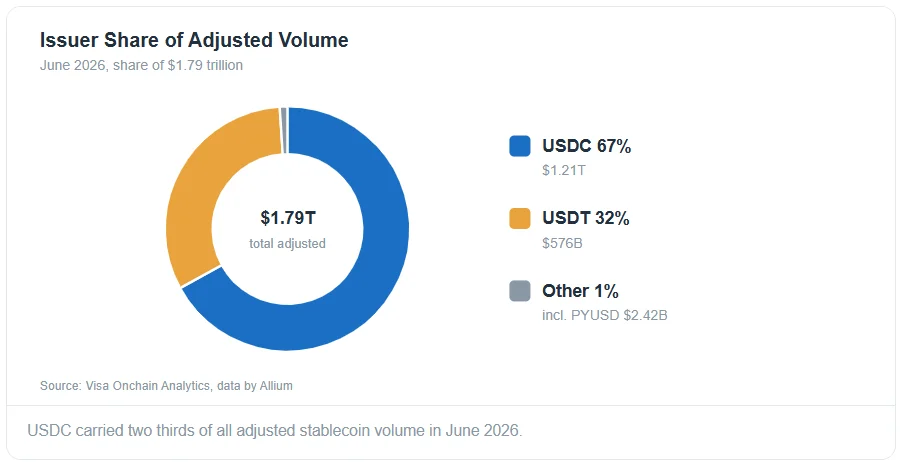
USDC carried roughly 67% of the flow, cementing its role as the leading settlement stablecoin.
A layer-2 chain topping Visa’s dollar table shifts the contest from token supply to payment distribution.
Stablecoin volume just posted its best month on record, and the leaderboard looks new. Visa’s Onchain Analytics dashboard tracked about $1.79 trillion in adjusted stablecoin volume during June. Moreover, Base ranked first among all networks at about $565 billion. Ethereum came in a close second at roughly $562 billion. As a result, the gap between the two chains sits at just $3 billion.
A Record Month for Stablecoin Volume
June’s total narrowly beat the prior record of $1.78 trillion, set in February. The figure also rose 63% from May’s $1.10 trillion. On a yearly basis, growth reached 125%. Furthermore, the rolling 12-month total now sits near $10.2 trillion, per Visa’s dashboard.
The surge arrived during a weak stretch for the wider crypto market. Consequently, many analysts see the data as proof of a new role. Stablecoins now act as core plumbing for moving money. In other words, payment flows no longer track the price cycle.
Concentration also deepened at the top of the table. Tron ranked third at about $320 billion, or roughly 18% of the total. Together, the top three chains carried close to 80% of all adjusted flow in June. In short, the stablecoin economy runs on a handful of rails.
Why Base’s Narrow Lead Matters
Base is a layer-2 chain that Coinbase incubated and launched in 2023. It bundles transfers off-chain, then posts the results back to Ethereum. As a result, users pay far lower fees while the mainnet still secures their funds.
A $3 billion edge sounds tiny next to half-trillion-dollar totals. However, the symbolism carries real weight. For the first time, a layer-2 chain sits above the Ethereum mainnet in Visa’s adjusted dollar table. That milestone moves the contest away from token supply. Instead, the fight now centers on payment reach. Wallet access, fee levels, app ties, and settlement speed decide where the dollars flow.
Coinbase built Base without a native token, and users pay gas in ETH. That design keeps the chain simple for users and firms alike. Fees often land below a cent, and transfers confirm in seconds. For payment use, those traits matter more than any ideology about layers.
The trend also has a longer arc. Visa’s insights page notes that layer-2 chains together passed Ethereum in monthly transfer count in August 2024. Therefore, June’s data extends that pattern from raw counts into adjusted dollar flows. The shift began with cheap retail transfers. Now it shows up in the money itself.
How Visa Filters the Noise
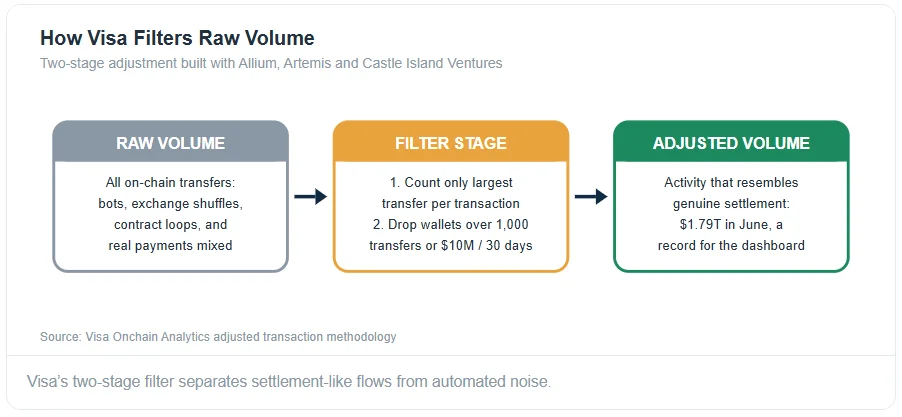
Raw blockchain volume overstates true payment activity by a wide margin. Bots, trading wallets, internal contract loops, and exchange shuffles all inflate the headline totals. For that reason, Visa built an adjusted method with Allium, Artemis, and Castle Island Ventures.
The filters work in two stages. First, a one-direction rule counts only the largest transfer inside each transaction. Second, an address rule drops wallets that send over 1,000 transfers or $10 million in any 30-day window. Together, the two rules strip out most robot churn. What remains looks much closer to a real settlement.
Visa admits the approach is still a best-guess system. It plans to refine the labels as coverage grows. Even so, adjusted data gives a far cleaner lens on the Base and Ethereum race than raw transfer totals alone.
USDC Dominates the Issuer Split
The issuer split showed a clear winner. Circle’s USDC accounted for about 67% of June’s adjusted volume, totaling $1.21 trillion. Meanwhile, Tether’s USDT held roughly 32%, or $576 billion. PayPal’s PYUSD trailed far behind at $2.42 billion.
USDC’s strength maps neatly onto Base’s rise. Coinbase helped found the USDC system with Circle, and the token anchors most payment flow on its chain. Accordingly, each gain for Base tends to lift USDC’s share as well. The two grow as a pair.
The Payment Layer Is Now the Product
Visa’s own research frames stablecoins as payment rails, not trading chips. Cross-border transfers, card programs, business payouts, and weekend settlement all rely on the underlying chain. In that frame, the network carrying the dollars becomes the core of the product itself.
Ethereum still earns fees from Base, since the layer-2 posts its data back to the mainnet. Nevertheless, the economics differ sharply. Cheap rails pull payment flow away from the base layer. Over time, that squeezes the mainnet’s direct fee income.
Circle and Tether also face fresh rivals on these rails. New bank-backed coins continue to enter the field. Hence, the chain war and the issuer war now run side by side.
The next test is staying power. One month proves little on its own, and the margin remains razor-thin. Furthermore, both chains cleared more than half a trillion dollars, so the race remains wide open. The signal to watch is simple. Can layer-2 chains keep winning payment flows across many months and market moods? June gave the first clear yes. The coming quarters will decide if it holds.




