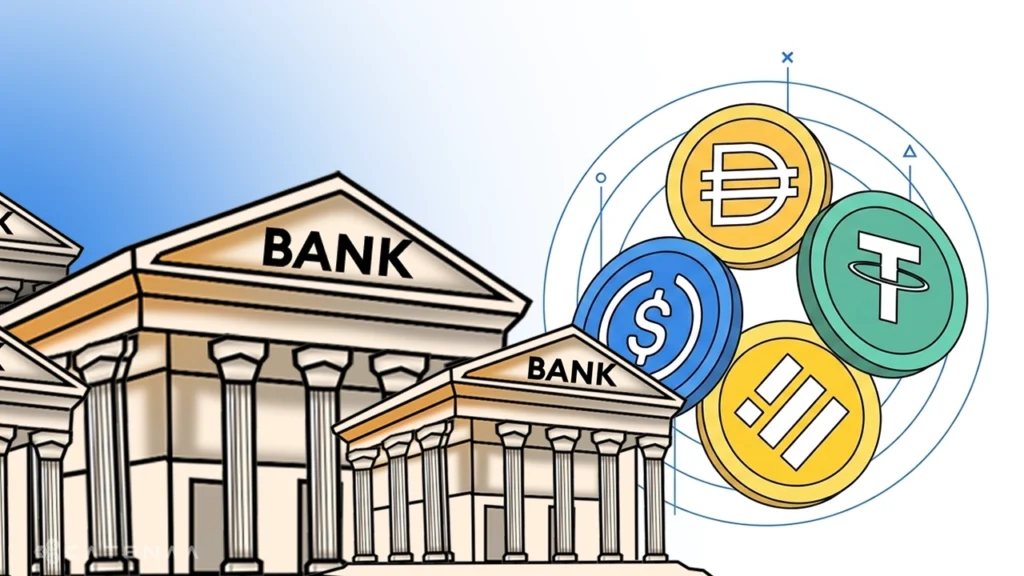


Catenaa, Sunday, June 07, 2026- Pressure between banks and the crypto industry intensified after analysts warned that yield-bearing stablecoins could weaken traditional banking deposit models by allowing users to hold and earn returns on digital dollars outside conventional financial institutions.
Crypto analyst EGRAG CRYPTO argued this week that banks increasingly view stablecoins as a direct threat to their core lending businesses rather than simply a regulatory concern.
The debate comes as US lawmakers continue negotiations surrounding crypto market structure and stablecoin legislation, including the CLARITY Act.
According to EGRAG, banks profit heavily from the spread between low-interest customer deposits and high-interest lending activity.
He said banks can lend deposited funds at rates reaching 28% while paying customers less than 1% interest on savings.
Stablecoins backed by short-term US Treasury bills now offer users potential yields near 5% while allowing direct custody and near-instant global transfers without relying on bank accounts.
Yield-bearing stablecoins have emerged as one of the fastest-growing sectors inside digital finance as tokenized dollars increasingly move into treasury management, remittances and decentralized finance.
Industry data showed the global stablecoin market recently surpassed $320 billion in circulation.
Tether’s USDT controls roughly $188 billion while Circle’s USDC holds approximately $76 billion.
Standard Chartered previously estimated US banks could lose nearly $500 billion in deposits to stablecoins by 2028 if adoption accelerates.
Analysts said stablecoins challenge the traditional banking structure by separating custody, settlement and yield generation into decentralized digital systems.
The shift could reduce bank funding sources if consumers and corporations increasingly hold Treasury-backed digital dollars instead of bank deposits.
During recent Senate Banking Committee discussions over the CLARITY Act, banking industry groups heavily lobbied lawmakers over stablecoin yield provisions.
Some lawmakers accused banks of attempting to suppress stablecoin competition to protect low-interest deposit models.
Market observers said the fight over stablecoin regulation increasingly centers on control over payment systems, deposits and financial infrastructure rather than cryptocurrency speculation alone.
Ripple research released earlier this year showed 74% of finance executives believe stablecoins could improve treasury operations and unlock working capital efficiency.
Others warned that rapid migration toward nonbank digital dollar systems could reshape global liquidity flows and reduce the role of traditional banks in cross-border payments.
Stablecoins have evolved rapidly from crypto trading tools into major settlement instruments used across payments, remittances, decentralized finance and tokenized asset markets.
At the same time, governments and central banks globally continue debating how to regulate stablecoin issuers and protect financial stability.
The growing adoption of Treasury-backed digital dollars has become one of the most politically sensitive developments inside the global financial system during 2025 and 2026.
Banks are intensifying opposition to yield-bearing stablecoins as Treasury-backed digital dollars threaten traditional deposit and lending business models.