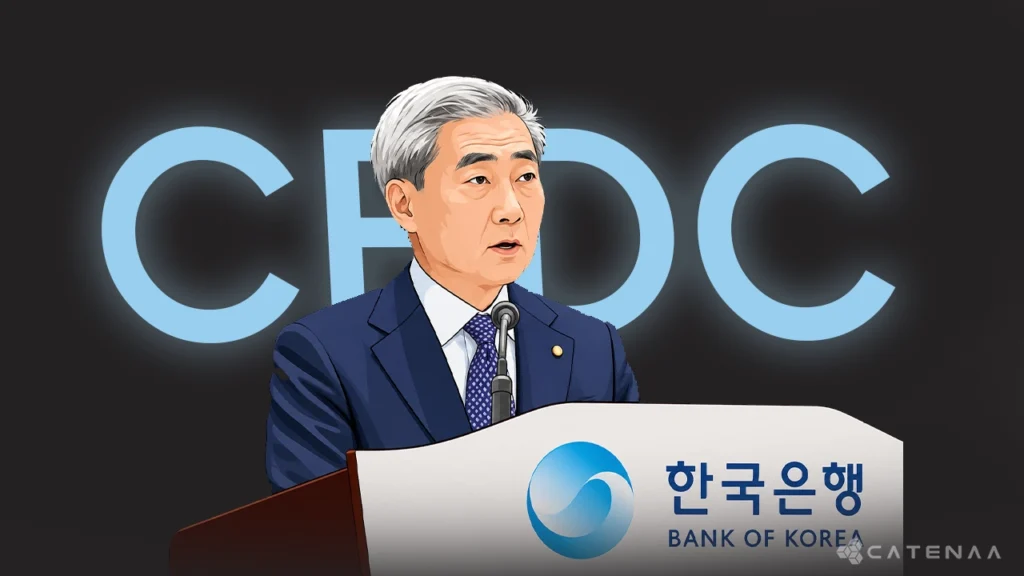


Catenaa, Saturday, April 25, 2026-South Korea’s new central bank chief has pledged to expand central bank digital currencies and deposit tokens as part of a wider push to modernize the country’s payment system, though he avoided direct mention of stablecoins in his first speech after taking office.
Shin Hyun-song, the new governor of the Bank of Korea, began his four-year term Tuesday with a speech focused on inflation risks, financial reform and the future of digital money.
Shin said the central bank will continue building a digital financial ecosystem centered on central bank digital currency, or CBDC, and tokenized bank deposits.
He pledged to expand the second phase of Project Hangang, which is testing blockchain-based payments and settlement tools across South Korea’s banking sector.
The next phase of Project Hangang includes broader use of deposit tokens, which are digital versions of bank deposits that can be transferred instantly on blockchain systems. Shin also said the Bank of Korea will continue cooperating with international projects such as Project Agora to strengthen the global role of the Korean won in digital payments.
Shin’s speech comes as South Korea debates how stablecoins, CBDCs and tokenized deposits should coexist in the country’s financial system.
Although he did not mention stablecoins directly during the speech, lawmakers are still working on a legal framework for won-backed stablecoins through the proposed Digital Asset Basic Act.
The omission stood out because won-based stablecoins have become an increasingly important topic in South Korea’s digital finance sector. Large banks, payment firms and technology companies have already started preparing for a regulated stablecoin market.
Last year, the Bank of Korea reportedly slowed parts of its CBDC work as stablecoin projects gained momentum. Shin now appears to be re-centering the discussion around CBDCs and regulated deposit tokens issued by banks.
Shin’s support for CBDCs and deposit tokens suggests South Korea may pursue a model that keeps the central bank and commercial banks at the center of digital payments.
Unlike private stablecoins, deposit tokens remain direct liabilities of banks and operate within the existing financial system. The Bank of Korea views them as a safer alternative because they can move quickly like crypto assets while remaining subject to banking regulation.
The second phase of Project Hangang now includes nine major banks and will test retail payments, peer-to-peer transfers and government subsidy distribution using tokenized deposits. South Korean officials believe these systems could lower merchant fees, speed up settlement and make public spending more transparent.
The project will also expand into everyday use cases, including payments at convenience stores, supermarkets, bookstores and coffee shops through QR codes and mobile apps. Biometric authentication and automatic token conversion features are also being added.
Shin previously took a skeptical view of stablecoins while serving at the Bank for International Settlements, arguing that fragmented stablecoin systems cannot replace sovereign currencies.
More recently, however, he has softened his stance. During his confirmation process earlier this month, Shin said that won-backed stablecoins could coexist with CBDCs and deposit tokens in a complementary but competitive way. He added that CBDCs and deposit tokens should remain at the center of the future monetary system because they are backed by central bank credibility.
Analysts say that shift may give South Korea a more flexible approach than other countries, allowing both public and private digital money systems to develop side by side.
Project Hangang is South Korea’s flagship digital currency initiative. The first phase tested whether digital currency and deposit tokens could operate smoothly from issuance to settlement.
The second phase, launched last month, expands the program to nine banks and introduces new use cases such as government subsidy payments and consumer transactions. Officials are considering using deposit tokens to distribute subsidies tied to electric vehicle charging projects, which would make South Korea one of the first countries to use blockchain-based public disbursement tools at scale.
South Korea’s digital currency strategy is entering a new phase under Shin’s leadership.
While stablecoin legislation remains delayed until after local elections, the Bank of Korea appears ready to push ahead with CBDCs and deposit tokens as the foundation of its digital payments system.
The balance between central bank-backed digital money and private stablecoins is likely to shape the next stage of South Korea’s financial system and may influence how other countries approach digital currency regulation.




