

April 20, 2026 – A Budapest university joins the VISTA science park. The move opens a new corridor into the $626B global space tech economy.
In Summary
Voyager Technologies signed an MOU with Obuda University, Budapest, making it VISTA’s first European academic partner.
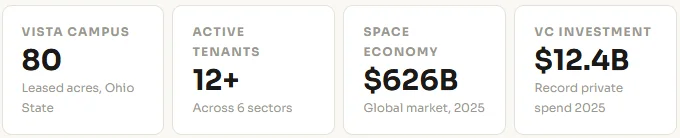
VISTA is the U.S.’s only science park dedicated to in-space research, located at Ohio State University on 80 leased acres.
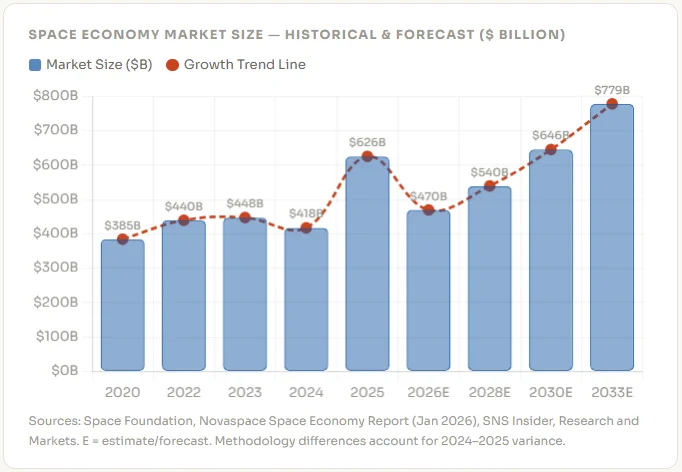
The global space tech economy reached $626B in 2025, up 7% year-on-year, and is tracking toward $1 trillion by 2034.
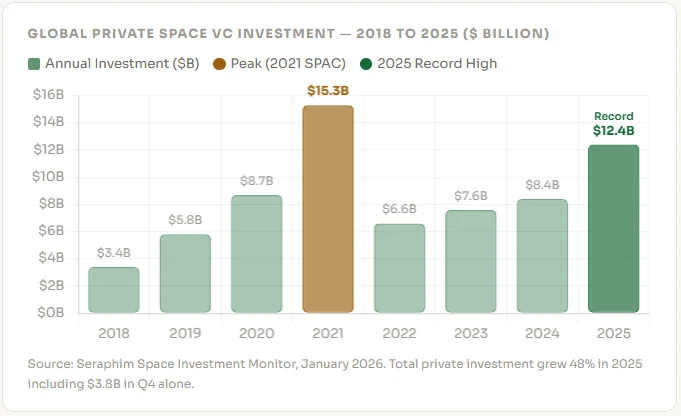
Private VC investment in space surged 48% to $12.4B in 2025, the highest since the 2021 SPAC boom.
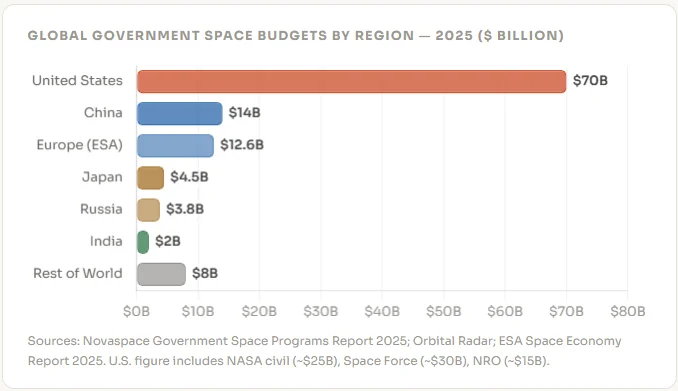
Global government space budgets reached $137B in 2025; the U.S. holds roughly a 51% share of that total.
VOYG analyst consensus is a Buy, with an average price target of $38, implying 21% upside from current levels.
Voyager Technologies (NYSE: VOYG) signed a Memorandum of Understanding with Obuda University in Budapest, Hungary. The deal brings the Central European institution into VISTA, the Voyager Institute for Space, Technology and Advancement. VISTA is America’s first science park dedicated entirely to in-space research.
The announcement is measured in scale. Its implications are larger. It marks the first European academic partner formally joining the VISTA ecosystem. Competition to attract international research talent into U.S. space infrastructure is intensifying.
What VISTA Is and Why It Matters
VISTA spans up to 80 leased acres at Ohio State University in Columbus, Ohio. It hosts more than twelve tenants today. Sectors represented include biopharma, agritech, AI, semiconductors, robotics, and biomedicine. The park’s defining advantage is direct access to the International Space Station. Tenants conduct microgravity research without needing bespoke space programs.
VISTA is explicitly platform-agnostic. It serves ISS users now. It is designed to serve post-ISS commercial platforms as the transition unfolds after 2030. As Jeffrey Manber, Voyager’s Special Representative to the Chairman and CEO, put it: VISTA “enables an international pipeline for the commercial LEO economy.”
The Obuda Partnership — Unpacked
Under the MOU, Obuda University gains reserved research resources within VISTA. It receives a tenant seat alongside Fortune 500 companies, startups, and federal agencies. The framework covers research, education, and technology development. Obuda is Central Europe’s recognised leader in engineering and business. It already has a growing presence in the space domain.
Why Hungary? Hungary is an ESA participating state. It has a strong engineering talent pipeline and a competitive cost base. Obuda’s network gives VISTA a direct research corridor into Central Europe, a region that previously had no structured U.S. space economy access.
The Global Space Tech Economy
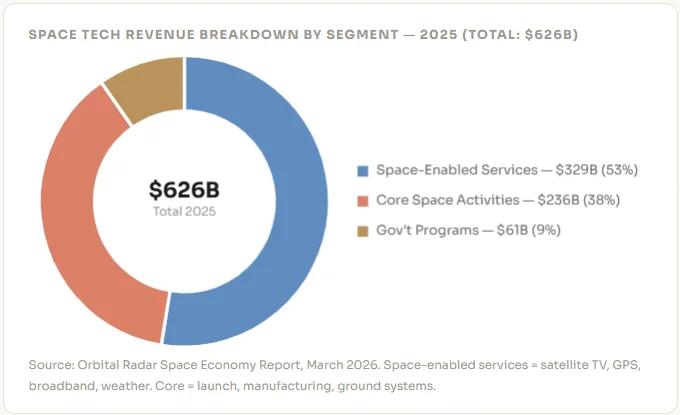
Space technology is one of the fastest-growing sectors in the global economy. The global space economy reached $626 billion in 2025, up 7% year-on-year. It is roughly double its size from a decade ago. The commercial segment accounts for 78% of all revenues. Private companies are growing at a CAGR of 9.9%.
Space-enabled services dominate the revenue mix. Satellite telecommunications, GPS navigation, broadband, and weather forecasting generated $329 billion in 2025 alone. Core space activities, launch, hardware, and ground systems contributed $236 billion. The remaining $61 billion came from direct government programs.
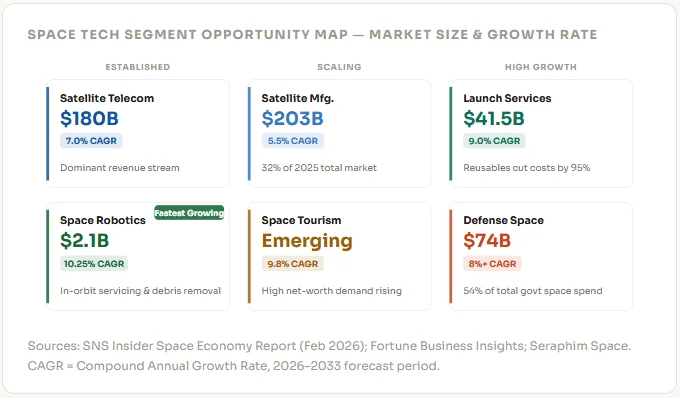
Defence is now the primary structural growth driver. Global government space budgets totaled $137 billion in 2025, up 10% from $135 billion in 2024. Defence spending exceeded civil budgets for the third consecutive year. It now accounts for $74 billion, 54% of total government spend. The United States alone accounts for roughly $70 billion in global government spending.
ISS Access and Platform-Agnostic Advantage
The strategic core of the Obuda deal is orbital access. VISTA connects tenants directly to the ISS. On April 15, 2026, Voyager was selected by NASA for its seventh private astronaut mission. That track record is rare. Most academic institutions have no credible path to in-space experiments. VISTA removes that barrier entirely.
VISTA tenants develop next-generation space-based technologies across civil, commercial, and national security markets. The platform-agnostic design means the ecosystem can pivot to Starlab and other post-ISS platforms. Obuda’s researchers will benefit from that continuity of access.
What This Means for Investors
VOYG traded at $31.31 on April 17, 2026. Ten analysts cover the stock. Consensus is Buy. The average target of $38.00 implies 21% upside. Wedbush flagged the company as well-positioned for rising space and defense demand ahead of Q1 2026 results on May 4.
In April 2026, Voyager doubled satellite propulsion capacity at its Denver-metro facility. That is a near-term, concrete revenue signal. VISTA is a longer-duration strategy. The two pillars, operational cash flow now, ecosystem revenue later, reduce execution risk across time horizons.
Bottom Line
The Obuda MOU is a small announcement with a large signal. Every international partner joining VISTA adds legitimacy, talent density, and research volume. The $626 billion global space tech economy is accelerating on multiple fronts: defence, private capital, satellite infrastructure, and in-space manufacturing. VISTA sits exactly where those forces converge. Voyager is building the infrastructure that the space economy does not yet fully know it needs, and that is typically the right bet to make.