

June 18, 2026 – Uniswap’s token rallied hard this week. A Standard Chartered note and a tokenized stock launch drove the move, yet real risks remain.
In Summary
UNI jumped about 20% in 24 hours, and it climbed roughly 48% across the week.
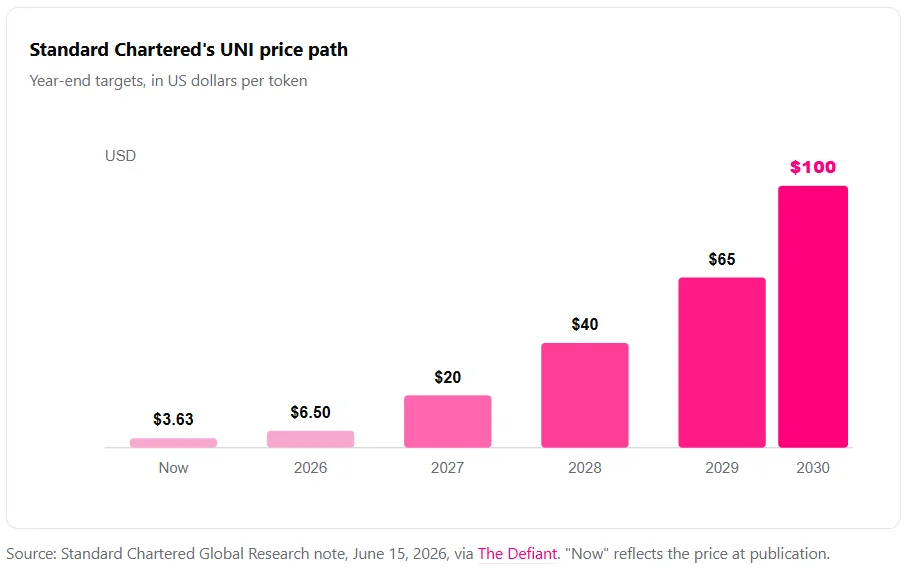
Standard Chartered started coverage with a $100 target by 2030, representing a near-40x move.
The bank also mapped yearly checkpoints, starting at $6.50 by the end of 2026.
Uniswap’s tokenized-stock launch on June 12 added fresh momentum.
However, UNI still trades far below its 2021 peak, so the thesis stays unproven.
Uniswap’s governance token UNI posted a sharp rally this week. The token surged to a local high near $3.70, its strongest level in more than a month. At the time of publication, it traded around $3.63, up 19.8% on the day and 48.4% on the week, according to CoinGecko data cited by Decrypt. Moreover, the move outpaced both Bitcoin and Ethereum.
The rally lifted Uniswap’s market value to roughly $2.26 billion. Daily trading volume sat near $864 million as institutional optimism spread across the DeFi sector. Therefore, attention quickly turned to what sparked the jump.

A bank sets a bold target
The main catalyst was a Standard Chartered research note dated June 15. Geoff Kendrick, the bank’s global head of digital assets research, set a $100 target for UNI by the end of 2030. That figure implies a near fortyfold gain from recent levels.
Importantly, Kendrick did not stop at one number. He laid out yearly checkpoints that investors can track over time. The bank sees UNI at $6.50 by the end of 2026, then $20 in 2027, $40 in 2028, and $65 in 2029. Finally, the path reaches $100 in 2030.
Kendrick framed Uniswap as core financial plumbing rather than a simple app. He urged traditional finance to view it “less as a retail DEX app and more as market infrastructure”. Furthermore, he compared Uniswap to YouTube and Coinbase to Netflix.
“The next opportunity for generational wealth in digital assets is going to come via the DeFi protocols.”
-Geoff Kendrick, Standard Chartered, via The Block
Why tokenization sits at the core
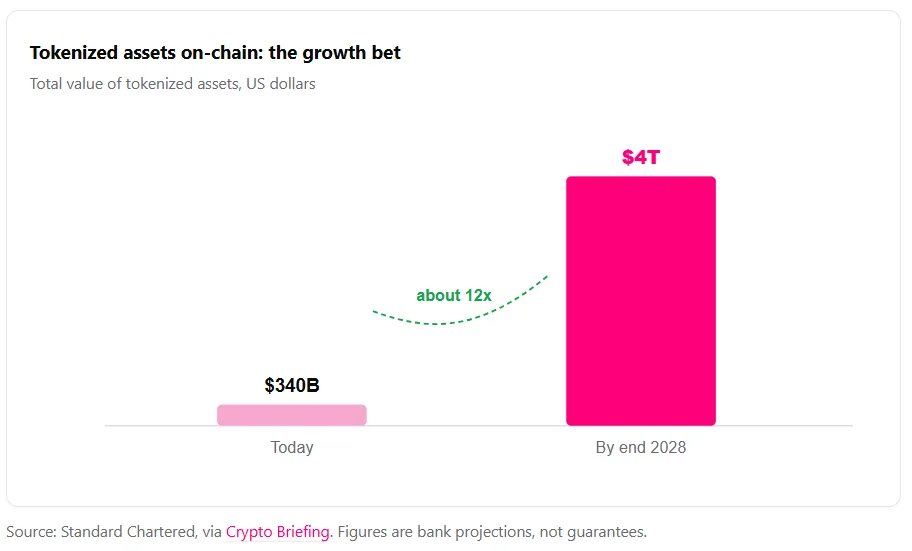
The thesis rests on one big bet. Tokenized real-world assets should move on-chain in large numbers. Consequently, Uniswap could become the venue where much of that trading happens.
Standard Chartered expects tokenized assets to grow sharply. The bank sees on-chain tokenized value rising from about $340 billion today to $4 trillion by the end of 2028. In addition, it expects the DeFi share of those assets to climb toward 30% by 2030.
A second catalyst arrived just days earlier. On June 12, Uniswap made tokenized securities live across its app, wallet, and API. As a result, eligible users can now trade tokenized versions of SpaceX, Apple, Tesla, and NVIDIA directly on the platform.
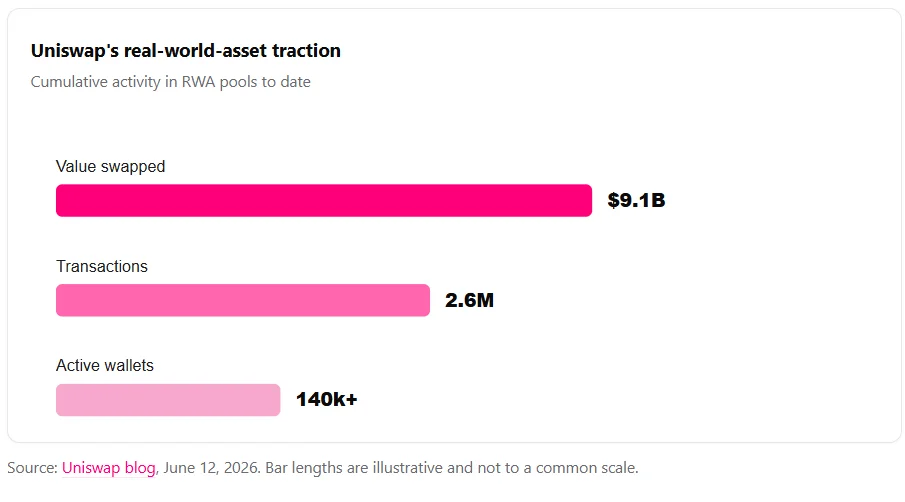
The launch builds on real activity, not just hype. Uniswap reports that more than $9.1 billion has already moved through its real-world-asset pools. Those swaps span more than 2.6 million transactions across more than 140,000 wallets, per the official Uniswap blog.
The supply story adds support
Token mechanics also help the bull case. A late-2025 “UNIfication” fee-switch upgrade now burns roughly 1% of supply each year. As a result, total supply has fallen to about 895 million from the original 1 billion.
Researchers point to strong fundamentals too. Uniswap posted a record $125 billion in monthly trading volume in October 2025. Since then, it has reclaimed the top DEX spot, accounting for roughly 25% to 30% of total volume, the Decrypt report notes.
The risks behind the rally
Still, the target remains far from certain. UNI is near a multi-year low and trades well below its all-time high of $44.92 set in May 2021. Therefore, the path to $100 demands a long and uninterrupted climb.
There is also a structural gap. UNI governs the protocol, yet it does not directly capture protocol revenue today. Any move toward $100 likely needs stronger token utility or deeper fee links to holders.
Kendrick himself flagged clear hazards. He cited niche competitors and the slow standardization of compliance rules. Moreover, he warned that tokenization alone does not guarantee deep liquidity. The yearly checkpoints will reveal early whether the thesis holds.