


May 20, 2026 – Standard Chartered sees Wall Street’s tokenisation wave making DeFi the backbone of institutional finance worldwide.
In Summary
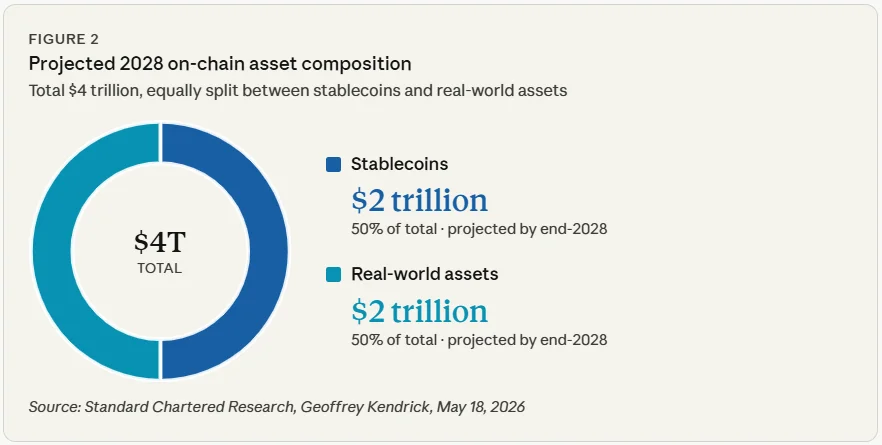
Standard Chartered projects $4 trillion in tokenised assets on-chain by end-2028.
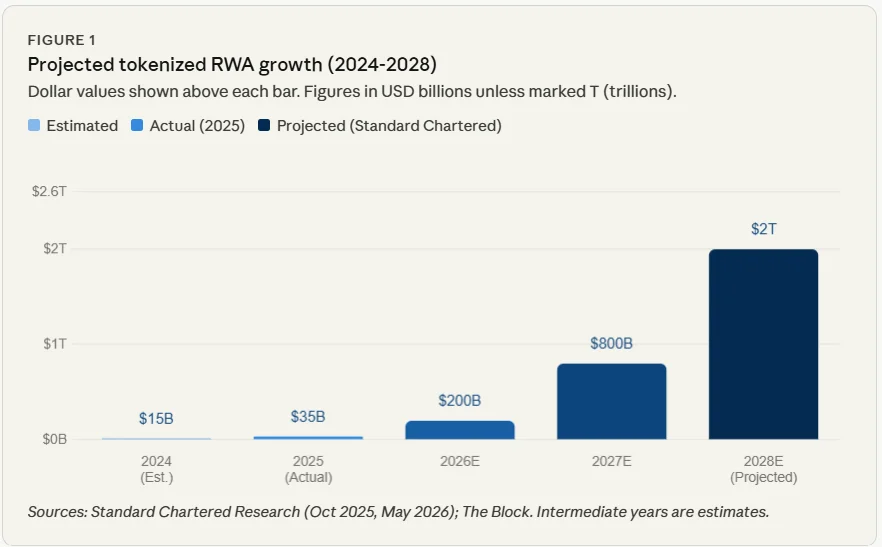
Stablecoins and real-world assets each target $2 trillion by 2028.
DeFi’s “composability” gives it a structural edge over traditional finance rails.
BlackRock’s BUIDL fund already integrates yield, collateral, and liquidity into a single token.
The U.S. CLARITY Act is the most critical near-term regulatory catalyst.
Aave’s daily stablecoin lending ranges from $1.5 billion to $2 billion.
Wall Street’s tokenisation push may permanently reshape decentralised finance. Standard Chartered released a landmark research report on May 18, 2026. The bank projects $4 trillion in tokenised assets on public blockchains by the end of 2028. DeFi protocols stand to become the core infrastructure layer for this shift.
The $4 trillion forecast
Geoffrey Kendrick leads digital assets research at Standard Chartered. He consolidated two separate forecasts in his latest report. The first targets $2 trillion in stablecoins. The second targets $2 trillion in real-world assets by the end of 2028.
Furthermore, off-chain assets currently outsize on-chain assets by roughly 1,000 times. This gap signals enormous untapped potential. Tokenisation, therefore, is the most significant financial opportunity of this decade.

Why DeFi wins: composability
Traditional finance moves assets in separate silos. DeFi, however, connects them seamlessly. Kendrick highlighted “composability” as DeFi’s most important structural advantage.
In DeFi, a single asset earns yield, serves as collateral, and stays liquid. It does all three simultaneously. Traditional finance cannot match this level of capital efficiency.
“In DeFi, liquidity begets new products, and new products beget new liquidity.”Geoffrey Kendrick, Global Head of Digital Assets Research, Standard Chartered
Additionally, DeFi’s liquidity enables the creation of new financial products. New products attract fresh liquidity in return. Consequently, a self-reinforcing growth cycle is underway. Kendrick confirmed he believes this cycle has already begun.
BlackRock leads by example
BlackRock’s BUIDL fund offers the clearest proof of concept available today. It was issued through the tokenisation specialist Securitise. BUIDL simultaneously generates Treasury yield for investors.
Additionally, BUIDL serves as collateral on DeFi lending protocols. The fund also acts as a reserve asset for products like Ethena USDtb and Ondo OUSG. Therefore, BUIDL demonstrates how one tokenised asset unlocks multiple streams of value.
Regulation as a catalyst
Regulatory clarity is accelerating institutional adoption rapidly. The U.S. GENIUS Act, passed in July 2025, established clear rules for stablecoins. This milestone boosted both retail and institutional confidence.
However, the next key milestone is the Digital Asset Market Clarity Act. Known as the CLARITY Act, it advanced through the Senate Banking Committee last week. Kendrick called this the most important near-term catalyst for institutional adoption.
Moreover, the SEC and CFTC may act in line with the Clarity Act’s intent. They could do so even before formal passage. The mid-2026 consultation period marks a critical milestone.
DeFi’s growing institutional scale
DeFi is no longer a retail-only market. Institutional capital is flowing in fast. Aave, the largest DeFi lending protocol, once matched the 38th largest bank in the United States by total assets.
Furthermore, Aave’s daily stablecoin lending volumes reach $1.5 billion to $2 billion. Meanwhile, the Coinbase-Morpho Bitcoin lending product has surpassed $1.75 billion in loans. These figures confirm growing institutional trust in DeFi infrastructure.
DeFi’s resilience under pressure
DeFi faced a severe stress test in April 2026. A $292 million exploit on KelpDAO triggered a sharp liquidity crunch in Aave. Aave deposits fell by roughly 38%. Active loans dropped by approximately 31%.
However, an industry-coordinated $300 million backstop quickly stabilised the system. Standard Chartered maintained its $2 trillion RWA forecast despite the shock. Kendrick described DeFi as “bent, not broken.” This response signals a maturing ecosystem capable of absorbing institutional-scale shocks.
The road to 2028
Tokenisation is no longer theoretical. It is reshaping markets in real time. Standard Chartered’s $4 trillion projection carries substantial institutional credibility. The bank itself is a direct participant in this transformation.
Therefore, investors and institutions must actively monitor this space. The migration from traditional financial rails to DeFi is accelerating. Furthermore, regulatory milestones in late 2026 will set the pace of adoption. The next two years could define a new era for global finance.