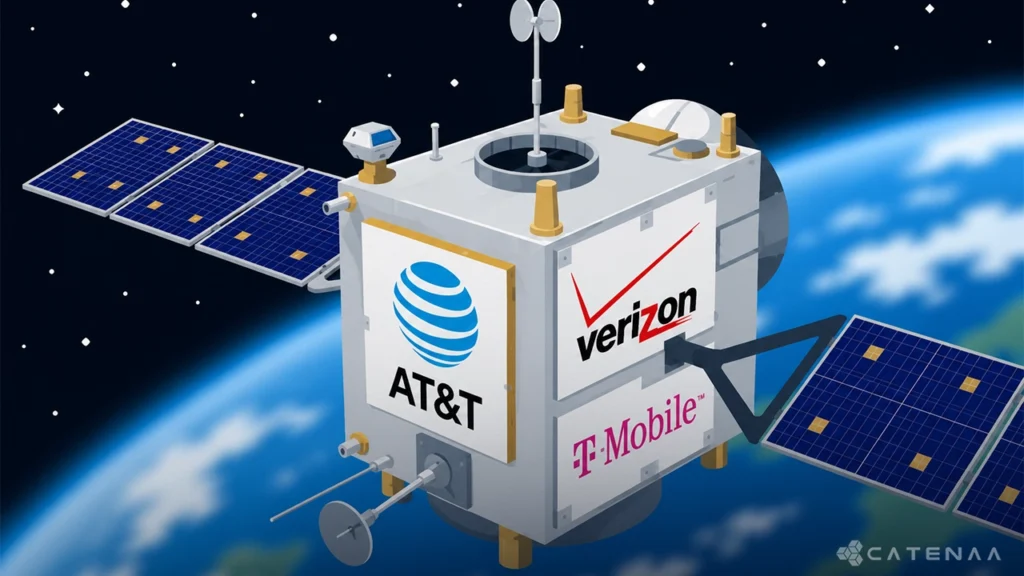


Catenaa, Friday, May 22, 2026-AT&T, Verizon and T-Mobile US agreed to jointly develop a unified direct-to-device satellite platform aimed at eliminating mobile dead zones across the United States as competition intensifies in the fast-growing satellite-to-smartphone communications market.
The three telecom giants announced Thursday that they will collaborate on standards, spectrum sharing and device compatibility to avoid fragmentation in the emerging direct-to-device, or D2D, industry.
The partnership marks a rare alliance between the country’s biggest wireless operators despite their separate commercial relationships with competing satellite companies.
T-Mobile already operates T-Satellite with Starlink, while AT&T and Verizon are partnered with satellite broadband firm AST SpaceMobile.
Unified Network
The operators said the new joint venture would focus on building a technology-neutral platform allowing multiple satellite providers to connect directly with mobile networks.
The companies said the initiative would improve coverage, strengthen interoperability and increase capacity by pooling limited spectrum resources.
The partnership also seeks to create industrywide compatibility between smartphones, mobile operating systems, applications and satellite systems.
Executives said customers should eventually remain connected automatically in remote areas without needing separate hardware or manual switching between terrestrial and satellite networks.
The companies did not disclose financial terms or a timeline for launching the joint venture.
They also said existing partnerships with satellite firms would continue independently.
Satellite Race
Direct-to-device technology allows ordinary smartphones to connect directly with satellites in orbit when traditional cellular towers are unavailable.
The sector has rapidly gained attention as telecom firms race to eliminate coverage gaps across rural regions, oceans, disaster zones and remote highways.
Industry analysts see satellite connectivity as one of the next major battlegrounds in wireless communications.
AST SpaceMobile quickly welcomed the announcement and said it plans to remain a major player in space-based cellular broadband.
The company is still preparing commercial launches despite suffering a satellite launch setback last month.
Skylo Chief Executive Parth Trivedi said the future of satellite connectivity depends on interoperability rather than isolated proprietary systems.
He said telecom operators are increasingly trying to shape the market instead of leaving control entirely to satellite firms.
Competitive Pressure
The alliance also reflects growing pressure on traditional mobile operators to respond to rising investment in low-Earth orbit satellite networks.
Companies including Starlink, Amazon’s Project Kuiper and AST SpaceMobile are competing to dominate space-based communications services.
T-Mobile Chief Executive Srini Gopalan said the expansion of satellite constellations could improve network capacity and speed innovation across the wireless sector.
The companies also pledged to help smaller rural telecom operators gain access to future satellite services.
Telecom analysts said the initiative could eventually influence global wireless standards if the three operators succeed in building a widely adopted ecosystem.
The direct-to-device market remains in its early stages, but competition is accelerating as mobile operators and satellite firms push to eliminate connectivity gaps worldwide.




