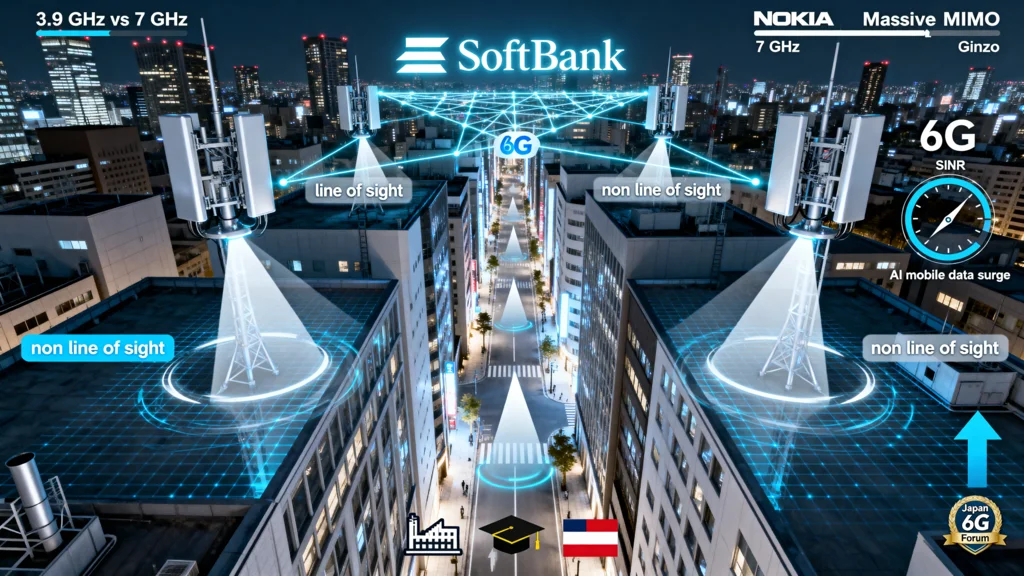


Catenaa, Sunday, December 07, 2025-SoftBank said its trial of the 7 GHz spectrum in Tokyo demonstrates the band can support wide-area coverage and high-quality communication, even in dense urban areas, positioning it as a viable option for 6G networks.
The Japanese operator collaborated with Nokia, deploying three experimental base stations with Massive MIMO in the Ginza district.
The trial measured signal power and connectivity in both line-of-sight and non-line-of-sight locations, including main streets and narrow alleys.
Results showed 7 GHz propagation loss in open areas was nearly identical to 3.9 GHz 5G, aided by reflections from surrounding buildings, while losses in obstructed locations were higher but manageable.
SoftBank noted the findings support the potential for 6G networks to handle high-capacity data transmission, particularly for AI-driven services expected to drive surges in mobile traffic.
Signal to Interference plus Noise Ratio (SINR) measurements confirmed stable connectivity across the tested areas.
The experiment used an outdoor experimental licence for 7 GHz, with performance assessed alongside commercial 3.9 GHz 5G base stations.
SoftBank said the results provide evidence for future 6G network planning and support the development of a global 7 GHz ecosystem.
Dr. Akihiro Nakao of the University of Tokyo, co-chair of the Japan 6G forum, said the trial highlights Japan’s leadership in 6G research and will inform collaboration between industry, academia, government, and international partners to implement the 7 GHz band for commercial networks.
SoftBank’s findings underscore the importance of cmWave spectrum as a candidate for 6G, demonstrating both technical viability and the potential for extensive urban coverage.
SoftBank’s Tokyo trial shows 7 GHz can deliver wide-area coverage and high-quality 6G connectivity, validating the band for future networks.