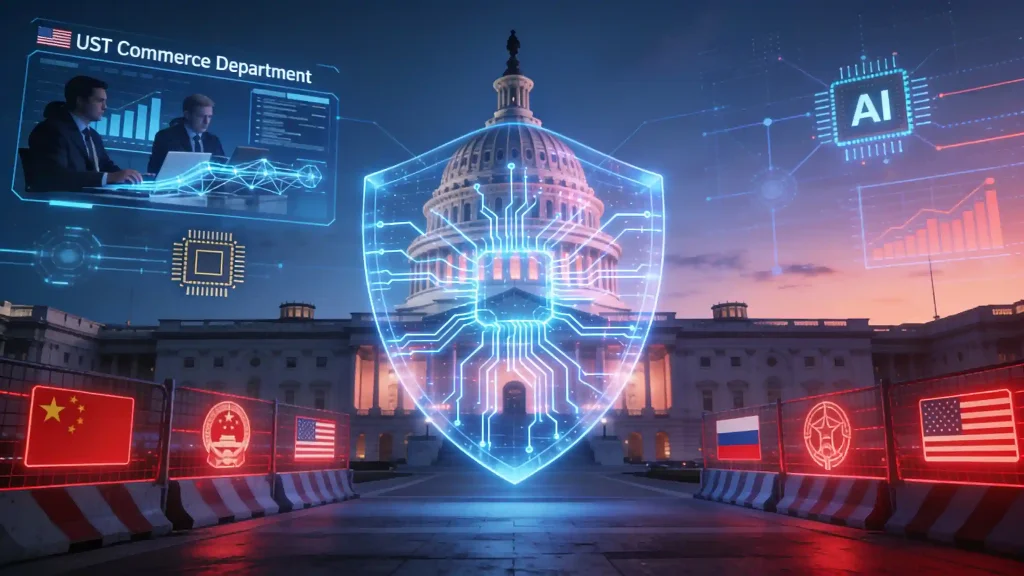


Catenaa, Tuesday, July 07, 2026-Two senior Republican senators have introduced legislation that would give the US Commerce Department sweeping new powers to prevent artificial intelligence technology from reaching foreign adversaries, marking Washington’s latest effort to tighten controls over strategic technologies amid rising geopolitical competition.
The bill, introduced by Senate Banking Committee Chairman Tim Scott and Senator Bill Hagerty, would authorize the Commerce Department to block transactions involving AI technologies that are designed, developed, manufactured or supplied by entities owned, controlled or directed by countries considered hostile to US national security.
The proposed legislation targets nations officially designated as foreign adversaries, including China, Russia, Iran and North Korea. Lawmakers argue that advanced AI systems embedded in communications networks, consumer electronics, vehicles and other digital infrastructure could be exploited for espionage, cyberattacks or other national security threats.
The proposal would establish a permanent position within the Commerce Department, an assistant secretary for information and communications technology supply chains, to oversee implementation and enforcement of the expanded authorities.
Scott said Americans should not have to worry that hostile governments could exploit technology integrated into everyday devices such as phones, vehicles and communications networks.
The legislation builds on broader US efforts to secure critical technologies from foreign influence while strengthening domestic innovation in artificial intelligence.
China remains at the center of US concerns because of its rapid AI development and expanding technology sector. Washington has steadily increased export controls on advanced semiconductors, AI chips and related technologies over the past several years to slow China’s access to cutting-edge computing capabilities.
Russia has also remained a focus of US cybersecurity policy following repeated allegations of state-backed cyber operations targeting Western governments and private companies.
The bill reflects growing bipartisan recognition that AI has become a strategic national security asset comparable to advanced semiconductors, telecommunications infrastructure and quantum computing.
Scott and Hagerty have also played prominent roles in digital asset legislation. Both lawmakers were instrumental in advancing the GENIUS Act, the landmark stablecoin framework enacted during the current Congress.
Their latest proposal suggests lawmakers increasingly view artificial intelligence and digital finance as interconnected sectors requiring stronger federal oversight, particularly where emerging technologies intersect with national security and critical infrastructure.
While the legislation is focused on AI rather than cryptocurrency, broader restrictions on technology transfers could eventually influence blockchain developers, AI-powered crypto applications and cross-border innovation involving advanced computing systems.
Despite proposing tighter controls on sensitive technologies, the legislation seeks to preserve public access to open-source AI software.
That provision attempts to balance national security concerns with continued innovation by ensuring researchers and developers retain access to publicly available AI models while restricting technologies considered vulnerable to foreign exploitation.
Earlier this month, President Donald Trump signed an executive order promoting American leadership in artificial intelligence while directing federal agencies to protect US intellectual property and AI innovation from foreign theft and exploitation.
The measure faces an uncertain path in Congress. With lawmakers approaching the summer recess and attention increasingly shifting toward the upcoming midterm elections, standalone technology legislation has limited time to advance.
Analysts believe the proposal has a greater chance of becoming law if its provisions are attached to broader national security, defense or government funding legislation later in the congressional session.
The bill nevertheless highlights Washington’s expanding strategy of treating artificial intelligence as a strategic asset requiring stronger government protection amid intensifying technological competition with rival nations.
The United States has steadily expanded restrictions on exports of advanced technologies viewed as critical to national security. Previous measures have focused on advanced semiconductor manufacturing equipment, AI accelerators, quantum computing components and telecommunications infrastructure. The Commerce Department already administers export controls through its Bureau of Industry and Security, but the proposed legislation would broaden its authority over AI supply chains involving foreign adversaries. The proposal also aligns with recent White House initiatives aimed at strengthening domestic AI leadership while limiting the ability of rival nations to obtain technologies that could enhance military, intelligence or cyber capabilities. As artificial intelligence becomes increasingly integrated into finance, healthcare, transportation and defense, lawmakers are placing greater emphasis on securing both public and private sector technology ecosystems.




