

Catenaa, Friday, July 10, 2026- UN Secretary-General António Guterres has warned that artificial intelligence is evolving faster than governments can regulate it, urging the international community to establish stronger global safeguards before the technology creates irreversible risks for humanity.
Opening the first Global Dialogue on AI Governance in Geneva, attended by representatives from all 193 UN member states, Guterres said artificial intelligence is already reshaping economies, labour markets, elections and global security while existing institutions struggle to keep pace.
He argued that governments must move beyond reactive policymaking and establish coordinated international rules capable of governing increasingly autonomous AI systems.
Guterres said artificial intelligence has achieved global adoption at an unprecedented pace, noting that technologies capable of making decisions and writing software are increasingly operating with reduced human oversight.
Borrowing the technology industry’s popular term “vibe coding,” which describes allowing AI systems to generate software with minimal human supervision, he used it as a broader warning against passive governance.
He argued that governments cannot rely on informal oversight when technologies possess the potential to transform society on a global scale.
The UN chief identified three major challenges confronting policymakers.
The first is the extraordinary speed of AI development, which he said is advancing more rapidly than regulatory institutions can respond.
The second is the concentration of computing infrastructure, advanced data resources and AI expertise among a relatively small number of companies and countries, potentially widening global technological inequality.
The third is the growing ability of artificial intelligence to generate highly convincing misinformation, threatening public trust and the integrity of information ecosystems worldwide.
Among the summit’s principal initiatives was the launch of an AI Child Safety Pledge.
The proposal calls for independent safety testing before AI systems are made available to children, strict safeguards preventing the generation of child sexual abuse material and mandatory access to human support when vulnerable children interact with AI services.
Guterres said children should not become test subjects for inadequately regulated artificial intelligence systems.
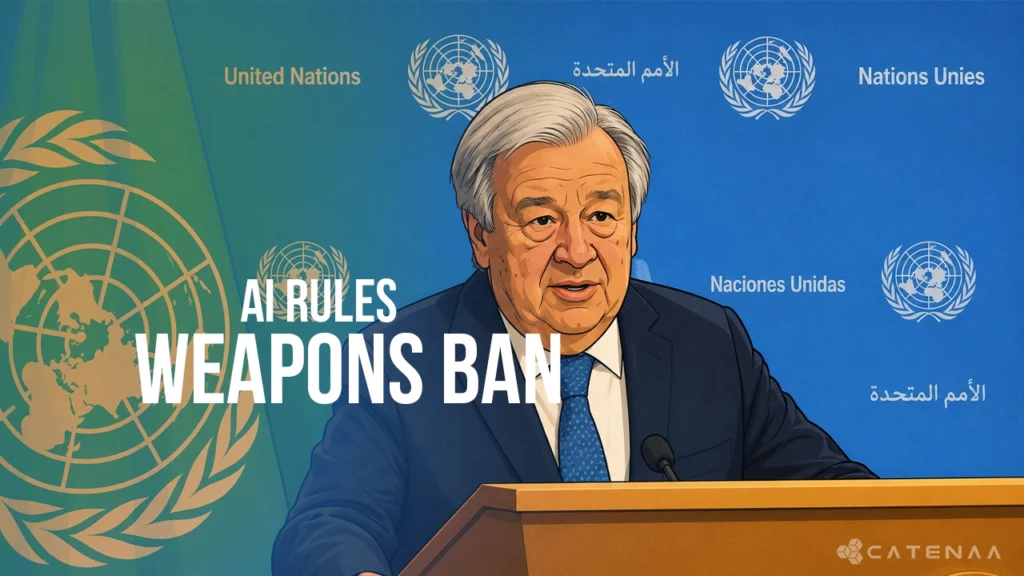
The Secretary-General also renewed calls for an international legal prohibition on lethal autonomous weapons.
He described weapons capable of selecting and engaging targets without meaningful human control as morally unacceptable and urged governments to negotiate a binding international treaty banning their development and deployment.
The issue has become increasingly prominent as military organizations worldwide expand investment in AI-enabled defense technologies.
The Geneva dialogue was established under the UN’s 2024 Global Digital Compact, which created an international framework for AI governance.
Guterres also proposed establishing a Global Fund for AI to expand computing resources for developing countries and challenged major AI companies to operate all data centers using renewable energy by 2030.
A second Global Dialogue on AI Governance is scheduled to take place in New York in 2027.
Artificial intelligence governance has emerged as one of the world’s fastest-growing policy challenges as increasingly capable AI systems expand into finance, healthcare, cybersecurity, scientific research, defense and public administration. Governments remain divided over how best to regulate frontier AI technologies while preserving innovation and international competitiveness. The United Nations has sought to establish a multilateral framework encouraging cooperation among governments, technology companies and researchers. The Global Dialogue on AI Governance represents one of the most ambitious international efforts to develop shared principles addressing AI safety, transparency, accountability and equitable access as the technology becomes increasingly integrated into global society.