

August 20, 2026 – Tokenised deposits have moved between two global banks on SWIFT’s blockchain ledger. Round-the-clock bank settlement now looks closer.
In Summary
HSBC and Standard Chartered executed the first live transaction on the SWIFT shared ledger.
The banks exchanged tokenised deposits, which are digital claims issued against customer balances.
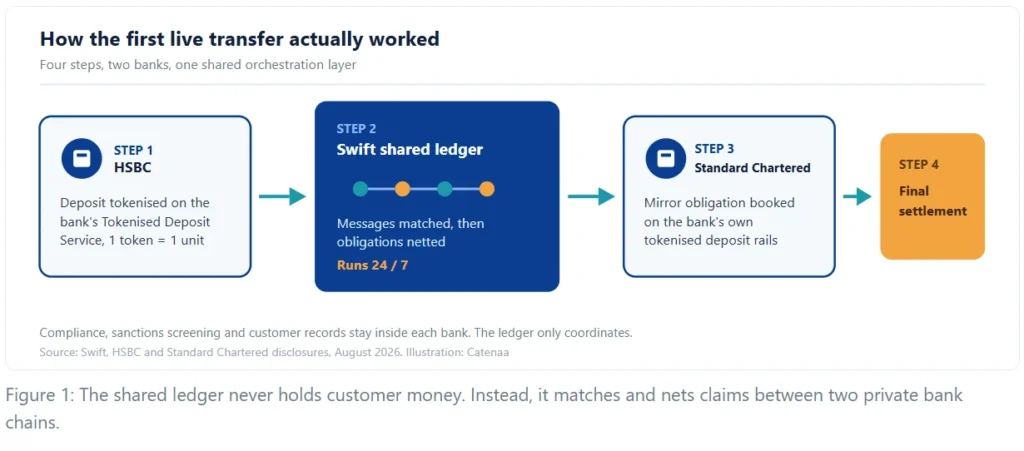
Swift’s ledger matched and netted the obligations, and settlement was completed through existing bank systems.
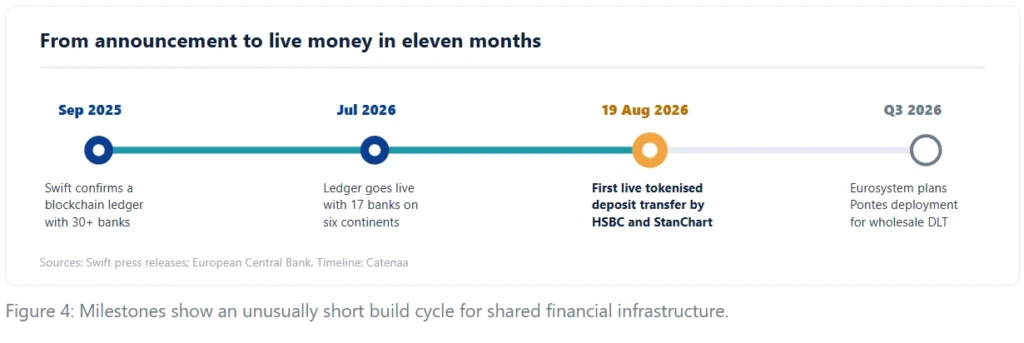
Seventeen banks across six continents now sit inside the pilot, which opened in July 2026.
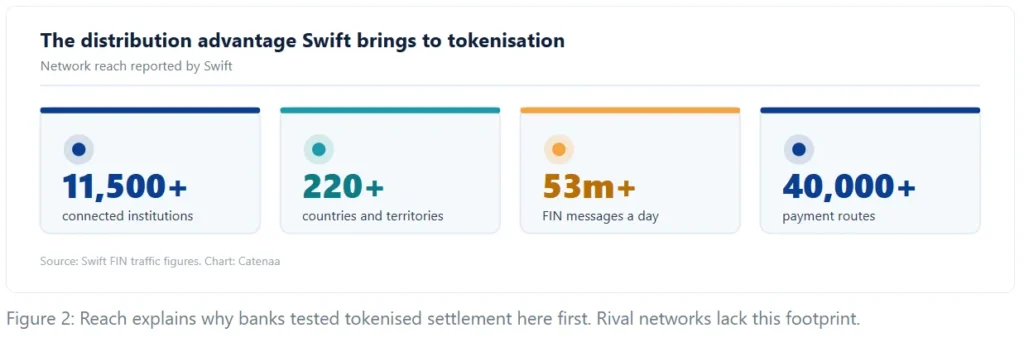
Swift already routes more than 53 million messages a day for over 11,500 institutions.
HSBC and Standard Chartered have completed the first live interbank transaction on SWIFT’s blockchain ledger. The two banks moved tokenised deposits between their systems in near real time. Moreover, the transfer became the first commercial use of infrastructure that Swift switched on only last month.
Neither lender disclosed the amount. Nevertheless, the plumbing behind the payment matters far more than its size.
A small transfer with large implications
Swift’s ledger did not hold the value itself. Instead, it worked as an orchestration layer between two private systems. HSBC recorded the payment on its Tokenised Deposit Service, which issues one token for every unit of deposit. Standard Chartered booked the mirror leg on its own tokenised deposit rails.
That architecture solves an awkward problem. Banks have spent years building single-bank blockchains that cannot talk to each other. Consequently, tokenised money kept circling inside closed loops. A neutral coordination layer breaks those silos without forcing anyone to migrate.
Lewis Sun, head of digital currencies at HSBC, called the transfer a landmark moment for tokenised deposits. Mark Willis leads emerging payments and digital assets at Standard Chartered. He calls tokenised deposits a key pillar of his bank’s digital assets strategy.

Why banks prefer tokenised deposits
A tokenised deposit is not a stablecoin. It remains a claim on a regulated bank, backed by the same balance sheet and the same supervision. Therefore, treasurers face a familiar credit profile rather than a novel one.
HSBC’s service already supports several currencies, including the US dollar, euro, sterling, Hong Kong dollar, and Singapore dollar. Corporate clients use it to shift liquidity between group entities outside banking hours. Ant International was one of the early users of that service.
Reach beats technology
Plenty of platforms can move a token. Very few can reach the whole correspondent banking map. Swift links more than 11,500 institutions across 220 countries and carries over 53 million messages daily.
Network effects therefore do the heavy lifting. Each new bank on the ledger raises the value for everyone already connected.
The clock the regulators set
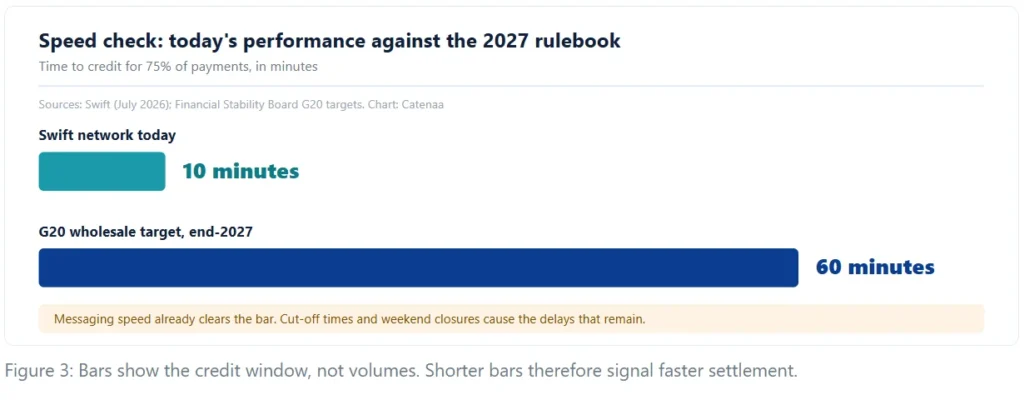
Speed remains the sharpest test. Swift reports that 75% of payments reach the beneficiary bank within ten minutes. Weekend cut-offs, however, still delay the final credit to customers.
The G20 roadmap wants 75% of wholesale cross-border payments credited within one hour by the end of 2027. Always-on settlement closes the remaining gap. As a result, supervisors watch this pilot closely.
What happens next
Seventeen banks across six continents joined the live phase in July 2026. That group includes Citi, BNP Paribas, UBS, DBS, MUFG, Wells Fargo and Lloyds. Swift moved from concept to activation in nine months, which looks brisk for market infrastructure.
Central banks are moving in parallel. The Eurosystem plans to deploy its Pontes solution in the third quarter of 2026. That system links market DLT platforms to settlement in central bank money. Together, both projects sketch a two-layer future. Commercial bank tokens handle the payment leg, while central bank money anchors finality.
The honest caveats
One transaction proves feasibility, not scale. Volumes, corridors, and pricing all remain unpublished. Furthermore, netting across many banks raises harder questions about liquidity and legal finality.
Adoption also depends on corporate demand. Treasurers will only shift flows once the service covers enough currencies and counterparties. Until then, tokenised deposits stay a promising pilot rather than a default rail.
Still, the direction looks clear. Bank money is learning to move at internet speed, inside rules that supervisors already recognise.




