

April 11, 2026 – The DePIN startup has beamed real blockchain data through orbit. With 3 billion people offline, it is now racing to scale, before SpaceX’s Starlink locks the market.
In Summary
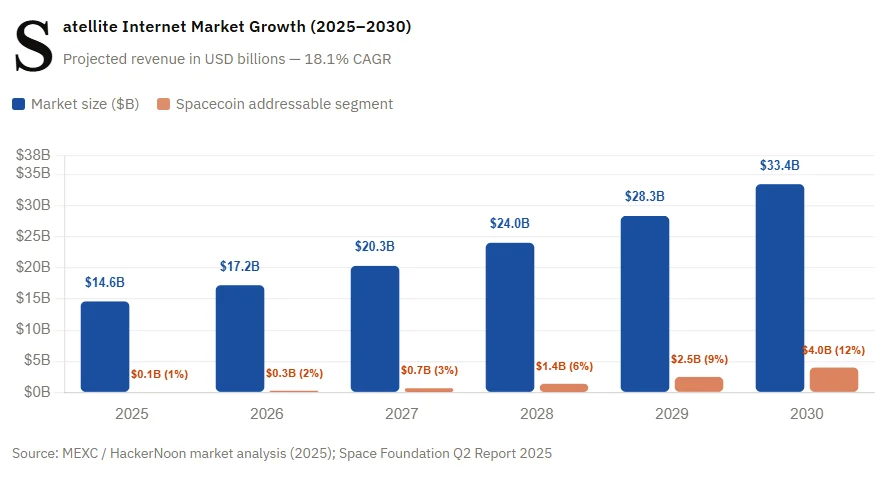
The global space economy reached $613B in 2024; the satellite internet segment alone is projected to hit $33.4B by 2030, growing at an 18.1% CAGR.
Spacecoin transmitted the world’s first encrypted blockchain transaction through space in October 2025, covering 7,000 km from Chile to Portugal via satellite CTC-0.
Its CTC-1 constellation of 3 satellites launched in November 2025 aboard SpaceX Transporter-15 to test inter-satellite mesh networking at scale.
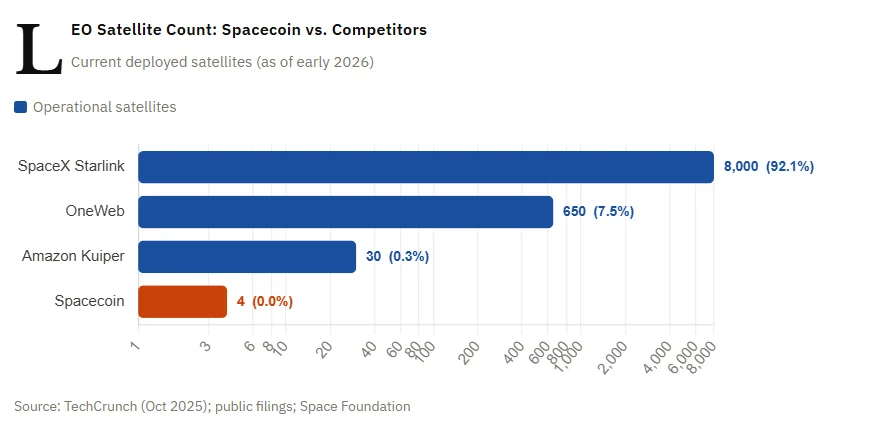
The project targets 3 billion unconnected people in developing markets, a segment ignored by Starlink (8,000+ satellites) and Amazon Kuiper (3,236 planned).
The DePIN sector is forecast to grow at a 40% CAGR through 2030; Spacecoin’s $SPACE token has distributed 11% of supply to 700,000+ community members.
The global space economy hit a record $613 billion in 2024, driven by fast growth in satellite demand. Yet most of that money flows to SpaceX, Amazon, and a few big players. Now, Spacecoin wants to change that using blockchain and low-Earth orbit (LEO) satellites to build an open internet network that anyone can own and earn from.

A Historic First: Blockchain Meets Orbit
In October 2025, Spacecoin reached a milestone no blockchain project had hit before. The company sent a fully coded blockchain transfer from Chile to Portugal via its first satellite, CTC-0. In total, the data crossed 7,000 kilometers. Moreover, the coded data arrived without any errors. Crucially, no land-based internet was used at all.
As a result, that single test proved Spacecoin’s core idea. Blockchain can work in orbit without losing data. Furthermore, it opened the door to open, global internet access free from censorship.
“Unlike land-based networks prone to outages, censorship, and high costs, a shared satellite system can deliver internet access that is global and free from monopolies.”
— Spacecoin, official statement (TechCrunch, Oct 2025)
The Satellite Roadmap
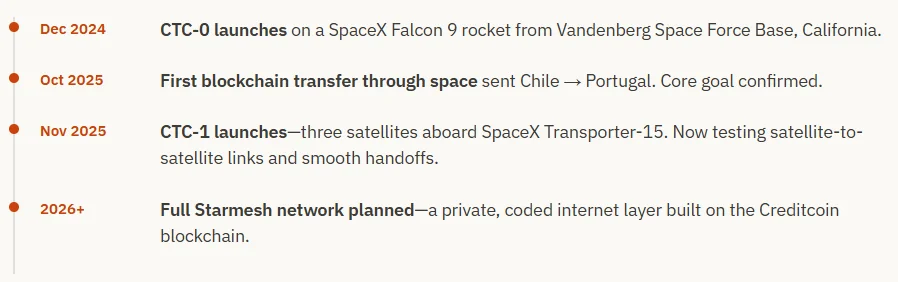
According to Spacecoin’s 2025 mission report, the CTC-1 group will test two key skills. First, it will check smooth handoffs as satellites move across the sky. Second, it will test direct satellite-to-satellite data sharing. Both steps are needed before a full mesh network in orbit can work.
Targeting the Unconnected 3 Billion
SpaceX Starlink now has over 8,000 satellites and serves millions of paying users. Similarly, Amazon’s Project Kuiper plans 3,236 satellites. However, both mainly serve rich markets. In contrast, Spacecoin focuses on the 3 billion people in poorer regions where laying cable is far too costly.
Instead of selling to end users, Spacecoin sells to operators. So telecom firms, aid groups, and governments buy the signal and share it locally. As a result, Spacecoin does not deal with last-mile costs. It earns from coverage, not from single user plans.
Tae Oh founded Spacecoin in 2022. Before this, he ran Gluwa, a finance firm that served low-income users. Therefore, the team has real experience building tools for people left out of the system. In short, Spacecoin is a natural next step from that earlier work.
The $SPACE Token: DePIN Economics
Spacecoin runs on the $SPACE token, which serves two roles. First, it pays for network access. Second, it rewards those who support the system by staking CTC tokens. In 2025, Spacecoin gave away 11% of all $SPACE tokens across two airdrop rounds. Because of this, the project now has over 700,000 active members.
Moreover, the token works with the Creditcoin blockchain. This means users can send money, not just data via satellite. For people in areas with no banks, that is a major step forward.
Analysts at Delphi Digital see the DePIN sector growing at 40% per year through 2030. Therefore, Spacecoin stands at the meeting point of two fast-growing trends: satellite internet and open, shared networks.
Risks and Competitive Pressures
Still, the risks are real. Space hardware leaves no room for error. So CTC-1 must show that its links between satellites hold up at scale. If any part fails, the failure is public and cannot be undone.
In addition, rules differ by country. For example, signal bands, launch rights, and data laws all vary across borders. As a result, these legal steps add time and cost to the rollout.
Furthermore, Starlink builds both rockets and satellites in-house, which keeps its costs low. No small blockchain firm can easily match that. Even so, Spacecoin’s bet is different: it is not trying to beat Starlink head-on. Instead, it aims to serve a market that Starlink does not want.
In summary, Spacecoin has done what most blockchain projects only talk about. It launched real satellites. It also sent real data through space. The satellite internet market is worth $33.4 billion and grows at 18.1% each year. So if Spacecoin can grow its network and win wholesale deals, it has a strong shot at reaching users that big players ignore. Above all, the next 18 months will show whether CTC-1 can deliver on that promise.