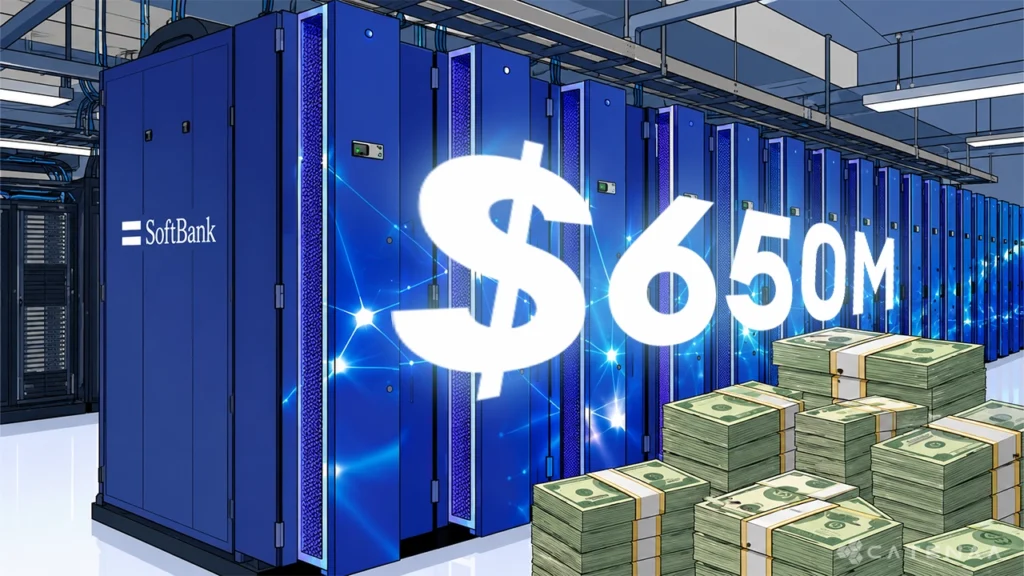


Catenaa, Tuesday, May 19, 2026- SoftBank announced plans to launch a ¥100 billion artificial intelligence battery business as the company accelerates investment in power infrastructure supporting next generation AI data centers.
The Japanese telecom and technology group unveiled the strategy alongside annual earnings results Monday, positioning battery manufacturing and energy storage as a central part of its long term AI infrastructure expansion plans.
SoftBank reported record annual financial results for the year ending March 2026, with revenue exceeding ¥7 trillion, or roughly $45 billion, while net profit attributable to shareholders reached ¥550.8 billion.
The company said growing demand for AI infrastructure and digital services continues driving expansion across the broader group.
Central to the new battery initiative is SoftBank’s large scale AI data center project being developed at the site of a former Sharp Corporation plant in Sakai City, Osaka.
The facility will include an AX factory focused on manufacturing AI infrastructure hardware alongside a GX factory dedicated to producing next generation batteries, solar panels and energy storage products.
SoftBank said battery cell production and energy storage system manufacturing are expected to begin during fiscal 2027, with plans for gigawatt hour scale mass production roughly one year later.
The company partnered with Cosmos Lab and DeltaX to develop battery technologies emphasizing high energy density and reduced fire risk compared with traditional lithium ion systems.
The announcement highlights how AI infrastructure growth is increasingly reshaping energy and industrial strategy beyond traditional technology sectors.
Artificial intelligence systems require enormous computing capacity and electricity consumption, creating rising demand for advanced battery storage, grid stability and renewable energy integration.
Analysts said SoftBank’s move reflects growing concern among technology firms about securing long term power supply for large scale AI operations.
The company plans to use the batteries primarily inside its own AI data center infrastructure across Japan. At the same time, SoftBank expects the business to generate external revenue through industrial, residential and power grid applications.
Industry researchers noted that telecom operators are becoming more deeply involved in AI infrastructure because data centers, connectivity networks and energy systems are increasingly interconnected.
Technology analysts said SoftBank’s strategy represents one of the clearest examples yet of a telecom operator vertically integrating AI computing infrastructure with energy generation and storage systems.
Researchers tracking AI infrastructure markets noted that power availability has become one of the largest bottlenecks facing global AI expansion as cloud providers race to build larger data centers.
Industry observers also highlighted SoftBank’s focus on zinc halogen battery systems developed with Cosmos Lab. The technology uses water based electrolytes intended to reduce fire risks commonly associated with lithium ion batteries.
Energy market analysts said companies capable of combining AI infrastructure, energy storage and power management could gain strategic advantages as global electricity demand from AI accelerates during the coming decade.
SoftBank’s new battery initiative demonstrates how the AI boom is extending far beyond software and semiconductors into energy infrastructure and industrial manufacturing.
The company is positioning itself not only as a telecom and technology provider but also as a long term supplier of power systems supporting artificial intelligence operations.
As AI computing demand grows globally, energy infrastructure may become one of the defining competitive battlegrounds for technology firms seeking to scale next generation data center networks.
Artificial intelligence expansion has sharply increased global demand for electricity, advanced semiconductors and large scale data center infrastructure. Major technology firms including cloud providers and telecom operators are investing heavily in AI computing facilities requiring enormous power capacity and cooling systems. Japan has increasingly prioritized digital infrastructure investment as part of broader industrial and technological competitiveness efforts.
SoftBank, led by founder Masayoshi Son, has spent years expanding into artificial intelligence, semiconductors and advanced computing through investments across the technology sector.
Battery storage systems have become increasingly important because renewable energy integration and AI workloads require more stable and scalable electricity infrastructure.
Telecom operators worldwide are also broadening their role beyond connectivity as AI transforms demand for cloud computing, edge networks and energy intensive digital infrastructure.