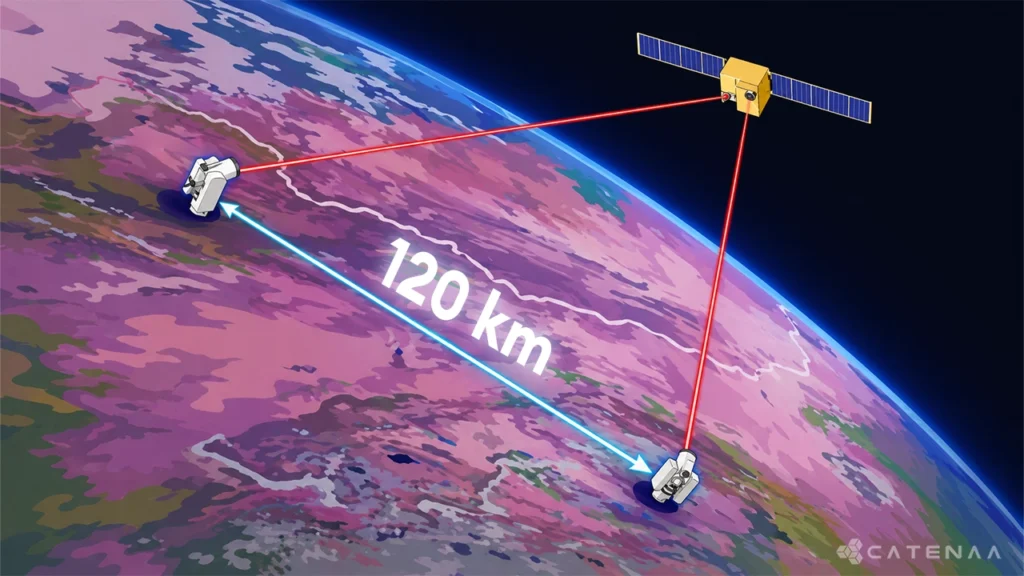


Catenaa, Monday, April 27, 2026- Researchers have demonstrated a quantum communication system that transmits encryption keys over more than 120 kilometers of optical fiber using quantum dots, marking a step toward secure quantum internet infrastructure.
The experiment, conducted by an international team of German and Chinese scientists, used semiconductor quantum dots to generate single photons for quantum key distribution. The system encoded information in time-based photon states, allowing stable transmission through fiber networks with reduced sensitivity to environmental noise.
The setup successfully sent quantum keys over distances exceeding 120 kilometers, or about 75 miles, while maintaining stable operation for more than six hours. The system achieved a secure key rate of about 15 bits per second under real-world conditions.
Researchers used time-bin encoding, a method that places quantum information into the timing of photons rather than their polarization. This approach is considered more resistant to interference from temperature changes, vibration, and fiber instability.
The system relied on a telecom-band quantum dot source that generated high-purity single photons at a rate of roughly 76 megahertz. The photons were then transmitted through standard optical fiber and decoded using superconducting detectors and stabilized interferometers.
Context
Quantum key distribution is considered one of the most secure forms of communication because it relies on quantum physics rather than computational complexity. Any attempt to intercept the transmission changes the quantum state, making intrusion detectable.
The research team said the use of quantum dots provides a practical route toward scalable systems, as they offer high brightness and compatibility with existing fiber infrastructure.
The experiment also achieved a quantum bit error rate below 11 percent across long distances, which is within the range needed for usable secure communication systems.
Implications
The results suggest a pathway toward intercity and eventually global quantum communication networks. Unlike traditional encryption methods, quantum key distribution could remain secure even against future quantum computers capable of breaking classical cryptographic systems.
However, the current key generation rate remains low compared to conventional encryption systems, meaning further engineering improvements are needed before widespread commercial deployment.
Researchers say the next step involves integrating quantum repeaters and improving photon efficiency to extend distance and increase data rates.
Quantum communication has been studied for decades, but practical long-distance systems have been limited by photon loss and environmental instability in fiber networks. Solid-state quantum dot emitters combined with time-bin encoding are now helping address these challenges.
The study marks one of the longest stable demonstrations of this approach in a real-world fiber environment and is seen as progress toward a functional quantum internet.




