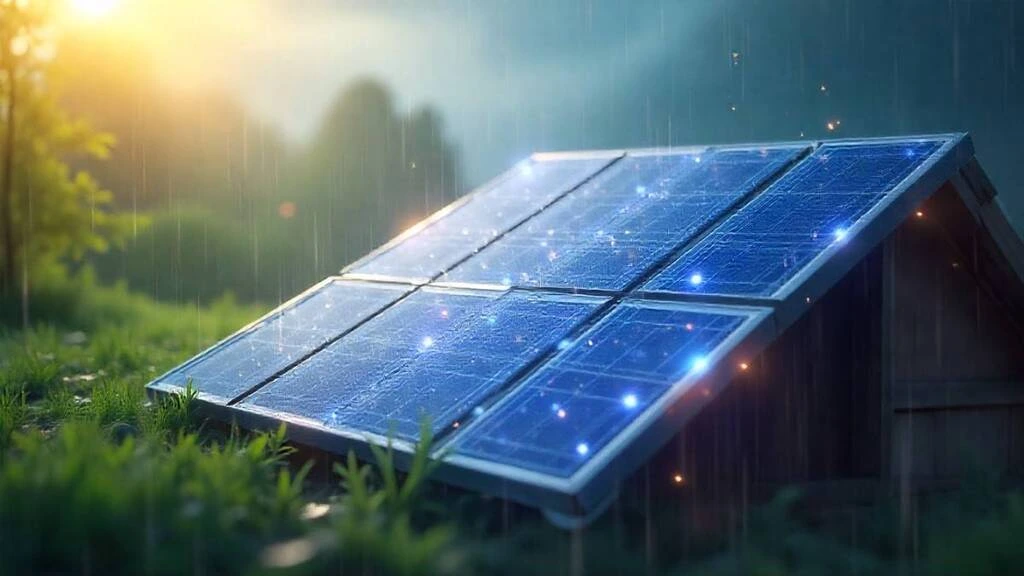


Catenaa, Sunday, April 12, 2026- Scientists have developed an innovative energy harvesting system that allows solar panels to generate electricity not only from sunlight but also from falling raindrops, a breakthrough that could help power portable electronics, environmental sensors and remote outdoor devices with greater continuity and resilience.
The research, led by the Institute of Materials Science of Seville — a joint center of the Spanish National Research Council and the University of Seville — combines two distinct energy technologies: perovskite solar cells and triboelectric nanogenerators. The result is a hybrid device that captures energy from both solar radiation and the mechanical force of rain, marking a step toward truly self‑sustaining, battery‑free systems.
Solar Power Meets Raindrop Energy
Traditional solar panels convert sunlight into electricity but suffer performance losses during cloudy weather and do not generate power at night. The new hybrid device overcomes this limitation by integrating a specially engineered protective thin film over perovskite solar cells. The coating not only shields the cells from moisture and temperature stress but also converts the force of individual raindrops into usable electrical power.
Perovskites are a class of synthetic crystalline materials that have emerged as high‑performance alternatives to silicon in solar technology. They are cheaper to produce and can absorb light more efficiently, but one of their biggest drawbacks has been susceptibility to environmental degradation. By applying a plasma‑deposited coating only about 100 nanometers thick — roughly one seven‑hundredth the width of a human hair — researchers achieved a protective layer that significantly improves durability while adding energy‑harvesting capability.
Tests conducted under laboratory conditions show that a single raindrop hitting the surface can generate more than 100 volts of electricity, enough to power small portable electronics and LED circuits without external power sources or batteries. The film remains stable under full water immersion and maintains performance across repeated humidity and temperature cycles, addressing a major weakness of many high‑efficiency solar prototypes.
Triboelectric Power: How Raindrops Become Electricity
The new technology merges two distinct physical phenomena. Photovoltaics convert photons from sunlight into electrical current, while triboelectric nanogenerators exploit the electrical charge generated when two dissimilar materials come into contact and then separate. In this case, the engineered nanostructure of the protective coating creates conditions favorable for charge transfer when raindrops strike the surface.
This conversion from mechanical energy to electrical energy is similar at heart to how certain natural structures — such as the wings of insects or the surfaces of some plants — generate static charge through friction. In engineered devices, the triboelectric effect has been explored for wearable electronics and energy scavenging, but integrating it with solar collection in a single, weather‑resistant panel is a first.
Toward Continuous Power in Outdoor Environments
The hybrid device opens up exciting possibilities for environments where traditional solar power alone falls short. Remote environmental sensors, structural health monitors on bridges and buildings, autonomous weather stations, and distributed networks of devices in agricultural settings all require robust, low‑maintenance power sources. In places with frequent rain or intermittent sunlight, a hybrid solar‑rain solution could dramatically increase uptime and reduce reliance on batteries or wired power.
Researchers say the technology is especially well suited to Internet of Things (IoT) applications where small, widely distributed devices must operate reliably without human intervention. In future “smart city” deployments, panels based on this hybrid approach could power outdoor signage, auxiliary lighting, air quality monitors or parking sensors, with energy generated from whatever weather conditions are present.
Scientists also note potential marine applications, where ocean‑facing stations could continuously harvest energy from both sunlight and rainfall, enabling long‑term operation even in remote waters without fuel resupply or battery swaps.
Engineering and Materials Innovation
The key to the breakthrough lies in the combination of perovskite’s light‑absorbing efficiency and the triboelectric characteristics of the protective layer. Using plasma deposition techniques, researchers created a surface that simultaneously strengthens the perovskite against environmental stress and harnesses the impact energy of raindrops. The coatings are produced with scalable methods, meaning the concept could be adapted for larger panels or integrated into existing manufacturing processes.
One of the leading researchers described the work as a demonstration of how multifunctional coatings can protect sensitive energy devices and enable energy collection from multiple sources. The team that developed the technology also highlighted that its durability and resistance to humidity, thermal cycling and moisture ingress make it a rare example of a high‑performance perovskite system capable of withstanding real‑world conditions.
Toward Practical Use and Commercialization
While the laboratory results are promising, bringing the technology to market will require further steps in engineering, cost optimization and real‑world testing. Perovskite technology as a whole has advanced rapidly over the past decade, with several companies moving toward commercialization in tandem with silicon or in tandem systems. Adding triboelectric harvesting adds a new dimension, and researchers are now focusing on how to optimize the coatings, integrate them with larger modules and ensure long‑term operational stability across diverse climate conditions.
The research also points to a broader trend in energy innovation, one that seeks to make power harvesting ubiquitous and responsive to local environmental conditions. As IoT networks expand and as energy demand increases globally, technologies that can extract power from ambient sources — sunlight, rain, mechanical vibrations and thermal gradients — could help reduce dependency on fossil fuels and centralized grids.
Experts in renewable energy highlight that hybrid generation systems could eventually lower the cost of energy harvesting, especially in developing regions where infrastructure is limited and climatic variability is high. By capturing more energy from the same physical footprint, such innovations could improve the return on investment for solar installations and enable a new generation of resilient, autonomous electronic systems.