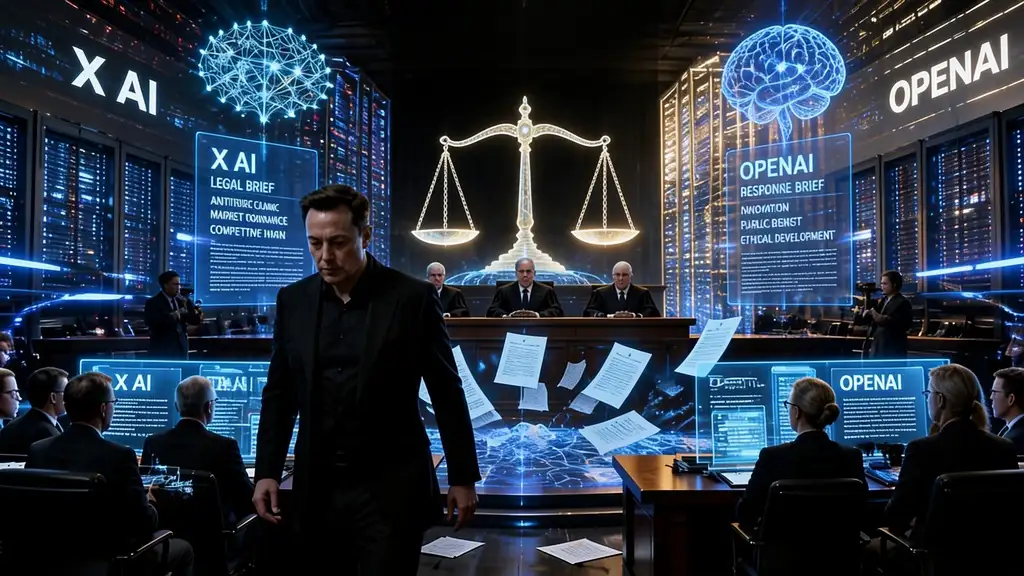


Catenaa, Thursday, June 17, 2026- Elon Musk’s artificial intelligence company xAI has suffered another legal setback after a US federal judge dismissed its trade secret lawsuit against OpenAI, ruling that the company failed to show that confidential Grok chatbot technology had been improperly obtained during the recruitment of a former engineer.
The ruling marks the second significant courtroom defeat for Musk in his escalating battle with OpenAI and its Chief Executive Officer Sam Altman.
US District Judge Rita Lin granted OpenAI’s motion to dismiss the lawsuit without leave to amend, effectively ending the case and preventing xAI from refiling a revised complaint.
The lawsuit centered on former xAI engineer Xuechen Li, who later entered OpenAI’s recruitment process.
xAI alleged that OpenAI deliberately sought confidential information related to Grok 4’s reinforcement learning systems and post-training techniques during discussions with Li.
The company argued that OpenAI knowingly encouraged disclosure of proprietary information and trade secrets.
Judge Lin rejected that claim.
The court found that asking candidates about previous work experience is a normal part of recruitment and does not automatically imply an attempt to obtain confidential information.
According to the ruling, xAI failed to present evidence showing OpenAI instructed, encouraged or induced Li to reveal protected material.
The judge also ruled that xAI failed to demonstrate OpenAI knew any trade secrets had been disclosed.
Court documents noted that the complaint did not clearly establish how much technical detail Li shared during presentations or discussions.
The ruling emphasized that merely discussing previous professional experience does not create liability for employers.
Judge Lin warned that accepting xAI’s argument could expose companies to legal risks whenever they interview employees from competing firms.
The decision significantly narrows Musk’s legal options regarding the recruitment-related allegations.
The dismissal follows another major defeat for Musk last month.
A federal jury rejected his high-profile lawsuit accusing OpenAI of abandoning its original nonprofit mission and improperly transitioning toward a commercial business model.
That case sought damages reportedly valued at $150 billion and targeted OpenAI, Altman and co-founder Greg Brockman.
Jurors ultimately sided with OpenAI.
Together, the two rulings represent a major setback for Musk’s broader campaign against the company he helped establish before departing in 2018.
The legal battles are unfolding amid fierce competition in the artificial intelligence sector.
OpenAI remains one of the industry’s dominant players through ChatGPT and enterprise AI services.
Meanwhile, xAI has been aggressively developing Grok, its competing AI platform integrated across Musk’s technology ecosystem.
Industry analysts view the lawsuits as part of a broader struggle over talent, technology and market leadership in the rapidly expanding AI industry.
The outcome reinforces the legal challenges companies face when attempting to prove trade secret theft involving former employees.
Despite the legal defeat, investor attention remained focused on Musk’s broader business empire.
SpaceX shares continued climbing following the company’s blockbuster public market debut, helping push its valuation beyond $2.5 trillion.
The strong market performance suggests investors currently view the AI litigation as having limited impact on Musk’s wider corporate holdings.
The dismissal strengthens OpenAI’s position in its legal conflict with Elon Musk while highlighting the difficulty of proving trade secret misappropriation during employee recruitment. With two major courtroom defeats now behind him, Musk may increasingly focus on competing with OpenAI through product development rather than litigation as the global AI race accelerates.
Musk co-founded OpenAI in 2015 before leaving the organization in 2018. Since then, relations between Musk and OpenAI leadership have deteriorated significantly. The launch of xAI and its Grok chatbot intensified competition between the two companies. OpenAI’s partnership with Microsoft and rapid commercial expansion have been frequent targets of Musk’s criticism. The legal disputes have centered on OpenAI’s business structure, governance and competitive practices. As artificial intelligence becomes one of the world’s fastest-growing technology sectors, legal battles over intellectual property, talent recruitment and market dominance are expected to become increasingly common.




