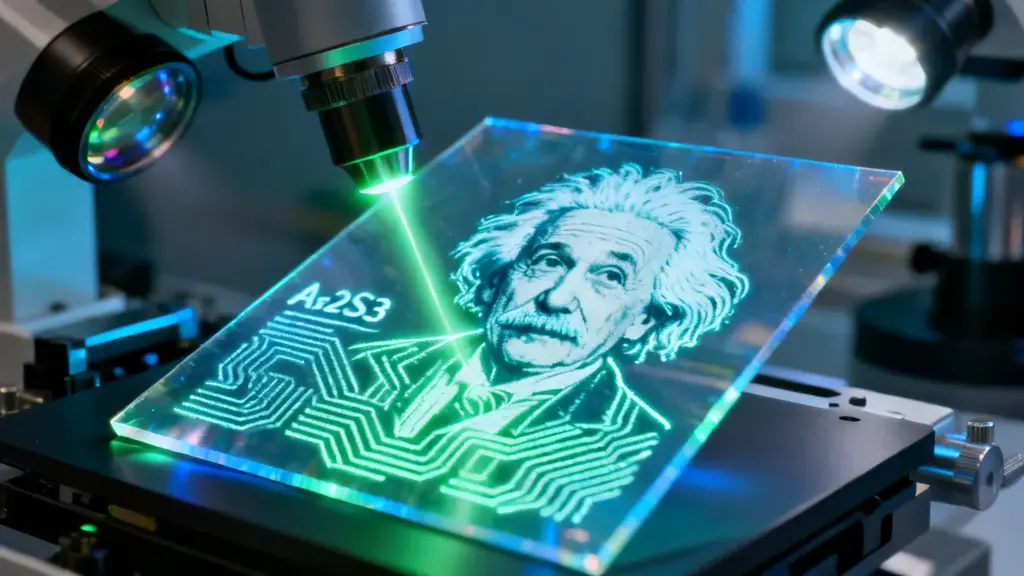


Catenaa, Tuesday, May 05, 2026-Researchers at the XPANCEO Emerging Technologies Research Center, working with Nobel laureate Konstantin Novoselov, have identified a crystal that can be permanently reshaped using ordinary light, enabling nanoscale pattern creation without traditional semiconductor lithography.
The material, arsenic trisulfide (As2S3), is a van der Waals semiconductor that responds strongly to light exposure. Scientists found that even low-intensity ultraviolet light can permanently alter its structure.
The study shows a large light-induced refractive index change of up to 0.3. This level of optical response exceeds many known photorefractive materials used in current optical systems.
Light Writing Method
Researchers demonstrated that a standard continuous-wave laser can “write” patterns directly into the crystal. These patterns remain embedded inside the material after exposure.
The approach removes the need for complex cleanroom fabrication. It also avoids high-energy pulsed laser systems typically used in nanoscale manufacturing.
The crystal allows light to define how it bends and guides future optical signals within the material itself.
Nanoscale Precision
Scientists created highly detailed structures with spacing down to 500 nanometers. One experiment produced a microscopic portrait of Albert Einstein using only laser exposure.
The patterns function as optical signatures. They can be read using light-based imaging due to changes in how the material refracts light.
Such precision suggests potential use in anti-counterfeiting systems and secure optical labeling.
Material Behavior
The crystal not only changes its optical properties but also physically expands under light exposure. Expansion can reach up to 5 percent.
This effect allows direct formation of structures such as microlenses and diffraction gratings. These components are essential in optical devices.
Researchers say this dual response, optical and mechanical, is rare among known materials.
Device Applications
The material could support new photonic systems, including waveguides for augmented reality displays and smart optical lenses.
It may also enable compact photonic circuits and nanoscale sensors. These systems rely on precise control of light within materials.
Developers see potential for integrating these crystals into future wearable and imaging technologies.
Research Insight
The findings suggest that materials themselves can act as programmable optical platforms. Instead of external fabrication steps, light becomes the tool for device construction.
This could reduce manufacturing complexity in photonics. It also opens new design approaches where optical behavior is written directly into the material.
Researchers believe this may shift how optical systems are engineered in the future.
Van der Waals crystals are a class of layered materials held together by weak atomic forces. They have gained attention for their electronic and optical properties.
Photorefractive materials change how they interact with light when exposed to it. These changes can be permanent or reversible depending on structure.
Traditional nanoscale fabrication relies on lithography and high-energy lasers. These methods are costly and require controlled environments.
The discovery of light-programmable crystals adds a new pathway for building optical systems. It combines material science with direct optical control at the nanoscale.