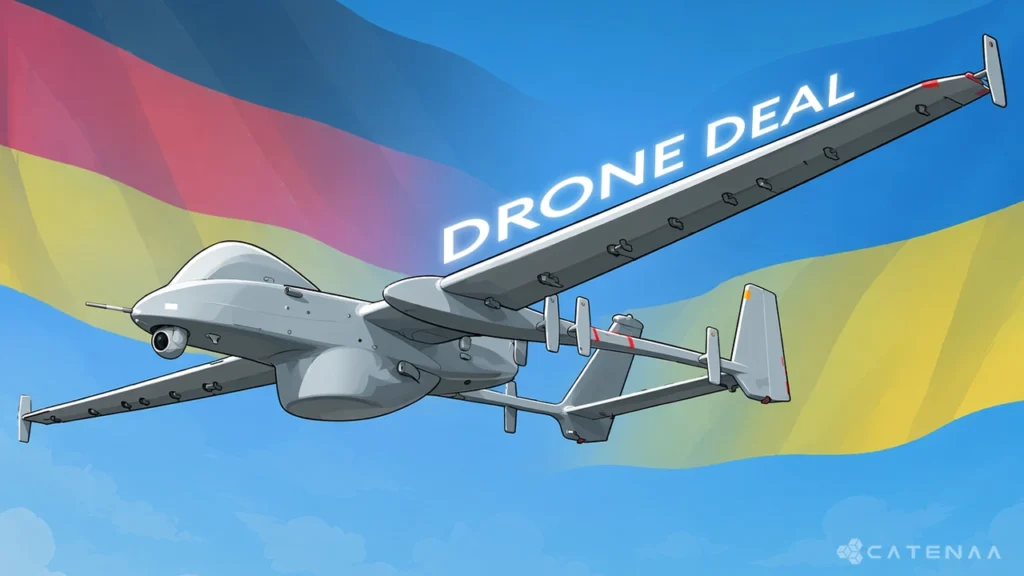


April 20, 2026 – Europe’s largest-ever autonomous strike drone order enters production. Combat-proven Ukrainian AI meets German industrial scale, reshaping the global defence tech economy.
In Summary
Germany signed its largest-ever order for autonomous strike drones on 14 April 2026.
Auterion and Airlogix will produce thousands of AI-guided systems annually on German soil.
Ukraine scaled drone output from 2.2 million (2024) to 4.5 million units (2025).
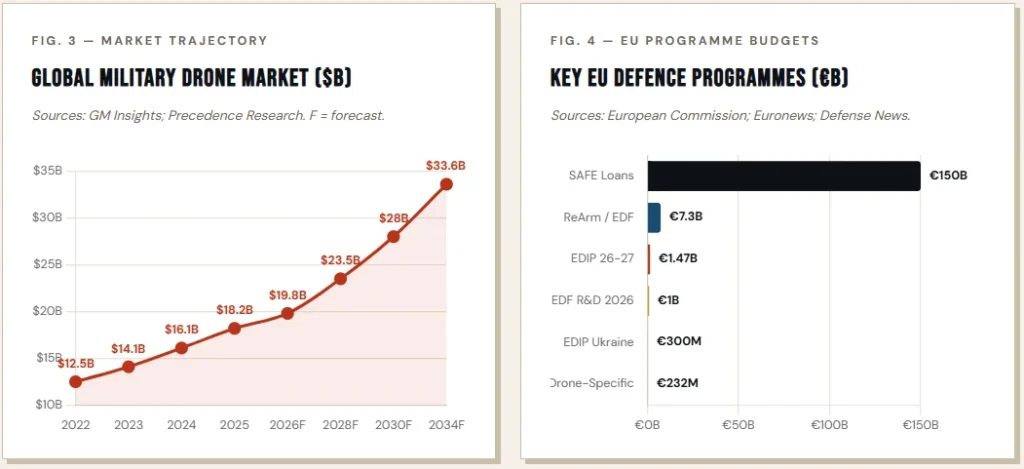
The global military drone market reached $16.1B in 2024. It is forecast to double by 2034.
The EU has committed €800 billion to defence modernisation through 2030.
The German production line is open to all allied nations, a scalable, open supply chain.

Germany signed a landmark cooperation agreement with Ukraine on 14 April 2026. The deal activates the Auterion Airlogix Joint Venture GmbH production contract. It is Germany’s largest-ever order for heavy autonomous strike drones.
The agreement converts a February 2026 Munich Security Conference announcement into a funded, large-scale reality. German factories will produce thousands of AI-guided systems per year. Every unit is built for GPS-denied, electronically contested environments.
The Players Behind the Deal
Airlogix is a Ukrainian defence scaleup. Founded in 2020, it pivoted to military production in 2022. Its systems have been battle-tested on active front lines. The Ukrainian Armed Forces and special operations units depend on them daily.
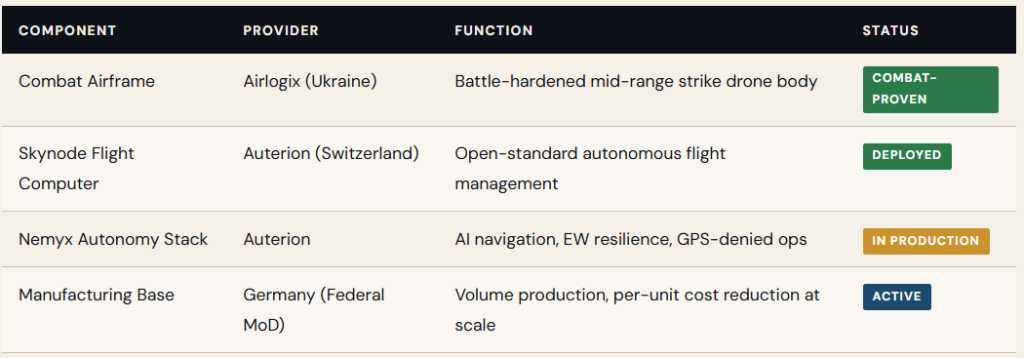
Auterion builds open, vendor-agnostic operating systems for autonomous drones. Its clients include the US Department of Defence, the UK Ministry of Defence, the German Bundeswehr, and the Ukrainian Armed Forces. The joint venture marries Airlogix airframes with Auterion’s Skynode flight computer and Nemyx autonomy stack.
“This contract proves that Europe can move at scale, thousands of autonomous systems drawing on the best autonomy software in the world.”
— Dr Lorenz Meier, CEO, Auterion
Inside the Technology Stack
Why Battlefield Urgency Drove This Deal
Europe has absorbed a painful lesson from the Ukraine conflict. Cheap, AI-guided drones rewrote the rules of modern combat. Europe’s defence industry was slow to respond. Ukraine scaled drone output from 2.2 million units in 2024 to 4.5 million in 2025. That production knowledge now flows directly into European factories.
Germany alone has allocated nearly $12 billion to build its national drone arsenal. The Bundeswehr gains immediate access to combat-tested systems. No lengthy development cycles. No unproven technology. These drones integrate into Western command architectures from day one.
The Defense Tech Economy: A Market in Overdrive
The Germany–Ukraine pact is not just a military story. It is an industrial and economic one. Defence tech has become one of the fastest-growing sectors globally. Governments are not simply buying weapons. They are building entire industrial ecosystems around autonomous systems.
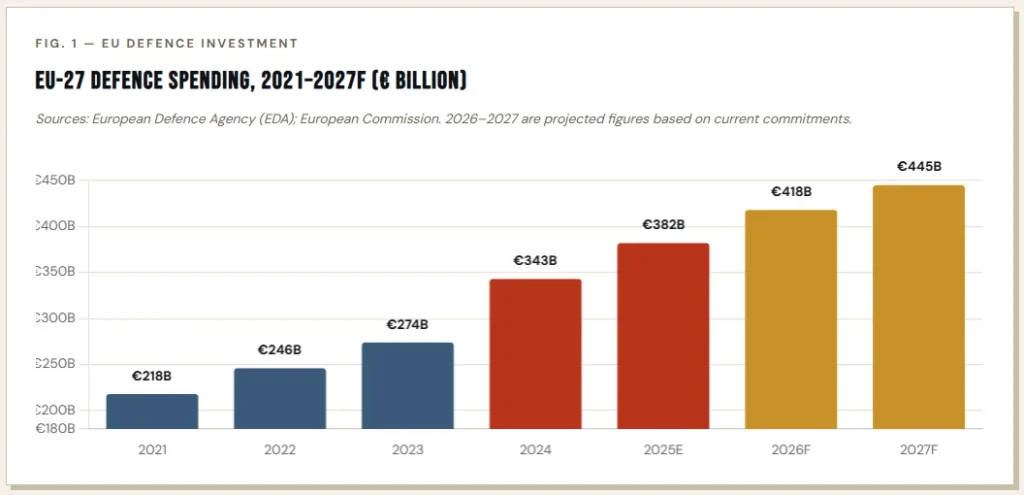
The EU’s EDIP programme allocates €1.47 billion across 2026 and 2027 to restructure European defence production. Over €232 million targets unmanned systems and drone supply chains directly. The EU also launched a €150 billion SAFE loan instrument. Its purpose: to accelerate defence procurement at the member-state level.
The broader ReArm Europe plan commits €800 billion to defence modernisation through 2030. Drones and AI are two of seven designated priority investment areas. The plan mandates that 55% of all military purchases come from European manufacturers by 2030. That is a massive structural shift in procurement and a multi-billion-dollar windfall for the European defence industry.
Global Drone Market: Staggering Growth Ahead
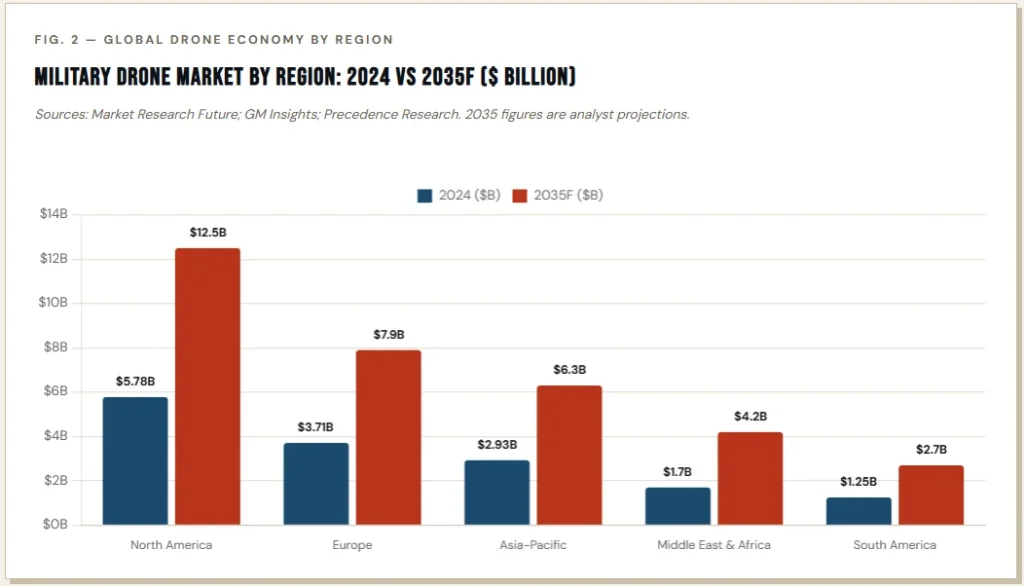
The global military drone market reached $16.1 billion in 2024. Analysts project it will exceed $33.6 billion by 2034. That is a near doubling in a single decade. The compound annual growth rate sits at roughly 8%.
North America currently leads with a 39% market share, driven by US procurement programmes. Europe holds 23%, powered by surging NATO commitments and the Ukraine conflict dividend. Asia-Pacific is the fastest-growing region. China alone accounts for over 70% of global civilian drone manufacturing capacity. The Middle East and Africa represent a smaller but rapidly expanding segment.
Economic Ripple Effects
Large-scale drone production creates powerful industrial multiplier effects. Germany alone needs 200,000 skilled defence workers by 2026. The EU-wide target is 600,000 by 2030. Drone manufacturing demands precision engineering, AI software development, and advanced materials science. These are high-wage, high-skill jobs, exactly the kind Europe wants to create.
There is a critical supply-chain dimension too. China controls 90% of global rare-earth magnet production. It supplies 98% of what Europe currently imports. Those materials are essential for drone motors and guidance systems. Europe’s rearmament push accelerates efforts to diversify away from Chinese inputs. The drone economy is geopolitically entangled at every level.
Per-unit costs fall sharply as production volumes scale. The Auterion–Airlogix model makes high-performance autonomous systems affordable at production-munitions volumes. That changes the economic equation of warfare. It changes who can equip at speed and who cannot.
What Comes Next
The German production line is explicitly open to allied nations. The joint venture is designed to scale beyond Germany. Five NATO nations, France, Poland, Germany, the UK, and Italy, already signed the LEAP programme in February. LEAP builds low-cost autonomous strike and drone-defence systems using Ukrainian combat expertise. The strategic logic is consistent: move fast, use proven technology, scale industrially.
The EU has selected 57 collaborative R&D projects for €1.07 billion in funding. Ukrainian entities now participate as subcontractors in EU projects for the first time. Europe is building something structurally new, a cross-border industrial base. Ukrainian battlefield expertise has become a strategic economic asset. The Germany–Ukraine drone pact is its clearest, most consequential expression yet.




