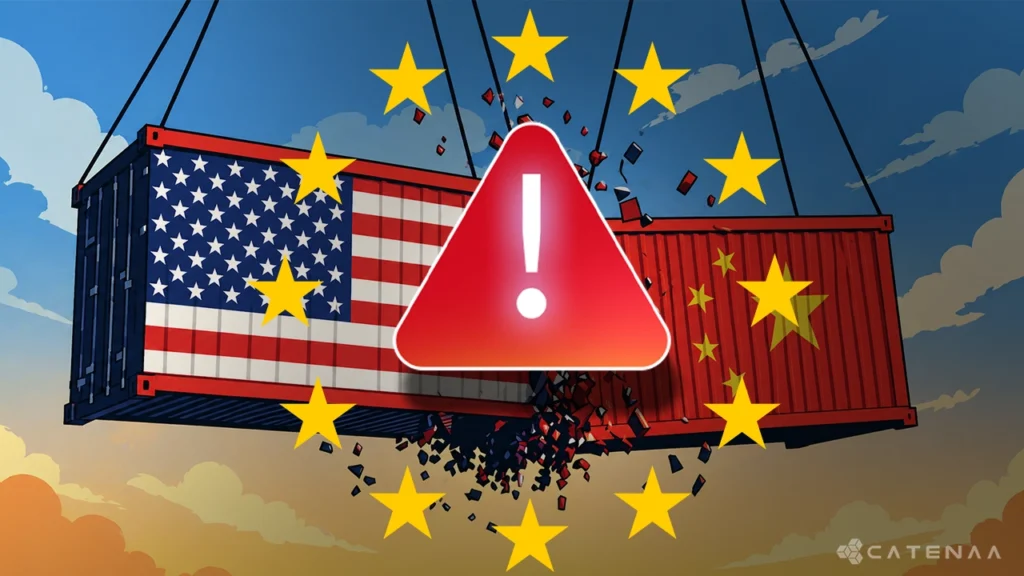


Catenaa, Sunday, April 26, 2026- Europe is increasingly exposed to economic and security risks as tensions between the United States and China escalate, according to a new industry report. The analysis highlights how trade restrictions, export controls, and geopolitical competition are reshaping global supply chains and putting European industries in a vulnerable position, according to a report.
On the Wall
The report, released by the European Union Chamber of Commerce in China, warns that Europe sits between two major economic powers using trade policy as a strategic tool. The United States has imposed export controls and tariffs targeting China’s technology sector for several years. These measures aim to slow China’s technological development and protect US leadership in advanced industries.
China has responded by expanding its own use of export controls, particularly in sectors where it holds dominant global supply chain positions. One of the most sensitive areas involves rare earth elements, which are essential for manufacturing electronics, electric vehicles, renewable energy systems, and defense technologies.
China controls a large share of global rare earth processing capacity, giving it significant leverage in trade disputes. The report suggests that any further escalation in export restrictions could directly impact global technology production. European manufacturers depend heavily on these materials for industrial and energy transition projects.
Industry leaders say this creates a structural dependency problem for Europe. The region relies on both US technology leadership in semiconductors and Chinese dominance in raw materials. This dual dependency limits Europe’s ability to respond independently to trade disruptions or geopolitical pressure.
The European Chamber report argues that China is in a strong position to influence global supply chains through targeted export policies. It also suggests that China could expand restrictions if tensions with the United States continue to rise. Such actions could affect not only US-China trade but also European access to critical industrial inputs.
Supply Chain Breaks
Business leaders warn that supply chain fragmentation is becoming more likely. As major economies adopt competing trade policies, global production networks are being reshaped around geopolitical alliances rather than pure economic efficiency. This shift increases costs and reduces predictability for international companies operating across multiple markets.
The report also notes that China has significantly increased its use of export controls over the past five years. These controls have expanded from narrow technical restrictions into broader regulatory tools affecting strategic industries. This trend reflects a global shift toward using trade policy as a form of economic security strategy.
European industry groups are calling for more predictable and transparent trade frameworks. They argue that sudden policy changes increase risk for manufacturers and reduce long-term investment stability. At the same time, policymakers face pressure to secure supply chains while avoiding deeper geopolitical alignment with either major power.
Experts say Europe’s challenge is structural rather than temporary. The region lacks sufficient domestic production capacity in several critical sectors, including semiconductors, battery materials, and rare earth processing. Building alternative supply chains would require long-term investment and coordination across multiple industries.
The report also highlights growing concerns about technological dependency. European companies rely heavily on US digital infrastructure, cloud services, and software systems. At the same time, physical manufacturing inputs often originate from China. This creates a complex dependency network that is difficult to replace in the short term.
Realignment
Analysts say the situation reflects a broader global realignment of trade relationships. Economic policy is increasingly influenced by national security considerations rather than purely market-driven decisions. This shift is leading to more fragmented global supply chains and higher operational risks for multinational companies.
The European Chamber warns that without coordinated policy responses, Europe could face increased exposure to supply disruptions. These risks extend beyond manufacturing into energy systems, transportation infrastructure, and digital technology deployment.
Some policymakers are exploring strategies to diversify supply chains and reduce dependency on single-source providers. However, progress remains slow due to high costs, limited alternative suppliers, and complex industrial requirements.
The report concludes that Europe is likely to remain vulnerable as long as US-China tensions continue to escalate. Trade policy is now closely tied to geopolitical competition, making neutral positioning increasingly difficult for third-party economies.
As both the United States and China continue to use trade restrictions as strategic tools, Europe faces growing pressure to adapt its industrial and economic policies. The outcome will likely shape global supply chains for years to come.




