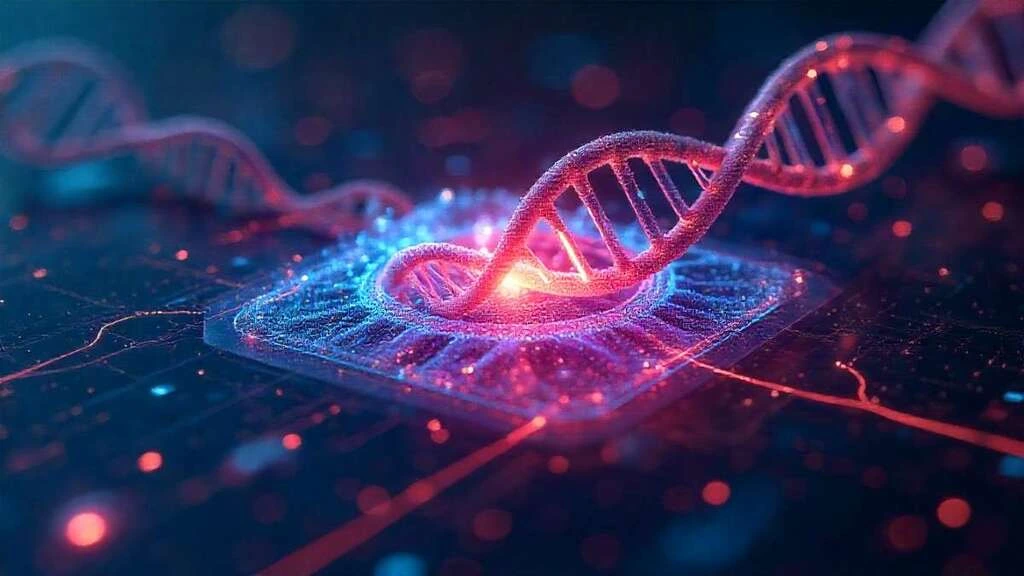


Catenaa, Sunday, April 12, 2026- Scientists have developed a new bio-hybrid technology that integrates synthetic DNA with electronic components, creating ultra-low power memory devices that could transform computing and data storage.
The approach combines the high-density storage capability of DNA with the electronic efficiency of perovskite semiconductors, offering a path toward faster, more energy-efficient and brain-inspired computing systems.
DNA is capable of storing immense amounts of information. A single gram can hold roughly 215 million gigabytes, far exceeding traditional storage media.
Harnessing DNA for electronics has been challenging due to its natural structure and lack of conductivity. Researchers at Penn State have addressed these challenges by engineering short synthetic DNA fragments and integrating them with crystalline perovskite, a semiconductor used in solar cells and advanced electronic devices. The synthetic DNA is chemically designed to perform specific electronic functions, and its short, rigid structure allows precise alignment at the nanoscale.
The team built a memory device known as a memristor, which can retain information and “remember” the direction of previous current even after power is removed.
This property mimics the brain’s neurons, making memristors suitable for neuromorphic computing, which processes information similarly to human cognition. The integration of DNA enhances storage density while consuming far less energy than conventional memory systems, reportedly up to 100 times lower than current flash storage.
The device incorporates silver nanoparticles doped into synthetic DNA sequences to make them conductive.
Combined with thin layers of perovskite, this forms highly organized channels for electrical current. The bio-hybrid device reliably operates at voltages below 0.1 volts, with stable performance across a wide temperature range and over six weeks at room temperature.
The integration of DNA and perovskite outperforms devices using either material alone, enabling high-density memory with minimal power.
This breakthrough offers potential for AI and advanced computing applications, where low-power, high-capacity memory is essential. Neuromorphic devices using this technology could process multiple inputs simultaneously and make decisions based on past data and future priorities. Researchers plan to refine the approach further, exploring additional ways to incorporate biological principles into electronic systems.
The development demonstrates how biological macromolecules can be transformed into programmable materials for high-performance electronics.
With further research, bio-hybrid memory devices could revolutionize data centers, personal computing, and AI hardware, creating systems that are faster, more efficient, and more environmentally sustainable.