

June 17, 2026 – China’s leading AI lab raised about $7.4 billion. The unusual structure keeps founder Liang Wenfeng firmly in charge.
In Summary
DeepSeek raised more than 50 billion yuan, roughly $7.4 billion, in its first outside round.
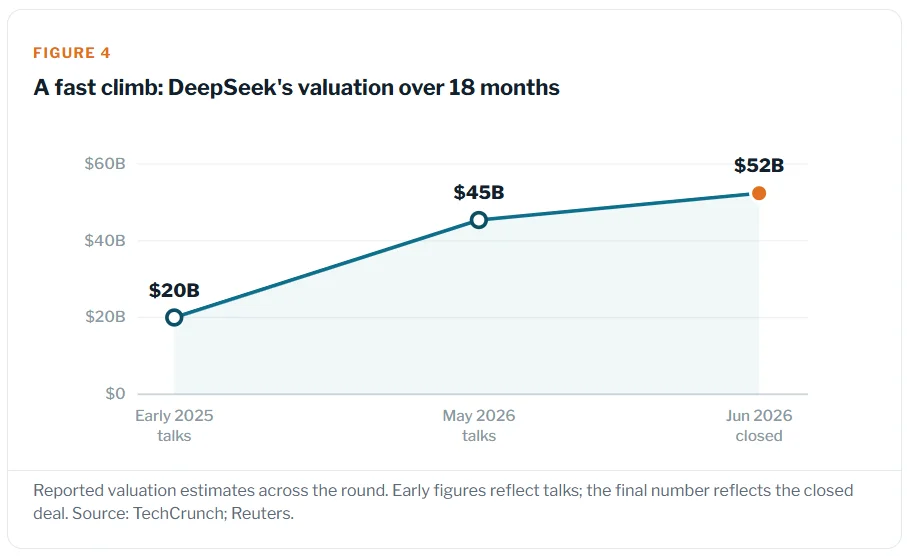
The deal values the AI lab above $50 billion, with estimates reaching $59 billion.
Investors joined a limited partnership run by CEO Liang Wenfeng, not DeepSeek itself.
Most backers accept a five-year lock-up and receive no voting rights.
China’s state AI fund is the only investor with direct equity and a vote.
Chinese AI lab DeepSeek has closed its first external funding round. The company raised more than 50 billion yuan, or about $7.4 billion at a valuation above $50 billion. As a result, the DeepSeek funding round ranks among China’s largest private technology deals. Moreover, the terms surprised many investors.
A record raise on the founder’s terms
DeepSeek built its reputation without venture capital. Until now, the lab ran entirely on cash from High-Flyer. High-Flyer is the quantitative hedge fund that Liang Wenfeng also founded. That fund returned 56.6% in 2025 and manages about $10 billion. Therefore, DeepSeek never needed outside money before this year.
This round changes that history. However, Liang refused to give up control. He committed roughly 20 billion yuan of his own money. That single check covers nearly 40% of the total raise. Consequently, the founder holds the largest stake in the deal.
Why the deal structure looks unusual
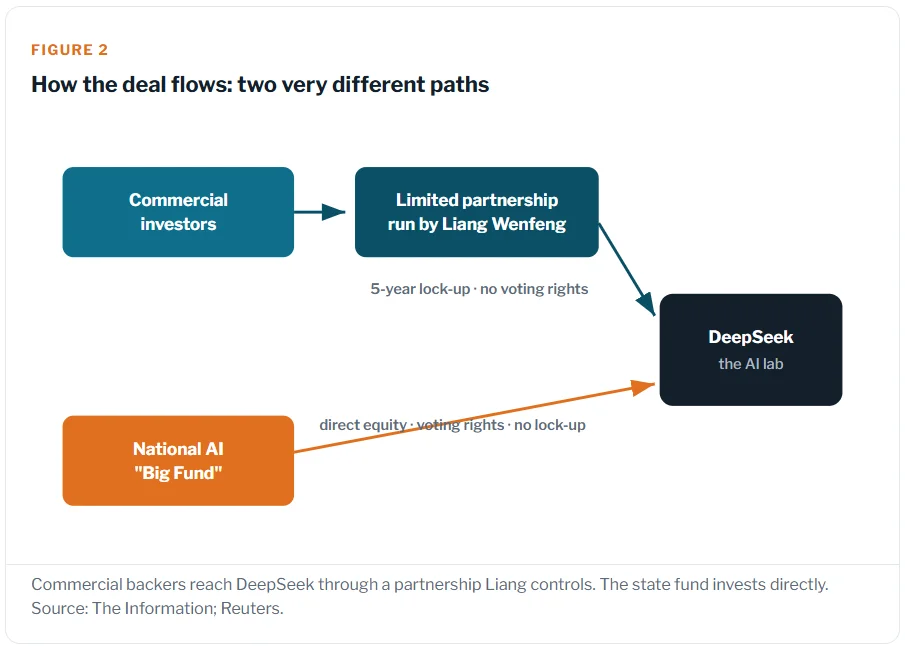
Most large rounds hand investors equity and a vote. The DeepSeek funding round does neither for commercial backers. Instead, investors route their capital into a limited partnership. Liang manages that partnership directly. In effect, the money reaches DeepSeek through a vehicle he controls.
The terms tighten his grip further. Commercial backers accept a five-year lock-up and receive no voting rights. During that period, they cannot sell their stakes. Still, they gain access to financial data and priority in future rounds.
The one exception
One backer escaped these limits. China’s National Artificial Intelligence Industry Investment Fund invested straight into DeepSeek. That state fund, often called the Big Fund, kept its voting rights. It also skipped the lock-up entirely. Clearly, the arrangement signals strong government interest in the company.
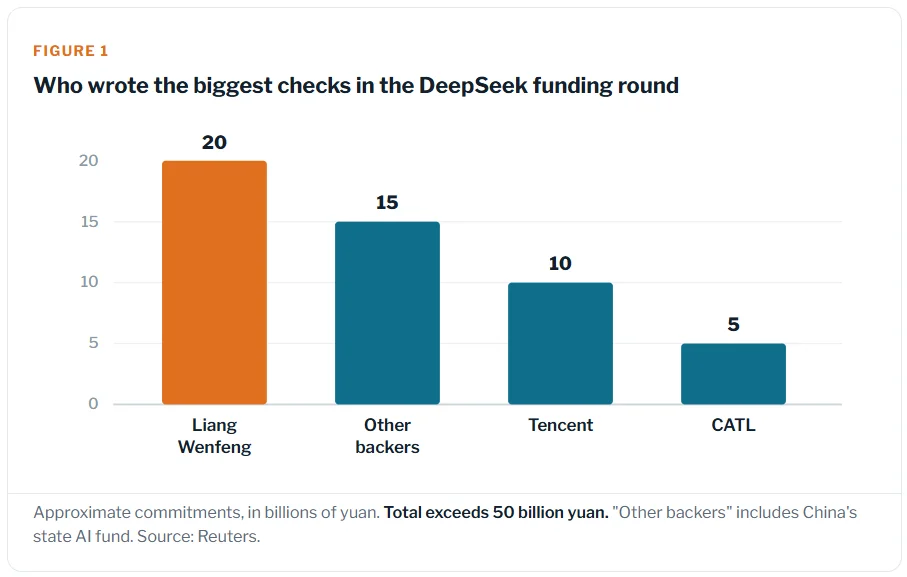
Who wrote the biggest cheques?
Liang led the round with his 20 billion yuan commitment. Tencent followed with about 10 billion yuan, while battery giant CATL added roughly 5 billion yuan. Together, these names rank as the largest external backers. In short, the list reads like a roster of China’s industrial champions.
A modest valuation beside US rivals
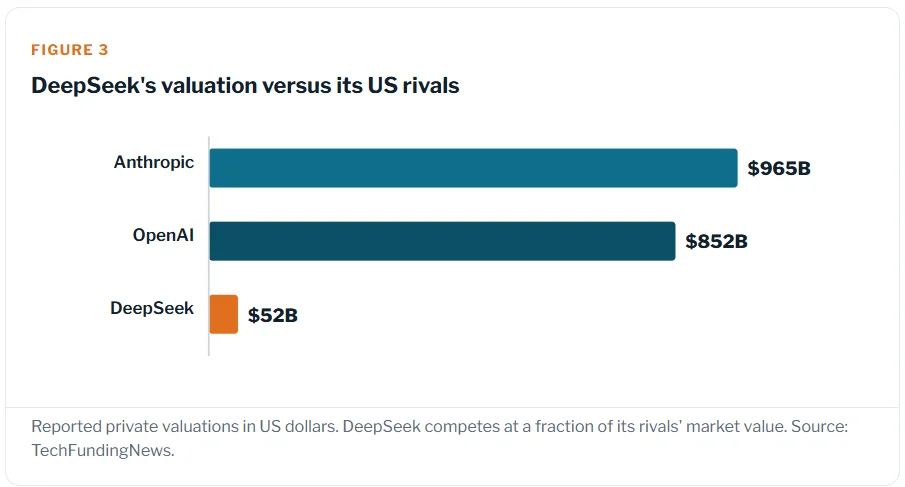
DeepSeek now competes with the biggest names in AI. Yet its price tag still trails them sharply. According to industry trackers, Anthropic sits near $965 billion and OpenAI near $852 billion. By comparison, DeepSeek’s $50 billion looks small. Nevertheless, the lab punches far above that weight on cost.
How DeepSeek closed the gap
DeepSeek shocked the industry in early 2025. Its R1 model matched costly Western systems on reasoning. However, the team trained those models on a fraction of the usual budget. Reports put the R1 training cost near $6 million. That efficiency rattled US technology stocks for days.
An open strategy that pressures rivals
DeepSeek also publishes its model weights for free. This open approach commoditizes the model layer. Therefore, rivals must compete on cost rather than raw capability. In turn, that strategy challenges the capital-heavy playbooks of American labs. For investors, the bet looks both ideological and commercial.
The lock-up term directly protects that mission. Because backers cannot exit early, they cannot force quick profits. As a result, the team can keep prioritizing research over revenue. Liang has long defended this patient model. So far, his results have justified the discipline.
Why investors accept no votes
The terms look harsh on paper. Even so, demand for the DeepSeek funding round stayed strong. Backers gain exposure to a rare Chinese AI champion. Furthermore, they secure priority in future rounds. Many also view government support as a powerful signal. In China’s market, that alignment carries real weight.
What the money will build
DeepSeek plans to spend the capital on frontier research. The lab wants stronger next-generation models. In addition, it will recruit more engineering talent. The team also needs specialized hardware for heavy training. Ultimately, DeepSeek is chasing artificial general intelligence, or AGI.
A strategic statement, not just a financing
The DeepSeek funding round reads as much like a strategy as a deal. Liang keeps control and protects an open mission. Meanwhile, the Chinese state signals clear backing through the Big Fund. For Western rivals, the message lands plainly. China now holds an independent AI champion with deep pockets.
Investors will watch the next models closely. If DeepSeek keeps pace cheaply, its valuation could climb again. For now, the lab holds money, control, and momentum together.
Risks still remain on the horizon. US chip curbs could limit DeepSeek’s access to compute resources. Meanwhile, rivals keep pouring billions into their own models. Even so, the round buys DeepSeek time and freedom. Few private labs anywhere enjoy that combination today.