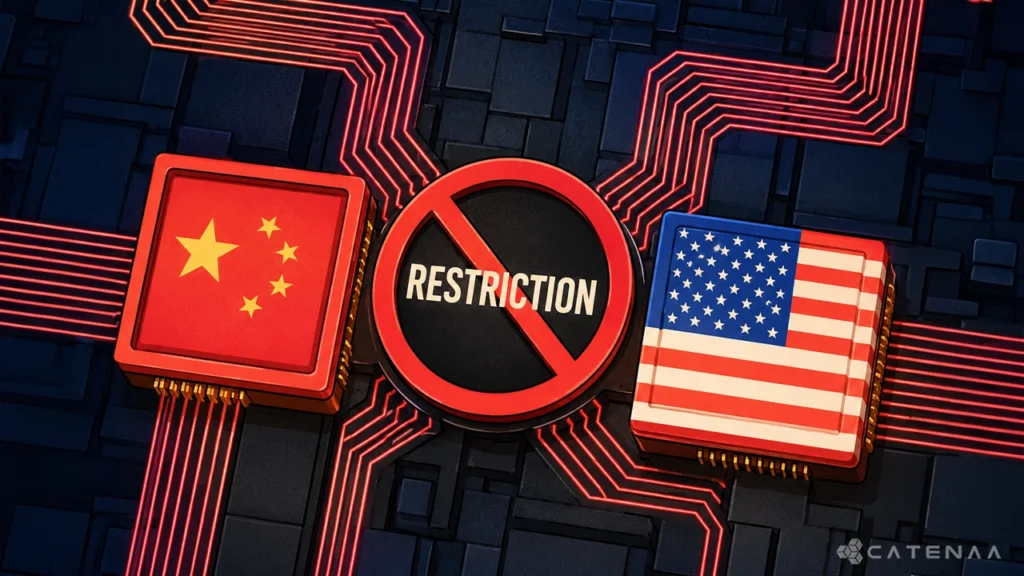


Catenaa, Tuesday, July 14, 2026- China is considering new restrictions on overseas access to its most advanced artificial intelligence models, a move that could reshape the global AI landscape by limiting access to some of the world’s fastest-growing open-weight models.
According to Reuters, China’s Ministry of Commerce has held discussions with leading domestic AI developers, including Alibaba, ByteDance and Z.ai, on proposals to regulate exports of frontier AI models. The talks reportedly cover both proprietary models and open-weight systems, including technologies that have yet to be publicly released.
The discussions mark Beijing’s latest effort to strengthen control over strategic technologies as competition with the United States increasingly shifts from semiconductor exports to artificial intelligence.
People familiar with the discussions told Reuters that officials are considering a tiered regulatory framework. Under the proposal, basic AI models would require only government registration before release, more advanced systems would undergo security reviews, while the most capable frontier models could be restricted to domestic use or barred from public distribution altogether.
The framework remains under discussion, and no implementation timeline has been announced. Officials are also debating whether the restrictions should apply only to future AI models rather than those already available internationally.
The reported discussions follow a series of US measures that tightened controls over advanced AI technologies.
In June, US authorities temporarily restricted overseas access to Anthropic’s Claude Fable 5 and Mythos 5 models under national security provisions before easing the restrictions later in the month. OpenAI also introduced phased access to its GPT-5.6 family after conducting security reviews with US government agencies before broader deployment.
Those developments demonstrated Washington’s willingness to extend export controls beyond advanced semiconductors to the AI models themselves.
Chinese officials are reportedly concerned that advanced foreign AI systems could be used to identify vulnerabilities in domestic digital infrastructure or expose sensitive technologies. The discussions also include proposals to strengthen legal protection against unauthorized disclosure or theft of advanced AI technology under China’s national security laws.
Any restrictions would represent a major shift for China’s AI industry, which has gained international recognition through freely available open-weight models.
Alibaba’s Qwen family, ByteDance’s AI technologies and Z.ai’s GLM series have attracted developers worldwide because of their relatively open licensing models and competitive performance. Chinese AI models have also become increasingly popular among developers seeking alternatives to restricted US commercial systems.
If Beijing limits overseas access to future frontier models, developers outside China could lose access to one of the few remaining sources of advanced open AI models.
Industry analysts note that such restrictions would affect software developers, startups and enterprises that rely on Chinese AI models for research, application development and commercial deployment.
The reported discussions illustrate how AI is becoming a strategic technology subject to national security policies rather than purely commercial competition.
Both Washington and Beijing now appear to view frontier AI models as critical national assets requiring export controls similar to those governing advanced semiconductors. If both countries adopt increasingly restrictive access policies, businesses worldwide may face reduced availability of cutting-edge AI technologies and fewer open alternatives.
The trend could also accelerate efforts by Europe, Canada and other regions to develop independent AI capabilities as governments seek to reduce dependence on foreign-controlled AI infrastructure.
For much of the past two years, Chinese open-weight AI models have gained global market share as developers searched for alternatives to increasingly restricted US frontier systems. Companies including Alibaba and Z.ai expanded rapidly by offering powerful models under permissive licensing terms and competitive pricing. The reported policy discussions suggest China may now be reconsidering that open strategy as artificial intelligence joins semiconductors, quantum computing and cybersecurity as a strategic technology at the center of global geopolitical competition.