

Catenaa, Monday, August 10, 2026 – A global semiconductor selloff is testing investor confidence in the artificial intelligence boom as China’s chipmaking advances collide with mounting concerns over the enormous sums financing AI infrastructure, the Bloomberg reported.
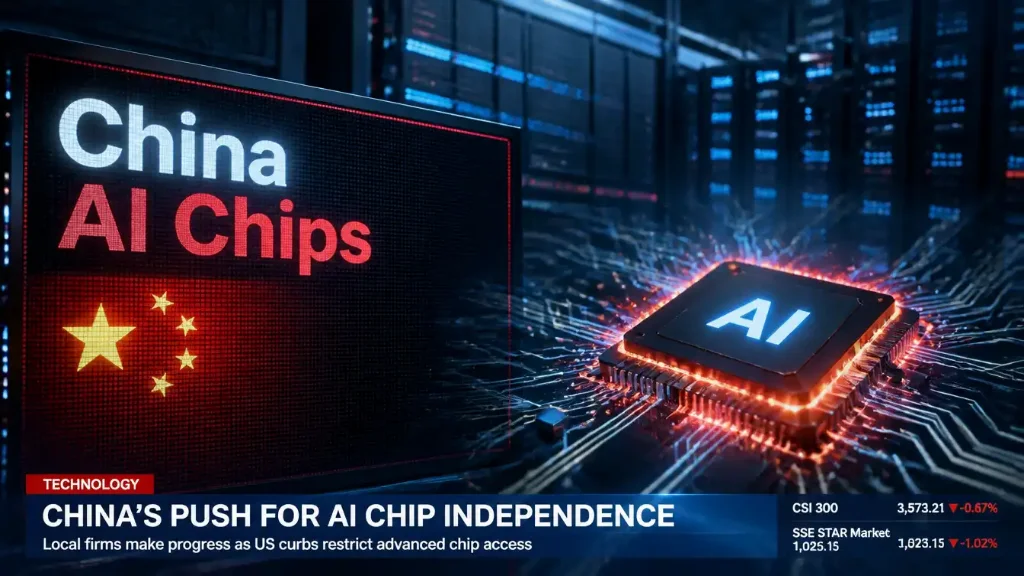
The latest pressure followed reports that a Chinese state-backed company had begun mass production of domestic immersion deep ultraviolet lithography equipment. Such machines are used in semiconductor manufacturing and could reduce China’s dependence on foreign technology.
The development rattled investors because advanced chipmaking equipment has been one of the strongest technological barriers separating Chinese manufacturers from global semiconductor leaders.
Asian semiconductor shares fell sharply during the selloff. South Korea was particularly hard hit, with Samsung Electronics and SK Hynix suffering steep declines as investors reduced exposure to some of the AI boom’s biggest beneficiaries.
The Philadelphia Semiconductor Index also extended losses, while the broader global semiconductor sector recorded one of its sharpest monthly declines in years.
The market reaction suggests investors are no longer assessing China merely as a customer restricted from buying the most advanced Western technology.
China is increasingly being evaluated as a potential competitor capable of developing more of the semiconductor manufacturing chain domestically.
That shift could eventually pressure companies supplying chipmaking equipment, memory and other infrastructure supporting the global AI buildout.
However, China still faces technological hurdles before domestic equipment can match the most advanced systems used by leading global chipmakers.
The second concern is financial.
Investors are scrutinizing the extraordinary capital flowing into AI data centers, chips and computing infrastructure and asking how quickly that spending can generate adequate returns.
Research shows the hardware costs and electricity requirements of leading AI computing systems have expanded rapidly alongside their processing capacity.
Recent financing structures across the AI industry have added another concern. Chipmakers, cloud companies, AI developers and infrastructure operators are increasingly connected through investments, supply agreements and financing arrangements.
The fear is not that AI demand has disappeared. It is that valuations may have assumed years of exceptional growth before companies have demonstrated returns matching the investment required.
That distinction could define the next stage of the AI trade.
The semiconductor boom was largely built around scarcity, soaring computing demand and Western technological leadership. China’s manufacturing push challenges the scarcity argument, while rising infrastructure costs challenge assumptions about profitability.
For investors, AI may therefore be moving from a market where almost every supplier benefited into one where technology, financing and actual returns increasingly determine the winners.




