

May 18, 2026 – Chamath Palihapitiya’s viral warning puts Anthropic’s guardrails under scrutiny.
In Summary
Chamath Palihapitiya criticised Claude for refusing to complete a stock-screening task on May 17, 2026.
In a direct head-to-head test, Grok, Gemini, and ChatGPT all completed the task. Claude did not.
Anthropic’s annualised revenue climbed from $9 billion (late 2025) to $30 billion by April 2026.
Claude leads enterprise AI, winning roughly 70% of head-to-head deals against OpenAI, per Ramp data.
Anthropic is reportedly in talks to raise $30 billion at a reported $900 billion valuation.
A single refusal has ignited a major debate. Venture capitalist Chamath Palihapitiya tested four leading AI systems on May 17, 2026. He used a stock screening prompt to compare their outputs. Grok, Gemini, and ChatGPT all delivered results. Claude, however, declined the task. Palihapitiya then posted his findings on X. His verdict was blunt: Anthropic risks becoming the “Friendster of the AI era.” That comparison carries real weight. Friendster once dominated social networking. It then lost its lead to faster, less restrictive platforms. For a company chasing a reported $900 billion valuation, this warning demands serious attention.
The Prompt That Started It
Palihapitiya ran a direct comparison test across four models. The systems were xAI’s Grok, Google’s Gemini, OpenAI’s ChatGPT, and Anthropic’s Claude. According to Benzinga, three of the four models returned comparable results. Claude refused to complete the task. Palihapitiya shared his findings with his nearly 2 million X followers. His message was terse: “Not the way to win, guys.” The post spread quickly through finance and tech communities. This incident is not merely a product complaint. It reveals a deeper tension between AI safety and commercial competitiveness. That tension is now very public.
“Anthropic needs to solve the computer/power problem, or they will be the Friendster of the AI era.”
Chamath Palihapitiya, on X (May 17, 2026)
A Rapidly Shifting Market
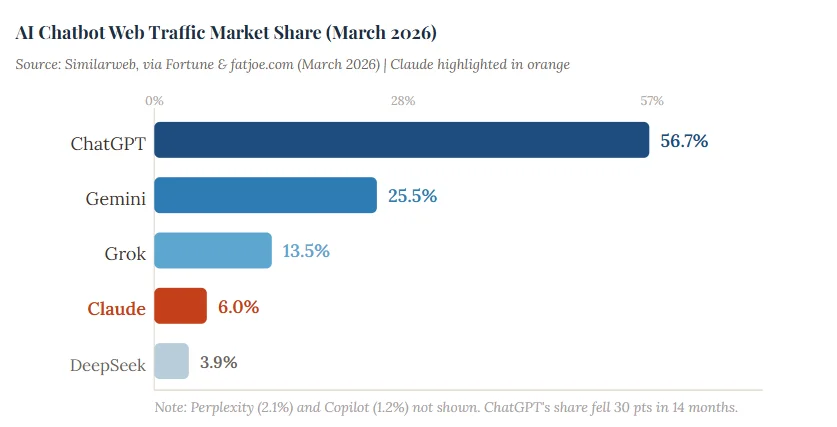
The AI chatbot market is evolving fast. ChatGPT’s web traffic share fell from 87.2% to 56.7% between January 2025 and March 2026. This figure comes from SimilarWeb data reported by Fortune. Google’s Gemini surged from 5.4% to 25.5% in the same period. Claude’s share also grew. It tripled from 2.0% to 6.0% between December 2025 and March 2026. However, Claude’s consumer traffic still lags far behind its rivals. The enterprise story is more favourable. Claude wins approximately 70% of head-to-head enterprise deals against OpenAI among new buyers, per Ramp spending data covering 50,000-plus businesses. Furthermore, the share of businesses paying for Anthropic grew significantly. They went from 1 in 25 to nearly 1 in 4 on Ramp’s platform in one year. Despite low consumer traffic, Claude’s commercial dominance in the enterprise is real.
Anthropic’s Financial Story
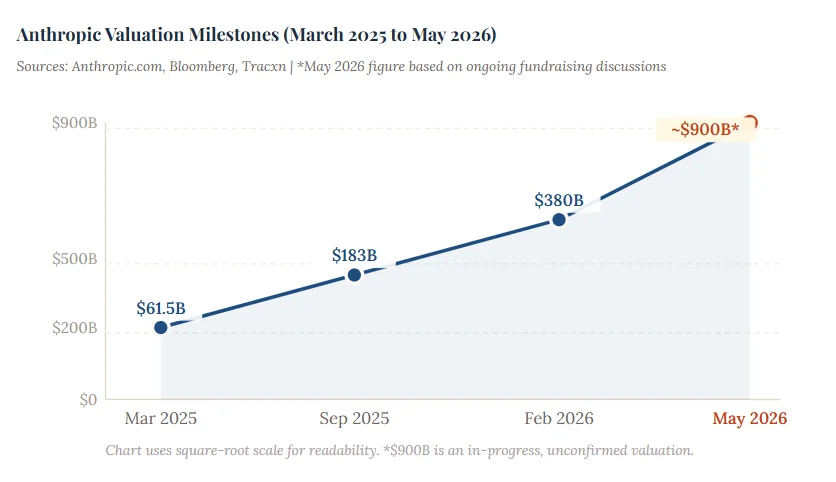
Anthropic’s revenue growth is extraordinary. The company closed a $30 billion Series G round in February 2026. Anthropic’s official site confirmed the post-money valuation at $380 billion. Its annualised revenue reached $30 billion by April 2026. That represents a sharp rise from $9 billion at the end of 2025. CEO Dario Amodei cited “80x growth” in both usage and revenue. Additionally, Claude Code generated $2.5 billion in annualised revenue by February 2026 alone. It had launched just nine months earlier. Enterprise customers spending over $100,000 annually on Claude grew 7x in one year. Over 1,000 businesses now spend more than $1 million per year with Anthropic. Furthermore, Bloomberg reported in May 2026 that Anthropic is seeking an additional $30 billion in funding. The targeted valuation stands at approximately $900 billion.
Safety vs. Utility: The Core Tension
Anthropic builds Claude on a Constitutional AI framework. This approach prioritises safety and ethical guardrails above all else. However, it creates friction in real-world use cases. Palihapitiya’s test is the latest evidence of this problem. Rivals like Grok and Gemini appear more permissive with financial queries. Therefore, users seeking quick, direct answers tend to choose those platforms. Engagement data, however, tells a more nuanced story. Claude users average 34.7 minutes per daily session. This is the highest engagement rate of any major AI app, per Apptopia data cited by Fortune. The users who choose Claude stay deeply engaged. However, refusals risk pushing new users away before they experience that value. Furthermore, each public refusal now becomes a branding issue. Social media amplifies these moments instantly.
Decoding the Friendster Warning
Friendster launched in 2002 and pioneered online social networking. Within two years, MySpace overtook it. Facebook then completed the collapse. The lesson is clear: early leadership does not guarantee long-term dominance. Palihapitiya’s comparison suggests Claude’s guardrails could become a similar bottleneck. Anthropic has moved to address competitive pressure. The company recently gained access to xAI’s Colossus 1 supercomputer for model training. It also rolled out Claude Code Security and Microsoft Office integrations. These moves show genuine awareness of the competitive threat. Nevertheless, critics argue that product utility matters more than raw compute alone. A model that refuses tasks loses users, regardless of its safety credentials. Consequently, Anthropic faces a product philosophy question, not just a technical one.
What Investors Are Watching
The financial stakes are very high. Bloomberg reported that Anthropic is in talks to raise at least $30 billion at a valuation above $900 billion. This figure would surpass OpenAI’s March 2026 valuation of $852 billion. Investors are clearly backing Anthropic’s growth story. Annualised revenue of $30 billion, with projections above $45 billion, supports their confidence. Nevertheless, Palihapitiya’s warning highlights a real product risk. If Claude refuses to complete tasks that competitors do, enterprise clients will notice. Anthropic must balance its commitment to AI safety with the utility demands of a competitive market. That balance will define its path forward. For now, the Friendster warning lingers.