


April 19, 2026 – Amex buys Sam Altman-backed Hyper to automate corporate expense management. The deal reshapes the $29B spend management market and signals a permanent shift toward agentic finance.
In Summary
American Express agreed to acquire Hyper (Hypercard) on April 16, 2026. Financial terms were not disclosed.
Hyper’s AI agents automate expense filing, policy checks, and employee reminders autonomously.
The deal is expected to close in Q2 2026, subject to regulatory approval.
The global spend management market is valued at $29.19B in 2026, growing at 13.2% CAGR.
This is Amex’s second AI-focused acquisition in 2026, following the Center acquisition in February.
American Express announced on April 16, 2026, that it will acquire Hyper, an AI-driven expense management startup. Notably, OpenAI CEO Sam Altman backs the company. The acquisition directly targets the $29B corporate spend market. As a result, this move signals that Amex is no longer just a card network. Instead, it is building an AI-powered operating system for corporate finance teams.
Marc Baghadjian and Nikolas Ioannou founded Hyper in 2022. The New York startup builds autonomous AI agents that handle expense workflows end-to-end. Specifically, these agents auto-categorise expenses, verify policy compliance, and send reminders to employees. The entire process needs no human intervention. Consequently, that capability is exactly what Amex needed to compete with agile fintechs like Ramp and Brex.
“Our customers want smarter, more efficient ways to manage expenses. AI has the potential to transform the way businesses get things done.”
— Raymond Joabar, Group President, Global Commercial Services, American Express
What Does Hyper Actually Do?
Hyper’s core product is a back-office automation platform. Its flagship AI agent works like a personal finance assistant via text. An employee submits a receipt. The agent reads, categorises, and files it instantly. It also checks the submission against company policy. If something looks wrong, it flags it automatically. This reduces processing time significantly. Manual data entry drops by up to 43%, according to industry research.
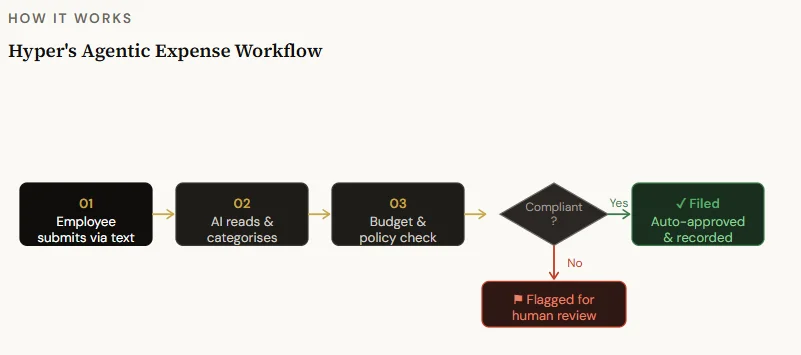
Hyper also has two additional agents currently under development. This pipeline of tools was a key attraction for Amex. The company wants to build an expense platform that will launch later in 2026. Hyper’s team gives Amex the AI expertise to do that faster.
A $29 Billion Market Heating Up Fast
The global spend management platform market is valued at $29.19 billion in 2026. It is growing at a 13.2% CAGR. By 2030, it is forecast to reach $45.93 billion. AI is the primary driver. Finance teams increasingly want zero-touch expense reporting, tighter controls, and faster book-close cycles.
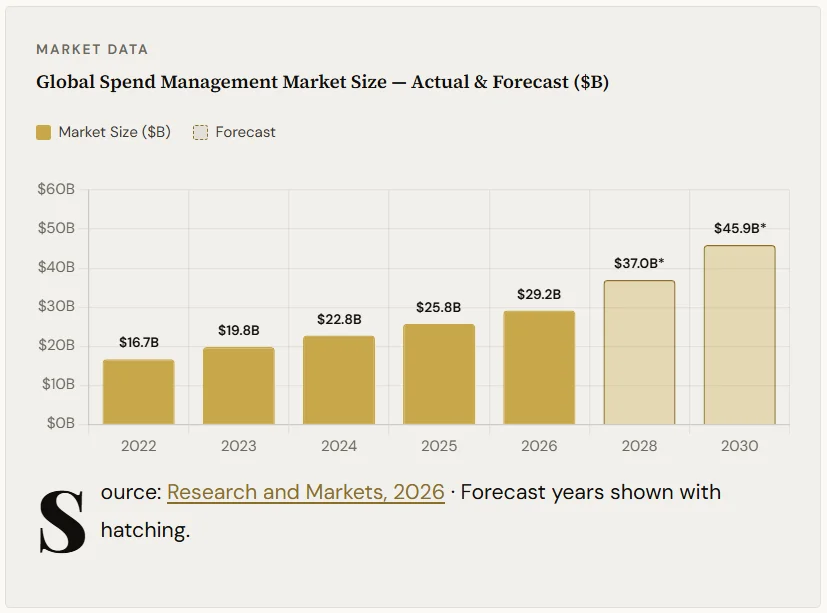
Corporate expense management has become a strategic battleground. Banks, card networks, and fintechs are all fighting for the same territory. Providers like Ramp, Brex, Navan, and SAP Concur have pushed hard on automation. They promise faster reimbursements, tighter controls, and lower admin costs. For Amex, acquiring Hyper was faster than building in-house.
Amex Enters the Deal From a Position of Strength
American Express reported record 2025 revenue of $72.2 billion. That is 10% growth year-on-year. Net card fee revenues hit a record $10 billion. This marked the 30th consecutive quarter of double-digit growth. Card spending grew 7% on an FX-adjusted basis. The company’s super-prime customer base remains resilient. It is largely unaffected by macroeconomic uncertainty.
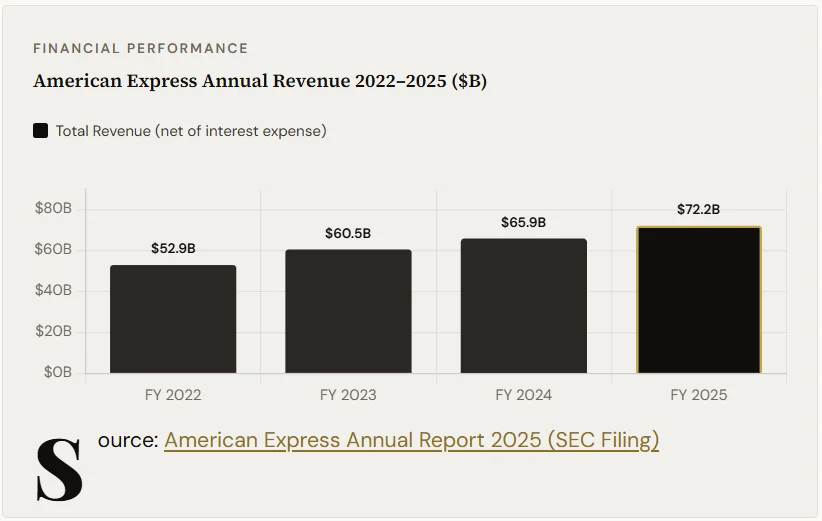
Analysts at Zacks project Amex’s Q1 2026 earnings at $4.01 per share. That is 10.2% higher than the prior year. Projected revenue for the quarter stands at $18.62 billion. This is 9.7% growth year-on-year. The acquisition of Hyper fits neatly into this growth story. Amex is buying AI capabilities ahead of an earnings beat, not to rescue a struggling unit.
The Consolidation Wave That’s Reshaping Fintech
The Hyper deal is not happening in isolation. A wave of consolidation has swept through the B2B expense management space over an 18-month period. Capital One agreed to acquire Brex for $5.15 billion in January 2026. TravelPerk absorbed Yokoy in 2025. Amex acquired Center in February 2025. These are not isolated deals. This is a market restructuring.
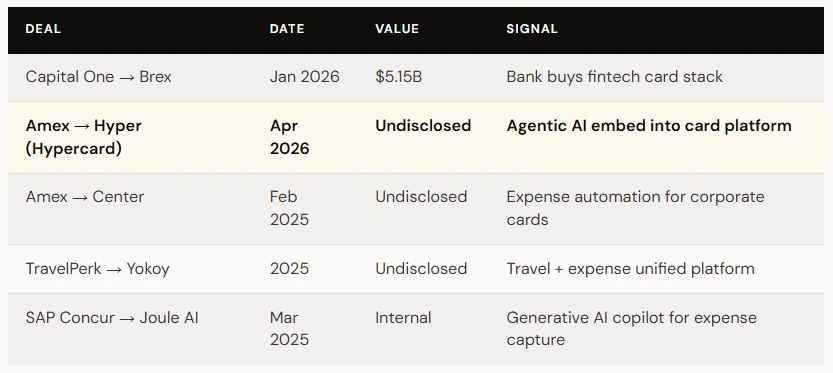
The pattern is clear. Legacy card networks are not ceding ground to fintechs. They are buying the technology that fintechs built. The Hyper acquisition gives Amex something its competitors lack: an AI agent that lives inside the payment workflow. That means Amex could become the operating layer for every business expense decision, not just the card that processes payment.
A Partnership That Became an Acquisition
This deal did not come out of nowhere. In 2024, Amex and Hyper co-launched the Hypercard Rewards American Express card. It featured embedded AI-powered expense agents built on Amex’s Agile Partner Platform. That product gave Amex’s business cardholders a live preview of agentic expense management. Since then, Hyper has further refined its technology. Amex then decided to own it outright rather than partner.
“Hyper was founded with the ambition to better automate expenses. We’re excited to continue this mission as part of the Amex team.”
— Marc Baghadjian, CEO & Co-Founder, Hyper
Marc Baghadjian and Nikolas Ioannou founded Hyper in 2022. Their original goal was to let employers reward staff with consumer credit cards. In 2023, Hyper raised roughly half of a $4.5 million funding round from Sam Altman. Altman is also an investor in Stripe and OpenAI. The deal is expected to close in Q2 2026.
What Comes Next for Amex and Corporate AI
Amex is planning to launch a full expense management platform later in 2026. Hyper’s team of AI specialists will build the core capabilities. The company has already deployed AI coding tools to over 11,000 engineers. A conversational AI for phone services is in testing. Agentic AI is now Amex’s central bet. Leadership has compared the shift to the move from physical to digital commerce.
The strategic goal is clear. Amex wants to turn its commercial card relationships into a full financial operating system. Expense management, reimbursements, and policy enforcement will all tie directly into its payment network. That would make Amex far stickier for enterprise clients. It would also substantially raise the cost of switching to a competitor.
AXP stock dipped approximately 0.69% on the day of the announcement. That is a negligible move for a deal of this strategic magnitude. Investors appear to agree. The real payoff comes when Amex’s new expense platform goes live, and AI agents start influencing every corporate dollar its clients spend.




