


August 03, 2026 – The Amazon OpenAI investment is now complete. The deal combines preferred shares with a vast AWS compute agreement. It could deliver equity upside and cloud revenue. However, the structure also raises execution and cash flow risks.
In Summary
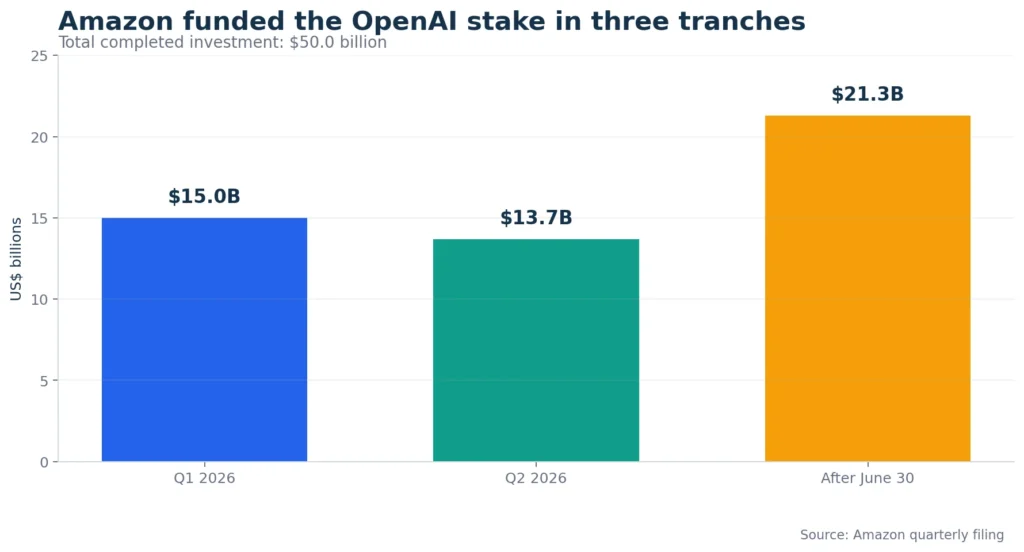
Amazon funded the investment through three tranches: $15 billion, $13.7 billion, and $21.3 billion.
OpenAI expanded its AWS commitment by $100 billion over eight years, following an earlier $38 billion agreement.
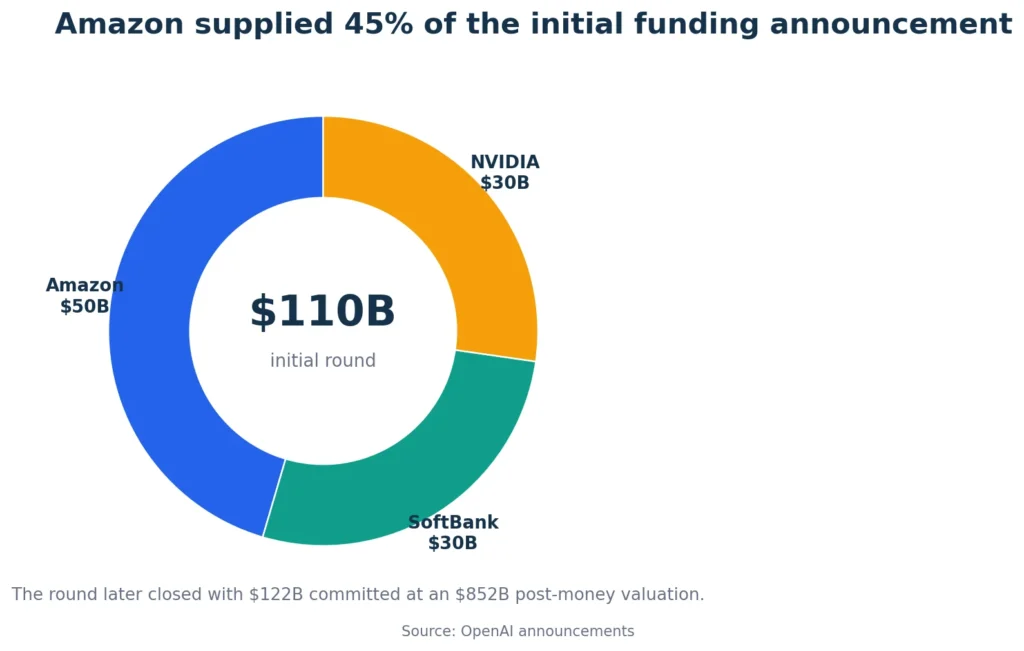
Amazon supplied 45% of OpenAI’s initial $110 billion funding announcement.
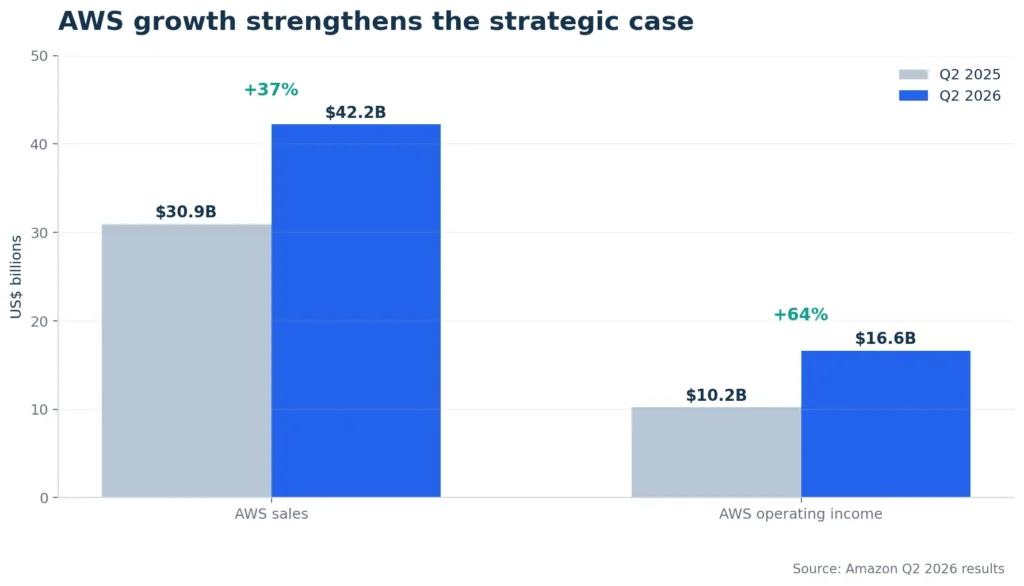
AWS sales reached $42.2 billion in the second quarter, while operating income reached $16.6 billion.
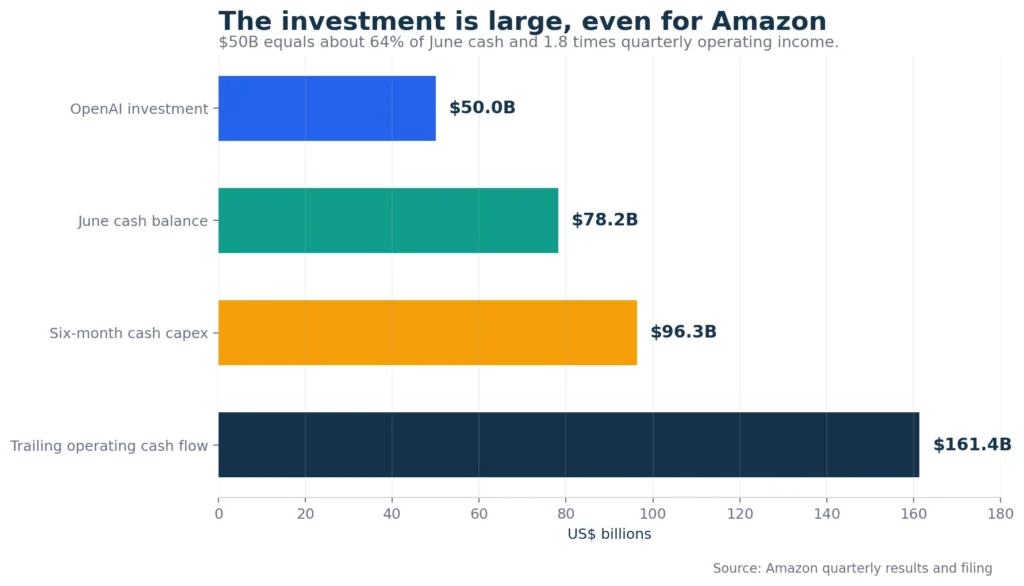
The $50 billion commitment equals about 64% of Amazon’s June cash balance.
Amazon OpenAI investment is complete
Amazon’s quarterly filing confirms the final funding sequence. The company invested $15 billion during the first quarter. It then added $13.7 billion during the second quarter.
Therefore, Amazon held $28.7 billion of OpenAI Series C preferred stock on June 30. It funded the remaining $21.3 billion after the quarter ended.
The securities would convert into common stock after an initial public offering or another liquidity event. However, Amazon does not consolidate OpenAI’s accounts. Its financial exposure remains tied to the investment’s carrying value and future valuation changes.
That accounting treatment matters. Private-market price adjustments can lift or reduce reported non-operating income. Yet those movements do not represent cash generated by Amazon’s core businesses.
The real prize may be cloud revenue
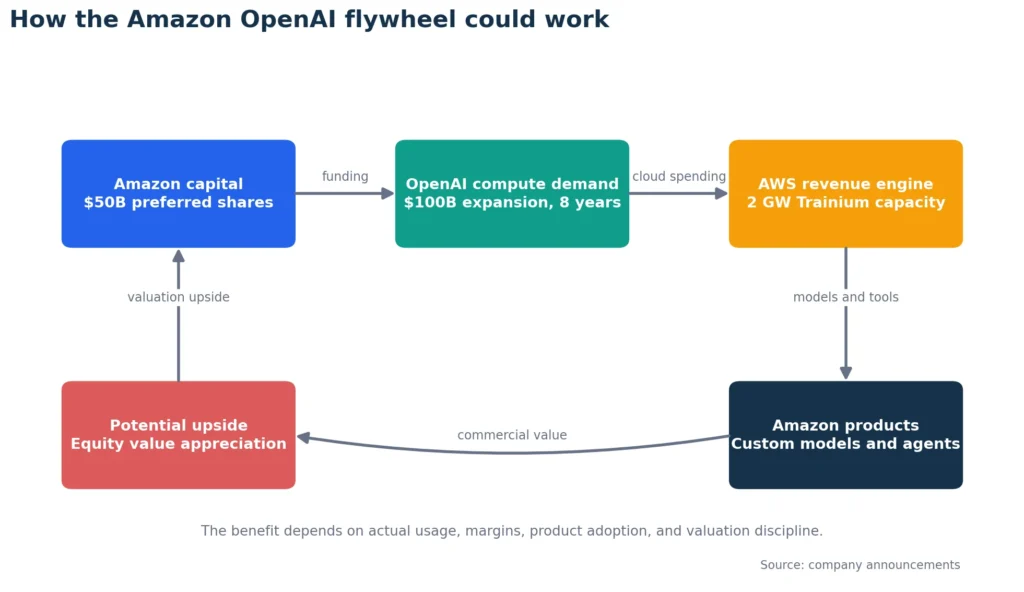
The equity investment sits beside a much larger commercial relationship. OpenAI and AWS expanded their existing $38 billion infrastructure agreement by another $100 billion.
The expansion runs for eight years. It includes approximately two gigawatts of AWS Trainium capacity. OpenAI will use that capacity for advanced models, enterprise agents, and other demanding workloads.
AWS also became the exclusive third-party cloud distribution provider for OpenAI Frontier. Furthermore, both companies plan to build a stateful runtime environment through Amazon Bedrock.
This arrangement creates a strategic flywheel. Amazon provides capital to OpenAI. OpenAI commits substantial spending to AWS. Amazon then gains cloud revenue, chip utilization, and potential equity appreciation.
However, the timing remains important. Amazon paid the investment through several large tranches. AWS will recognize commercial revenue gradually as OpenAI consumes infrastructure and services.
Valuation math raises the stakes
OpenAI first announced $110 billion of new investment at a $730 billion pre-money valuation. Amazon contributed $50 billion of that total.
Consequently, Amazon represented about 45.5% of the announced funding. The round later closed with $122 billion of committed capital at an $852 billion post-money valuation.
Amazon’s contribution equals roughly 41% of the final committed round. Still, cash contribution does not reveal ownership percentage. Preferred rights, security classes, and other terms can materially change the economics.
The valuation also sets a demanding performance threshold. OpenAI must convert rapid adoption into durable revenue and improve unit economics. Meanwhile, Amazon needs cloud spending and equity gains to justify the capital deployed.
Amazon has scale, but pressure is visible
Amazon reported second-quarter sales of $200.6 billion and operating income of $27.5 billion. AWS generated $42.2 billion of sales, up 37% from the prior year.
AWS operating income reached $16.6 billion, rising about 64%. That growth supports Amazon’s willingness to fund more infrastructure and custom silicon.
Even so, the $50 billion investment equals 1.8 times Amazon’s quarterly operating income. It also equals about 64% of June cash and cash equivalents.
Amazon produced $161.4 billion of trailing operating cash flow. However, trailing free cash flow fell to negative $7.6 billion. Higher artificial intelligence infrastructure spending drove much of that decline.
Therefore, the transaction strengthens Amazon’s AI position while increasing execution pressure. The investment only works if OpenAI demand becomes profitable AWS consumption.
What investors should watch next
Investors should track OpenAI’s actual AWS usage, rather than headline commitments alone. Trainium utilization will reveal whether custom chips can improve margins.
They should also watch the Frontier rollout and the stateful runtime launch. Successful adoption could widen AWS’s enterprise AI moat.
Finally, cash flow discipline will remain critical. Amazon must balance data-centre expansion, private-market exposure, and shareholder returns. The deal is bold, but its value will depend on execution.




