

Catenaa, Thursday, July 16, 2026- The global artificial intelligence boom is reshaping the smartphone industry as soaring demand for memory chips from AI data centers drives up component costs, pushing affordable handsets out of reach and forcing manufacturers to rethink their product strategies.
Preliminary second-quarter figures from market researchers show smartphone shipments suffered their weakest performance in more than a decade as memory shortages evolved from a supply-chain disruption into a broader demand problem.
Counterpoint Research estimated global smartphone shipments fell 11% year over year during the second quarter, marking the lowest second-quarter shipment levels since 2013. Omdia reported a smaller 4% decline but reached the same conclusion: the industry is becoming increasingly polarized between premium manufacturers and brands focused on entry-level devices.
The trend reflects a fundamental shift in the semiconductor industry.
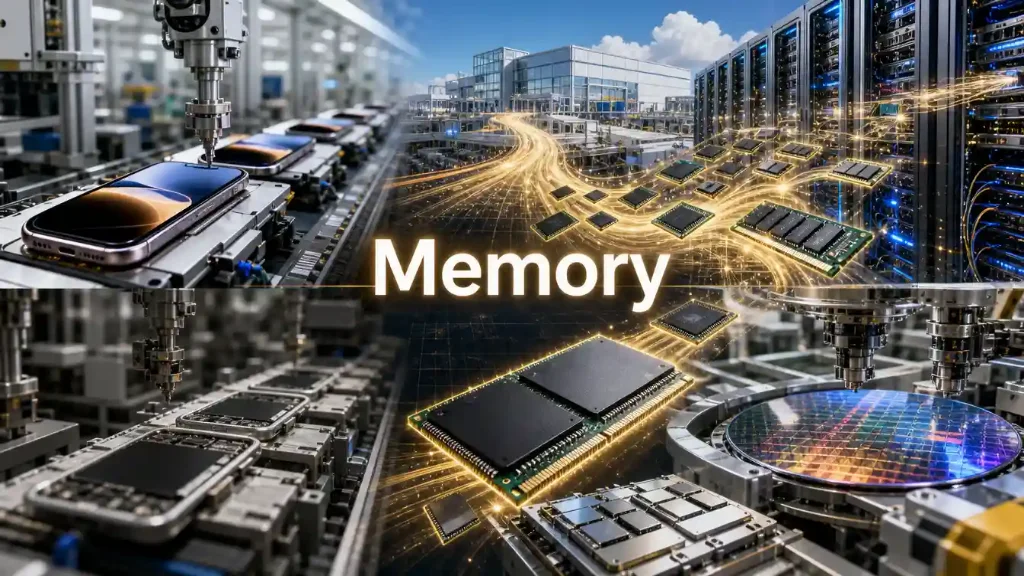
Rather than supplying memory primarily to consumer electronics, manufacturers are increasingly allocating production toward high-performance AI servers, cloud computing infrastructure and advanced data centers, where profit margins are substantially higher than in the budget smartphone market.
The global race to build artificial intelligence infrastructure has transformed memory chips into one of the industry’s most constrained resources.
Modern AI systems require enormous quantities of high-speed memory to train and operate increasingly sophisticated models, creating demand that now competes directly with consumer electronics manufacturers.
As AI investment accelerates worldwide, memory suppliers have prioritized enterprise customers willing to pay premium prices.
The result has been a sharp increase in memory costs across the smartphone industry.
Industry analysts estimate memory and storage now account for more than 60% of the bill of materials for many entry-level smartphones, compared with roughly 30% for premium flagship devices.
That imbalance has made low-cost smartphones increasingly difficult to manufacture profitably.
The memory shortage has affected smartphone makers unevenly.
Samsung strengthened its leadership position during the quarter, supported by resilient demand for premium Galaxy devices despite weakness in lower-priced models.
Apple also expanded its market share to a record second-quarter level, benefiting from continued demand for high-end iPhones and relatively stable pricing throughout much of the period.
Manufacturers concentrated in the mid-range and budget markets have experienced greater pressure.
According to market analysts, companies including Xiaomi, OPPO and vivo recorded double-digit shipment declines as higher component costs forced price increases that discouraged cost-conscious consumers.
The contrast highlights how premium brands possess greater flexibility to absorb higher production costs, while manufacturers competing primarily on affordability face shrinking margins and weaker demand.
The consequences extend beyond manufacturers.
Rising retail prices are encouraging consumers to postpone smartphone purchases, extend replacement cycles and increasingly consider refurbished devices instead of new handsets.
For many buyers, particularly in emerging markets, the price difference between new entry-level devices and previous-generation smartphones has narrowed considerably.
Analysts expect that trend to continue through the remainder of 2026 as memory shortages persist.
Manufacturers are increasingly shifting their focus from shipment volumes toward higher-value devices capable of preserving profitability despite rising production costs.
The smartphone slowdown illustrates a broader transformation taking place across the global semiconductor industry.
Artificial intelligence has become the sector’s most profitable customer.
Memory chips once destined for consumer electronics are increasingly being redirected toward AI accelerators, cloud infrastructure and enterprise computing platforms powering next-generation machine learning systems.
The result is a redistribution of semiconductor resources across industries.
Rather than smartphones driving demand for advanced memory technology, AI infrastructure is now setting the pace for investment, production priorities and pricing throughout the semiconductor supply chain.
As AI deployment continues expanding, consumer electronics manufacturers may need to adapt permanently to a market where memory is no longer abundant or inexpensive.
The smartphone industry’s latest downturn therefore represents more than weaker consumer demand.
It signals that artificial intelligence is beginning to reshape global technology supply chains, influencing everything from semiconductor investment to the price consumers pay for everyday devices.
The global smartphone market has faced multiple headwinds since the pandemic, including component shortages, inflation and longer device replacement cycles. However, the rapid expansion of artificial intelligence infrastructure has introduced a new challenge by sharply increasing demand for advanced memory chips used in AI servers and data centers. Semiconductor manufacturers have increasingly prioritized higher-margin enterprise customers, tightening supplies available for consumer electronics. Market researchers now view memory availability as one of the most influential factors shaping smartphone production, pricing and competition. The trend is expected to continue as governments and technology companies invest hundreds of billions of dollars in AI infrastructure, making memory one of the world’s most strategically important semiconductor components.