

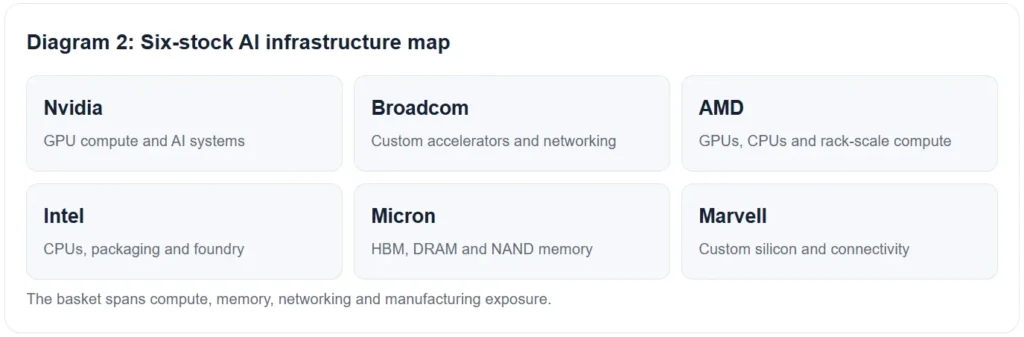
August 12, 2026 – AI spending is spreading across compute, memory, networking and manufacturing. Six chip stocks now offer distinct ways to capture that expansion.
In Summary
Semiconductor revenue reached $702 billion in the first half of 2026.
Memory remains the strongest growth engine, but logic demand is also accelerating.
Nvidia still leads AI compute, while Broadcom and AMD are gaining scale.
Micron, Intel and Marvell offer different exposure to the same infrastructure cycle.
The artificial intelligence chip boom is becoming a broader semiconductor cycle. Demand now reaches far beyond graphics processors. The strongest evidence comes from industry shipments. The semiconductor market reached $702 billion during 2026’s first half. That marked 102% year-on-year growth, according to World Semiconductor Trade Statistics.
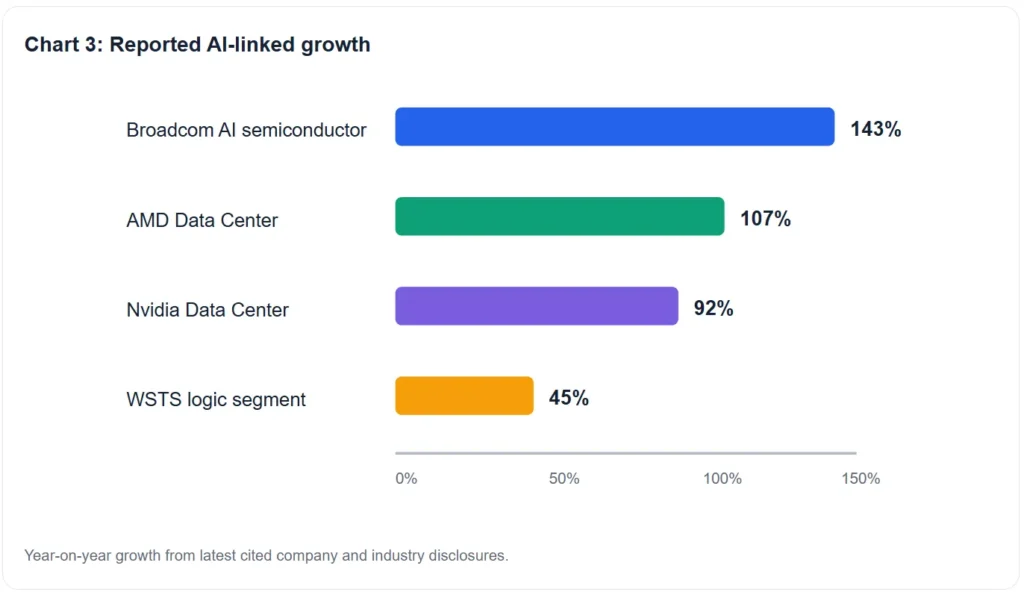
Memory sales surged 305%, while logic sales rose 45%. Therefore, AI spending is lifting several parts of the supply chain. The growth mix is important for investors. Memory still drives the largest increase, but logic confirms broader demand. That reduces the risk of viewing 2026 as only a memory-price story. Compute and connectivity are also expanding quickly.
Six stocks sit across the AI stack
Nvidia remains the center of AI compute. Its latest quarter shows why the leadership position still matters. Nvidia reported $81.6 billion of quarterly revenue. Data Center revenue reached $75.2 billion, up 92% year-on-year. Those figures come from Nvidia’s fiscal 2027 first-quarter results.
However, the opportunity is no longer limited to one architecture. Broadcom is scaling custom accelerators and AI networking. Its AI semiconductor revenue reached $10.8 billion in fiscal Q2. That figure jumped 143% from a year earlier.
Broadcom expects $16 billion next quarter, according to its latest earnings release. This creates a useful distinction within AI chip stocks. Nvidia sells a broad accelerated-computing platform. Broadcom competes through tailored silicon and networking. AMD combines general processors with increasingly competitive accelerators.
Those models can all benefit from higher data center spending. However, their margins and customer concentration differ materially.
AMD is also converting AI demand into faster data center growth. Its segment revenue reached $6.7 billion. That was 107% above last year, according to AMD’s second-quarter results.
Intel offers a different route. Investors gain exposure to CPUs, advanced packaging, ASICs and domestic foundry capacity. Marvell adds networking and custom silicon exposure. Those products become more important as AI clusters grow larger. Intel offers greater turnaround sensitivity than the other names. Its foundry strategy could expand upside, but execution remains crucial. Marvell has a narrower infrastructure profile. That can amplify gains when hyperscale networking programs accelerate.
Memory turns into a strategic bottleneck
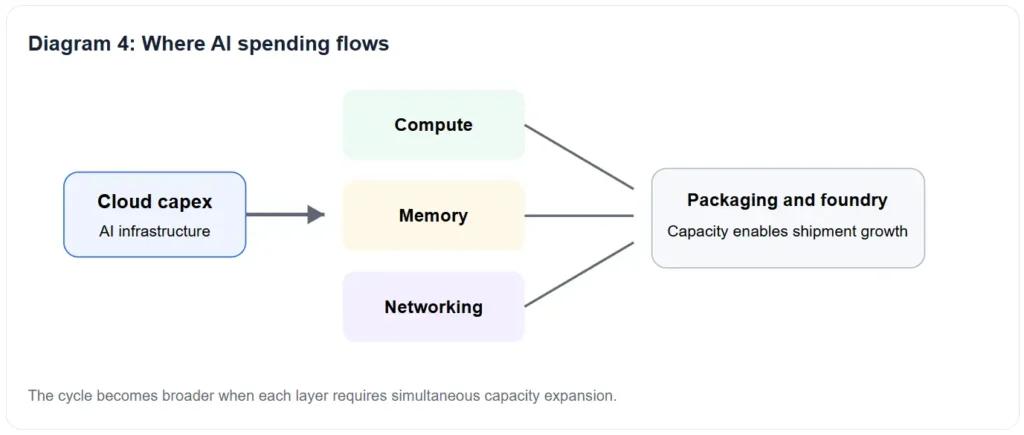
AI accelerators need high-bandwidth memory beside raw compute. That makes Micron central to the broader investment case. Micron posted fiscal Q3 revenue of $41.46 billion. A year earlier, revenue stood at only $9.30 billion. The jump appears in Micron’s fiscal Q3 results.
This matters because memory supply can restrict accelerator shipments. Higher memory prices can also shift profit across the value chain.
The opportunity also carries new risks
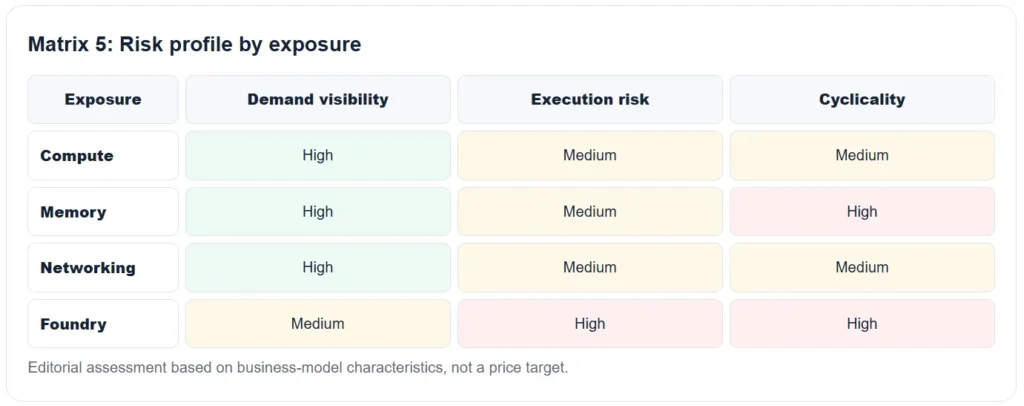
Broadening demand reduces dependence on one supplier. Yet it does not remove valuation, execution or capacity risks.
Compute leaders face rapid product cycles. Memory producers face pricing volatility. Foundry businesses require heavy capital spending.
Meanwhile, networking suppliers depend on large customer programs. Delays can move revenue sharply between quarters.
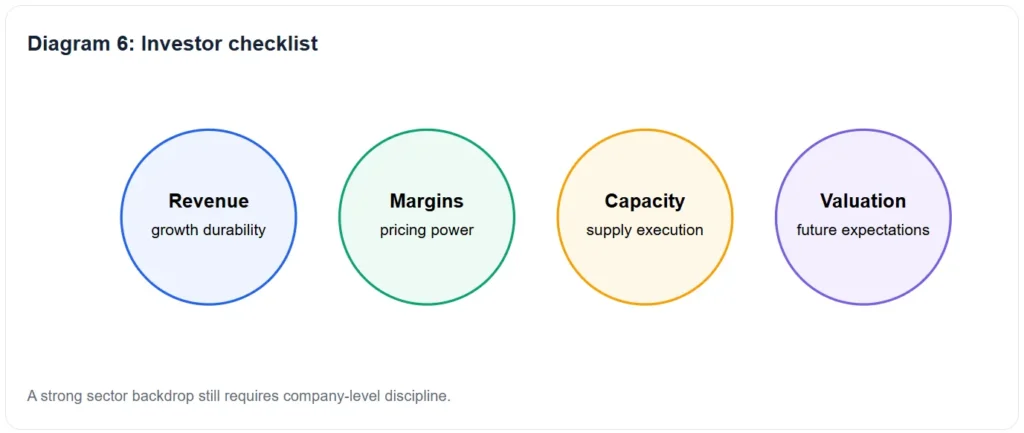
Investors should therefore separate industry growth from stock returns. Strong revenue does not guarantee attractive future returns.
What the market should watch next
The next phase depends on whether AI demand remains strong outside flagship GPUs. Current data suggest that shift is underway.
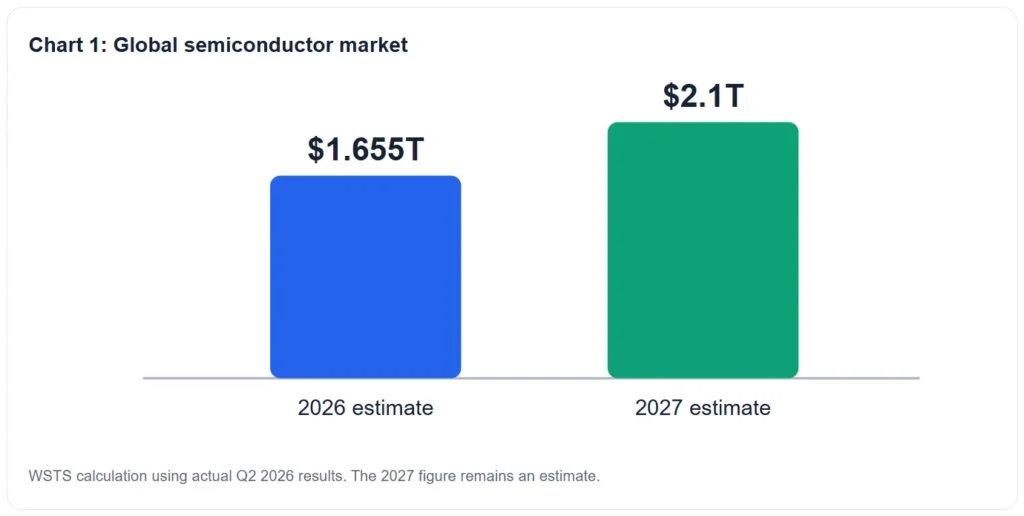
WSTS now calculates a $1.655 trillion semiconductor market for 2026. It sees about $2.1 trillion in 2027. That trajectory supports a wider opportunity set. However, stock selection should still focus on margins, execution and customer concentration.
The implied 2027 market growth is roughly 27%. That is slower than 2026, but still unusually strong. Therefore, investors should expect dispersion. Companies with durable pricing power may outperform simple volume beneficiaries.
Nvidia may remain the benchmark. Yet the semiconductor boom increasingly looks like an ecosystem trade rather than a single-stock story.