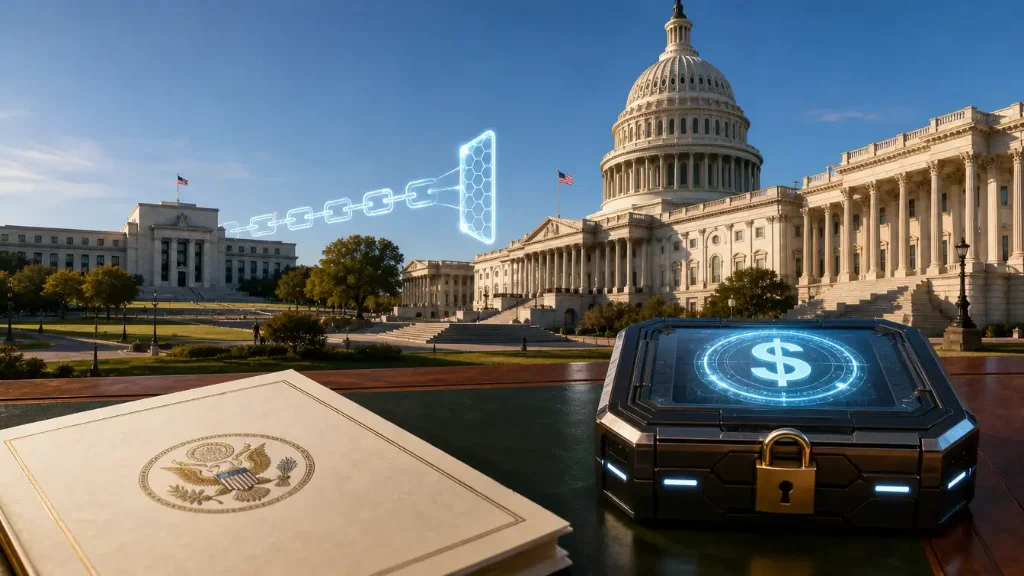


Catenaa, Sunday, July 12, 2026- The United States has taken its strongest legislative step yet against a central bank digital currency after a bipartisan housing bill containing a Federal Reserve CBDC ban automatically became law without President Donald Trump’s signature, closing the legal path for a US digital dollar unless Congress reverses its position.
The 21st Century ROAD to Housing Act entered into force after the constitutional 10-day review period expired without presidential action, despite Trump publicly stating he would withhold his signature in protest over unrelated election legislation.
The measure passed the Senate by 85-5 and the House of Representatives by 358-32, giving it overwhelming bipartisan support before reaching the White House.
While primarily focused on expanding housing affordability and financing, the legislation also includes a provision prohibiting the Federal Reserve from issuing a central bank digital currency.
The CBDC provision represents more than a policy decision on digital money.
It reinforces Congress’s authority over the future of sovereign digital currency in the United States.
Although the Federal Reserve has repeatedly stated it would not launch a CBDC without explicit congressional authorization, the new law goes further by legislatively blocking the central bank from moving ahead under its existing authority.
The result shifts the debate from regulatory discretion to statutory law, making congressional approval a prerequisite for any future US CBDC initiative.
The legislation also reflects the changing direction of US digital asset policy.
Rather than developing a government-issued digital dollar, lawmakers have increasingly supported privately issued, fully reserved stablecoins operating under federal regulation.
That approach accelerated with the passage of the GENIUS Act, which established a regulatory framework for payment stablecoins while leaving central bank digital currency outside the administration’s digital finance strategy.
Together, the two laws signal that Washington is placing greater emphasis on regulated private-sector innovation than on direct government participation in digital payments.
The decision further distinguishes the United States from several major economies that continue exploring central bank digital currencies.
Countries including China have advanced pilot programs for sovereign digital currencies, while other central banks remain in various stages of research and testing.
By contrast, the United States has now embedded congressional opposition to a retail CBDC into federal law, creating one of the clearest legislative rejections of a central bank-issued digital currency among major economies.
The move is likely to influence international debates over the future balance between public digital money and privately issued stablecoins.
Republican lawmakers have argued that a CBDC could expand government surveillance of financial transactions and threaten individual privacy.
Those concerns increasingly shaped negotiations surrounding broader digital asset legislation over the past two years.
Although the Federal Reserve consistently maintained it would require congressional approval before issuing a CBDC, Congress has now gone beyond requiring authorization by expressly prohibiting such issuance under current law.
Central bank digital currencies are digital versions of sovereign fiat currencies issued directly by central banks. Unlike privately issued stablecoins, CBDCs represent direct liabilities of the issuing monetary authority. The Federal Reserve began formally studying the concept in 2022 but repeatedly stated that it would not proceed without congressional approval. As US policymakers simultaneously developed legislation governing privately issued stablecoins, opposition to a Federal Reserve digital dollar grew among many lawmakers, particularly over concerns involving financial privacy and government oversight. The CBDC provision included in the 21st Century ROAD to Housing Act marks the clearest legislative expression of that policy shift.