

April 26, 2026 – The protocol redesigns its consensus layer to skip signature aggregation entirely, giving it a far simpler, cheaper path to post-quantum security than most competitors will ever have.
In Summary
Sonic’s SonicCS consensus avoids BLS aggregation, the core obstacle to quantum migration.
NIST published three finalised post-quantum standards in August 2024, including Dilithium (ML-DSA).
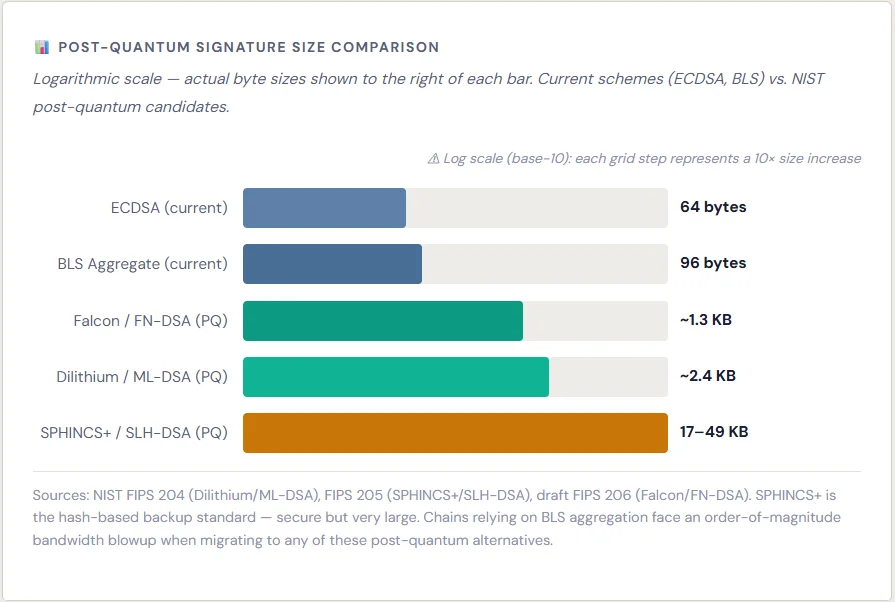
SPHINCS+ signatures can reach 17–49 KB, orders of magnitude larger than ECDSA’s 64 bytes.
SonicCS uses only two cryptographic primitives, making its upgrade path uniquely simple.
Most PoS chains that use BLS aggregation require deep architectural redesigns, not simple swaps.
Why Quantum Computing Threatens Blockchain Security
Elliptic-curve cryptography sits at the heart of nearly every major blockchain today. For example, networks like Ethereum, Solana, and Avalanche rely on ECDSA or Ed25519 to verify validators and sign transactions. Both schemes rest on one key idea: that the discrete logarithm problem is hard to solve.
A quantum computer running Shor’s algorithm breaks that idea. As a result, it can quickly solve the discrete logarithm. In other words, an attacker could pull private keys from public data, forge signatures, and steal funds at scale.
The timeline is uncertain. However, a 2016 NIST report cited experts warning that RSA could be broken by 2030. More recent estimates range from ten to fifty years. Even so, security researchers agree: waiting until the threat is real is already too late.
In contrast, hash functions resist quantum attacks far better. This difference is central to how Sonic builds its security edge.
The Aggregation Trap Holding Most Chains Back
Most proof-of-stake chains compress validator votes into a single certificate. To do this, they rely on BLS signatures and threshold signing schemes. As a result, hundreds of votes collapse into one small, easy-to-check object.
The problem, however, is severe. No NIST-approved post-quantum version of BLS aggregation exists today. Moreover, the quantum-safe options, Dilithium, Falcon, and SPHINCS+, do not compress well.
For protocols like HotStuff, Tendermint, or Narwhal, migration therefore means rewriting core consensus systems. Certificate layouts need a full redesign, and bandwidth models must also be rebuilt. All of this happens on live, billion-dollar networks, a process that takes years and carries serious risk.
SonicCS: Designed to Avoid the Trap
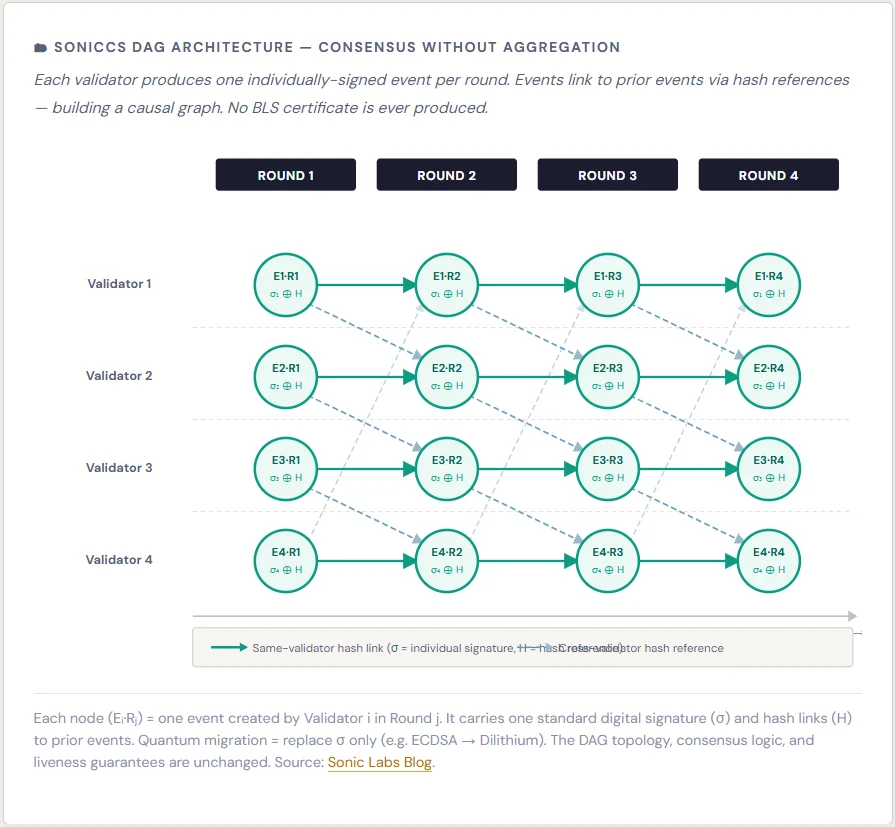
Sonic took a different design path from the start. Its consensus protocol, SonicCS, uses a directed acyclic graph (DAG) structure. In this model, each validator produces one signed event per round. Each event then links back to prior events via hash references.
“Whether sufficiently powerful quantum computers arrive tomorrow or in 50 years, the industry must be prepared.”
— Bernhard Scholz, Chief Research Officer, Sonic Labs
SonicCS produces no grouped certificates at all. There is no BLS, no threshold signing, and no randomness beacon built from pairing-based math. Instead, the protocol relies on exactly two building blocks: a digital signature scheme and a hash function.
When the industry moves to post-quantum standards, Sonic simply swaps the signature scheme. Crucially, the DAG structure, consensus logic, and liveness rules all stay the same.
NIST Has Already Published the Replacements
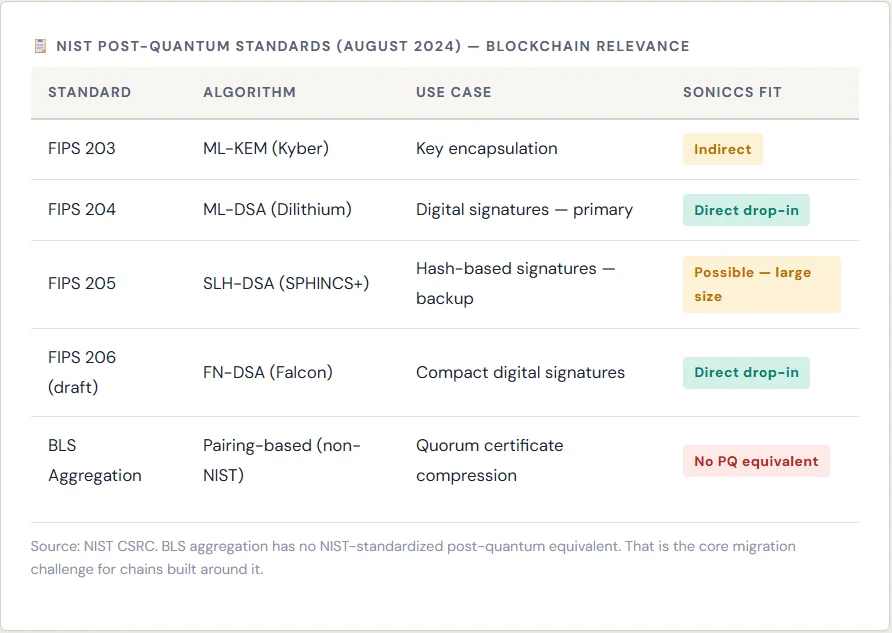
The security community has not been waiting. NIST finalised its first three post-quantum standards on August 13, 2024. Notably, these are ready for use right now, no waiting required.
For SonicCS specifically, migration would use Dilithium (ML-DSA) or Falcon (FN-DSA). FIPS 203, 204, and 205 were published in August 2024, while FALCON is progressing through FIPS 206. Both produce single, standalone signatures. As such, both fit cleanly into SonicCS’s per-event signing model.
What This Means for the Broader Crypto Market
Quantum computing is moving fast. Indeed, IBM, Google, and IonQ all publish annual roadmaps showing stronger processors each year. As a result, the threat to public-key security grows more real with every passing year.
Governments, meanwhile, are already taking action. The U.S. federal government has told agencies to migrate to NIST post-quantum standards. Similarly, financial regulators in Europe are issuing formal guidance. In short, the window for action is open right now.
Trillions of dollars in digital assets still depend on elliptic-curve security. Consequently, any network that cannot migrate smoothly faces a serious risk, and so do its users.
When regulators demand compliance, Sonic’s team simply swaps one signature scheme. By contrast, chains running HotStuff, Tendermint, or BLS-based DAG protocols face months, possibly years, of deep redesign work on live networks. This gap is not a minor detail; it is a structural one.
Furthermore, the Sonic team is closely tracking Ethereum’s path. Sonic has committed to following the Ethereum Foundation’s post-quantum roadmap and research, applying useful findings along the way. This keeps Sonic at the centre of the broader EVM quantum-readiness discussion.
The Bottom Line
Sonic is not the first blockchain to talk about quantum resistance. However, it may be the first to build its consensus layer around avoiding the main barrier to getting there.
Most PoS networks made sensible engineering choices to boost speed. Over time, though, those choices have built up as technical debt. Migrating to post-quantum security means paying that debt, in full, and in public.
SonicCS avoids that problem by staying simple. It uses just two building blocks: one signature per event and one hash reference per link. As a result, when the industry shifts to NIST post-quantum standards, Sonic ships a routine software update. Other chains, by contrast, must ship a full redesign.
The quantum threat may not arrive for ten years or more. Nevertheless, migration timelines for key financial systems run just as long. Therefore, the time to plan is now, not later.