

June 23, 2026 – The remittance giant now helps secure Solana, deepening a five-year shift onto blockchain payment rails.
In Summary
MoneyGram now runs an official validator on the Solana blockchain.
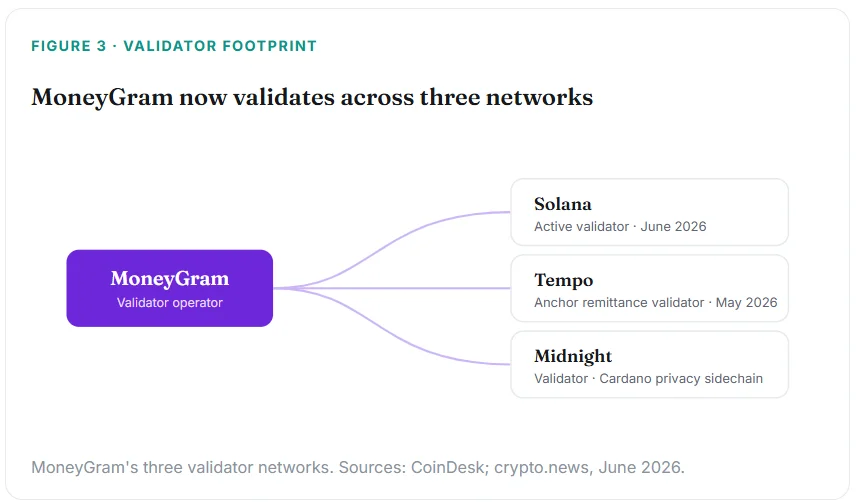
Solana becomes its third validator network, after Tempo and Midnight.
The firm also joined the Solana Developer Platform for institutions.
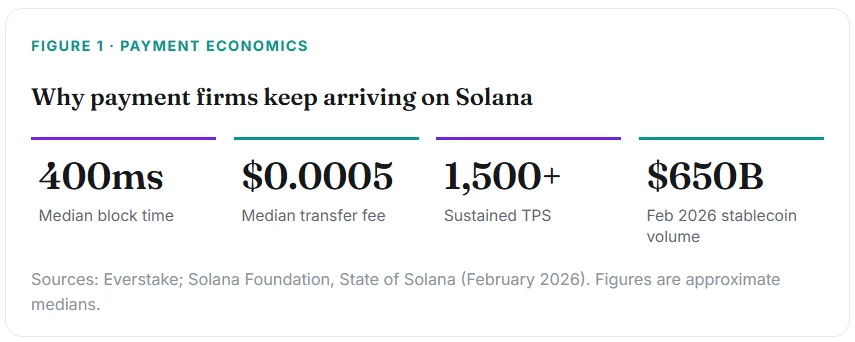
Solana offers near-instant blocks and fees close to $0.0005 per transfer.
The step follows MoneyGram’s launch of the MGUSD stablecoin on June 2.
MoneyGram has taken a validator role on Solana. The remittance giant now stakes SOL, processes blocks, and helps secure the network. This step turns a longtime blockchain user into a blockchain operator. Moreover, it marks the firm’s first formal move into Solana’s ecosystem.
A payments giant becomes an operator
The company confirmed the news on June 22, 2026. MoneyGram also joined the Solana Developer Platform, a toolkit for firms building financial products. That platform already hosts Mastercard, Worldpay, and Western Union. Luke Tuttle, MoneyGram’s product and tech chief, kept the logic plain. He said the company now helps run the rails it moves money on. In short, MoneyGram wants influence at the protocol level, not just access to it. Chairman and CEO Anthony Soohoo framed the shift as a duty. He argued that firms relying on a network should help secure it. By validating, he said, MoneyGram strengthens the network it now leans on.
Inside the Developer Platform
The platform is more than a badge. The Solana Foundation launched it in March 2026. It gives big firms an API-driven way to build compliant apps. Modules cover stablecoin issuance, payment routing, and onchain trading. More than 20 tech partners support it. Names include Anchorage Digital, Chainalysis, and Paxos. As a result, firms can ship products in weeks, not months. For MoneyGram, that toolkit could speed future launches.
Why Solana fits cross-border money
Solana appeals to payment firms because it is fast and cheap. Block times sit near 400 milliseconds. Median fees run close to $0.0005 per transfer, with throughput above 1,500 transactions per second. Those numbers matter for remittances. Families often send small sums across borders. Therefore, steep fees can swallow a large share of each transfer. Cheap, instant settlement changes that equation. Settlement speed also helps merchants and apps. Funds clear in under a second. That reliability supports payroll, payouts, and recurring billing.
Stablecoins strengthen the case
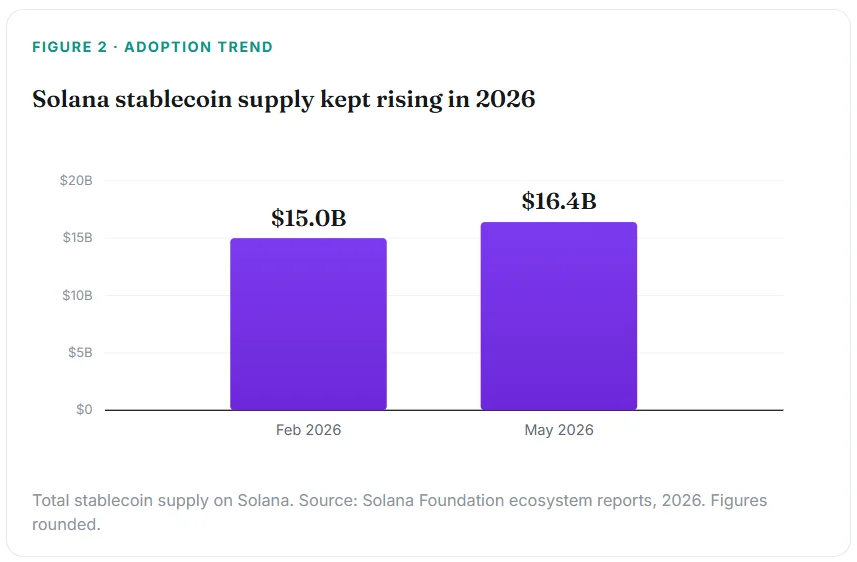
Stablecoin activity boosts Solana’s payments pitch. The network processed about $650 billion in stablecoin volume during February 2026, while supply held near $15 billion. That monthly total led every other blockchain. By May, the supply base had climbed toward $16.4 billion. Steady growth signals real usage, not passing hype. Solana still trails Ethereum on raw supply. However, each Solana dollar circulates far more often, because speed and low cost drive turnover. This velocity edge fits remittances well. Money should move quickly and cost little. Solana delivers both at scale.
A multi-chain bet, not one wager
MoneyGram refuses to rely on a single network. Solana now becomes its third validator chain, alongside Tempo and Midnight. Tempo is a payments-focused chain incubated by Stripe. Midnight is Cardano’s privacy-focused sidechain. This spread reflects a clear plan. The company wants to learn where stablecoin rails perform best. Consequently, it keeps several doors open at once.
Five years of steady building
The Solana move did not arrive from nowhere. MoneyGram has built blockchain products for about five years. Its partnership with Stellar started in 2021. A USDC cash service followed in 2022. Today, that service spans more than 170 countries and has a total volume of roughly $30 million. The firm also serves over 60 million active customers. That history gives the latest step real weight.
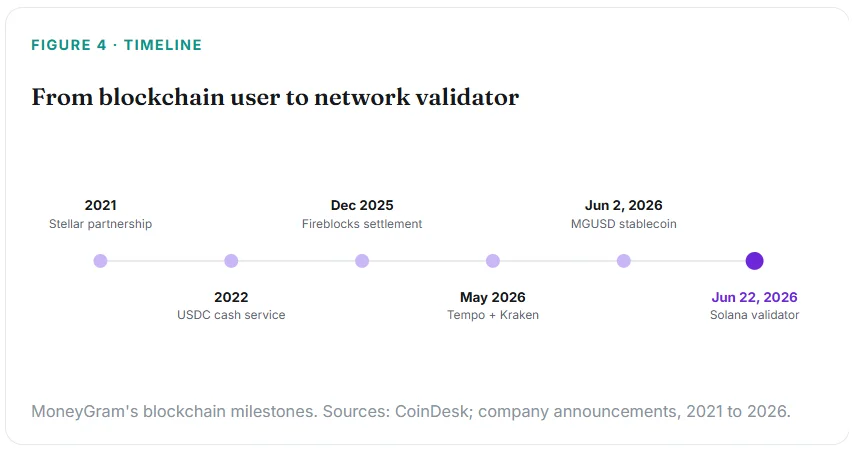
Recent months brought a faster pace. In December 2025, MoneyGram added Fireblocks for settlement. In May 2026, it joined Tempo and enabled Kraken cash-outs. Then on June 2, the firm launched MGUSD, its own dollar stablecoin. The Solana validator role landed just three weeks later. MGUSD did not appear overnight either. Bridge, a Stripe company, issues the token. M0 powers minting and burning. Fireblocks handles custody. The stablecoin launched first in the United States. Wider markets come next.
What the role really signals
Running a validator means more than running a server. Validators help decide who operates a network long term. As a result, a global payments brand lends weight to Solana’s push for big firms. Sheraz Shere of the Solana Foundation underlined that idea. He said large operators shape how on-chain payment activity moves. Still, the move does not launch a new consumer product today. Instead, it deepens MoneyGram’s role on public blockchains. It also gives the firm a direct hand in checking transactions. That access could shape future products. For Solana, the endorsement matters too. Payment brands rarely run nodes on chains they distrust.
The wider race for stablecoin rails
Traditional payment firms are rushing onto stablecoin rails. Western Union has rolled out its USDPT token on Solana. PayPal and Visa have also widened stablecoin settlement. Meanwhile, MoneyGram has aimed straight at consumer wallets. The next phase should reward integrated products. Wallets, compliance, settlement, and payouts must work as one system. MoneyGram already owns the hardest piece. It reaches real people in cash, across borders. That retail network is tough to replicate. Stablecoin rails could make it faster and cheaper.
Risks worth watching
The path still carries clear risks. Solana has suffered network outages in the past. Adoption must also last beyond the headlines. Rules remain a moving target too. The GENIUS Act gave US stablecoin issuers a federal framework. MGUSD relies on that framework through its issuer, Bridge. For now, the direction looks firm. A legacy remittance brand wants to help operate the rails it depends on. Whether the bet pays off will hinge on real adoption. Rivals add pressure as well. Banks and fintechs keep launching rival tokens. MoneyGram must prove its rails move faster and cost less. Trust, scale, and compliance will decide the winners.
The bottom line
MoneyGram has crossed a meaningful line. It no longer simply uses blockchains. Now it helps run three of them. That shift signals conviction, not curiosity. The company is betting that stablecoins will carry mainstream payments. Solana gives that bet a fast, low-cost home. The coming year will test the thesis.




