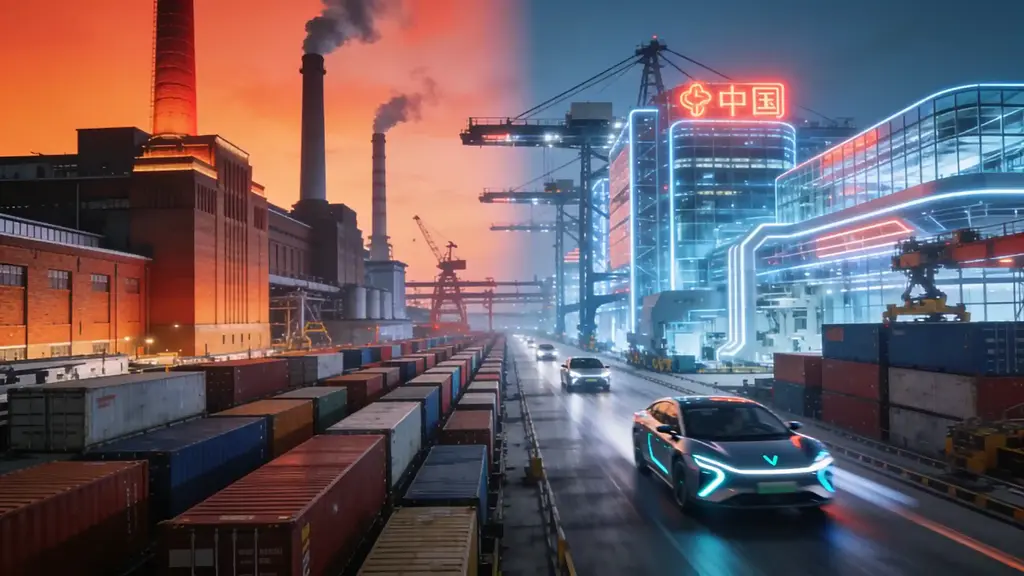


Catenaa, Tuesday, June 16, 2026- European leaders are confronting growing concerns that a surge in Chinese exports could trigger a new industrial crisis across the continent, as Beijing redirects goods previously destined for the United States into European and Asian markets following years of escalating American tariffs.
The issue emerged as a central topic at the G7 summit in France, where policymakers warned that China’s expanding manufacturing dominance is increasingly threatening European industries ranging from electric vehicles and batteries to machinery, chemicals and renewable energy equipment.
Despite eight years of tariffs and trade restrictions imposed by Washington, China recorded a record global trade surplus of approximately $1.2 trillion in 2025, highlighting the resilience of its export machine.
Economists have begun referring to the trend as “China Shock 2.0,” drawing comparisons with the wave of Chinese imports that entered Western markets after China joined the World Trade Organization in 2001.
Unlike the first China Shock, which mainly affected low-cost manufacturing sectors such as textiles and furniture, the latest phase targets higher-value industries that form the backbone of advanced economies.
Chinese firms now compete directly in electric vehicles, batteries, robotics, industrial machinery, software and advanced manufacturing equipment.
China’s share of global merchandise exports has increased from 4% in 2000 to roughly 16% today, making it the world’s largest exporter.
The pressure is particularly visible in Germany, Europe’s largest economy and manufacturing powerhouse.
German companies that once relied heavily on exports to China are now facing growing competition from Chinese rivals in sectors including automobiles, chemicals and industrial equipment.
Germany’s economy contracted in both 2023 and 2024 before recording only modest growth of 0.2% in 2025, reflecting broader challenges facing Europe’s industrial sector.
Trade data also points to a widening imbalance.
Chinese exports to the European Union rose 16.4% during the first five months of 2026 compared with the same period a year earlier.
France’s trade deficit with China increased to $5.3 billion from $3.3 billion over the same period, according to Chinese customs statistics.
European leaders increasingly argue that China’s domestic economic policies contribute to the problem.
State-backed lending, industrial subsidies and a weak consumer spending environment have encouraged Chinese manufacturers to continue expanding production capacity despite slowing domestic demand.
As a result, excess output is being exported to overseas markets at highly competitive prices.
The concern for Europe is that prolonged pressure from low-cost imports could weaken strategic industries that governments are actively trying to develop, including electric vehicles, renewable energy technologies and advanced manufacturing.
Several economists warn that the situation could trigger a broader wave of protectionist measures.
The European Union already imposes tariffs of up to 35% on Chinese electric vehicles, but further trade barriers are increasingly being discussed.
A coordinated response involving the European Union, Canada, Japan and the United States is also emerging as a possible outcome of ongoing G7 discussions.
For global markets, the implications extend beyond trade policy.
A widening confrontation between Europe and China could reshape supply chains, influence inflation trends and alter investment flows across manufacturing, technology and energy sectors.
For cryptocurrency markets, slower global growth and heightened trade tensions could affect risk appetite, while any acceleration in economic fragmentation may further strengthen interest in alternative settlement systems, tokenized assets and cross-border digital payment networks.
China’s export surge has evolved from a trade challenge into a strategic economic issue for Europe. Whether policymakers choose tariffs, industrial subsidies or deeper cooperation with allies, the response could shape global manufacturing and trade patterns for years to come.
The original “China Shock” followed China’s accession to the World Trade Organization in 2001. Research later estimated that Chinese import competition contributed to the loss of approximately 2.4 million US jobs. Today’s “China Shock 2.0” differs because China now dominates global manufacturing and increasingly competes in advanced industries rather than low-cost consumer goods. As Western governments invest heavily in electric vehicles, batteries, artificial intelligence infrastructure and clean energy technologies, competition from Chinese manufacturers has become a major geopolitical and economic concern.