

April 30, 2026 – Backed by PayPal Ventures and General Catalyst, Kite is engineering the financial rails AI agents need at near-zero cost and sub-100ms speed.

AI agents are learning to work. But they cannot yet pay for anything, at least not efficiently. Legacy payment infrastructure was built for humans. It demands KYC verification, manual authorisation, and days-long settlement windows.
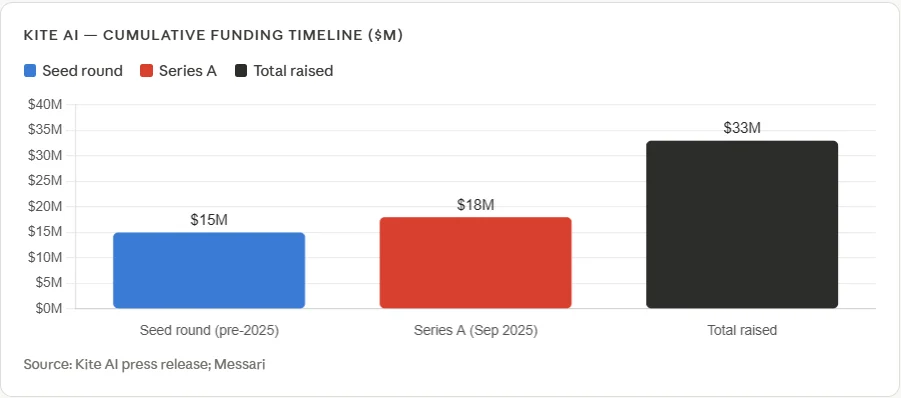
Kite AI wants to fix that. The company is building a Layer-1 blockchain designed from the ground up for AI agent payments. On September 2, 2025, Kite closed an $18M Series A, lifting total capital raised to $33M.
The round was led by PayPal Ventures and General Catalyst. Other investors include 8VC, Samsung Next, HashKey Capital, and Animoca Brands.
The Problem: Legacy Rails Block Agent Commerce
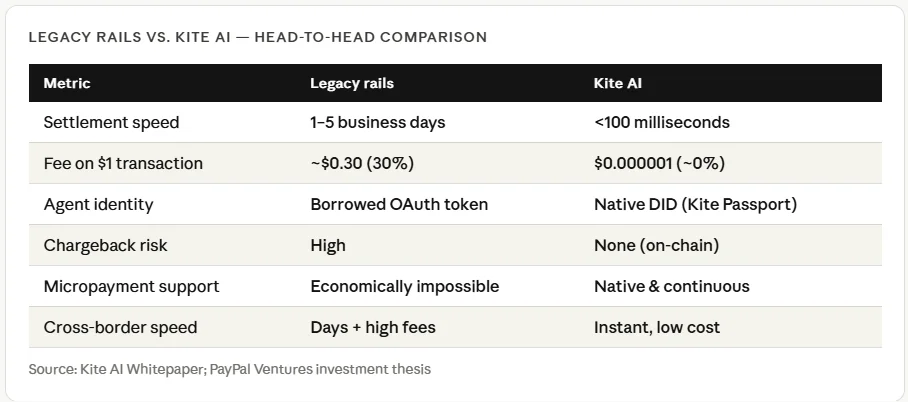
Today’s autonomous agents face a brutal paradox. They can analyse markets in microseconds. But they must wait days for a cross-border payment to settle.
Kite’s whitepaper shows that processing a $1 payment on legacy rails can cost $0.30 or more. That is 30% overhead, unworkable for micro-transaction-heavy AI workloads.
PayPal Ventures’ investment thesis states it plainly: agents today lack first-class identities. They borrow OAuth tokens from users. This breaks down into complex, multi-hop workflows.
How Kite’s infrastructure works
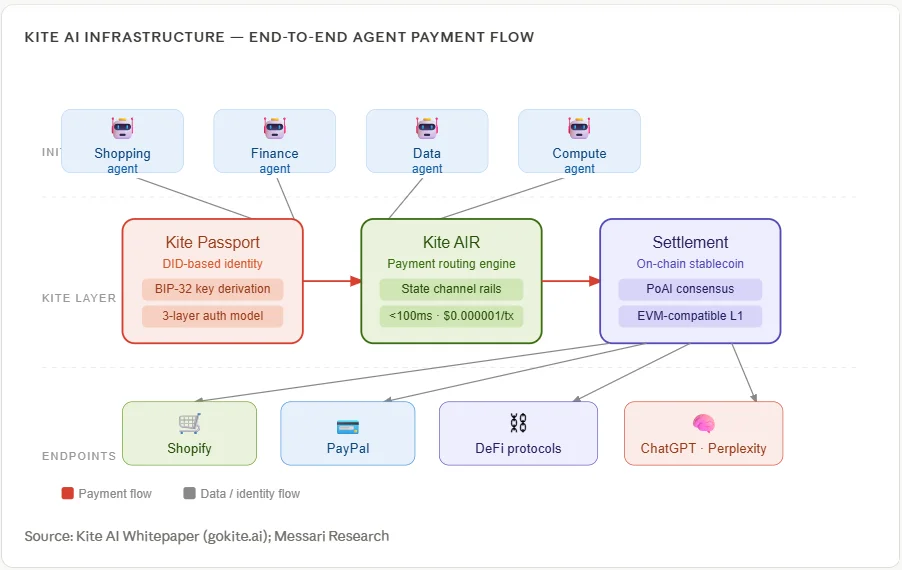
Kite sits as a universal middleware layer between AI agents and commerce platforms. The architecture has three core components working in sequence. Each solves one of the three fundamental failures of existing systems.
1. Kite Passport agent identity
The Passport is a decentralised identifier system for AI agents. It uses a three-layer identity model: user (root authority), agent (delegated authority), and session (ephemeral authority). Agents get cryptographic credentials, not borrowed login tokens.
2. Kite AIR: payment routing engine
AIR routes payments through state channels. It delivers sub-100ms latency at roughly $0.000001 per transaction. This makes AI micropayment streams economically viable for the first time.
3. On-chain stablecoin settlement
Proof of Artificial Intelligence (PoAI) is Kite’s consensus mechanism. It attributes and rewards contributions across agent actions. Settlement happens on an EVM-compatible Layer-1 with no chargeback risk.
“Payment has proven to be a challenging technical gap. Kite bridges this by providing stablecoin-based, millisecond-level settlement with low fees and no chargeback fraud.”
— Alan Du, Partner at PayPal Ventures (PayPal Newsroom)
The market opportunity: a $4.4 trillion bet
McKinsey Global Institute estimates that generative AI will generate $2.6 to $4.4 trillion in annual economic value. Autonomous agents are positioned to capture most of that uplift.
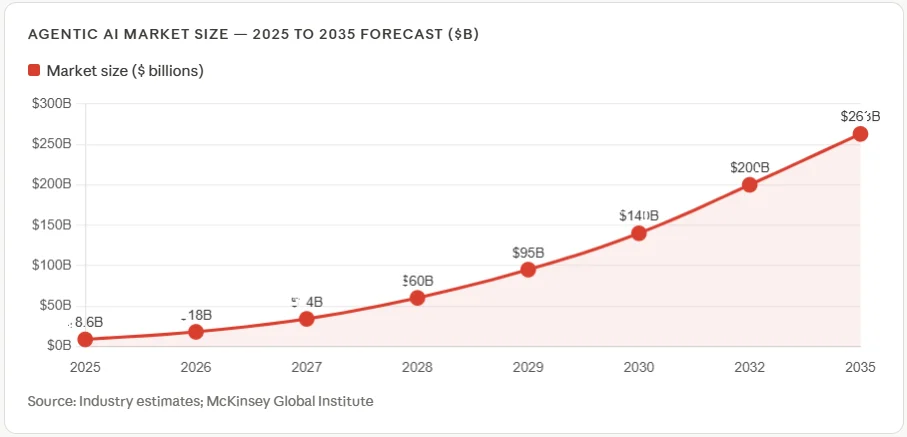
The agentic AI systems market sits at $8.6B in 2025. By 2035, estimates put it at $263B, a 30x expansion in a decade. Kite believes that payments are the critical bottleneck slowing this growth.
KITE Token: Debut and Tokenomics
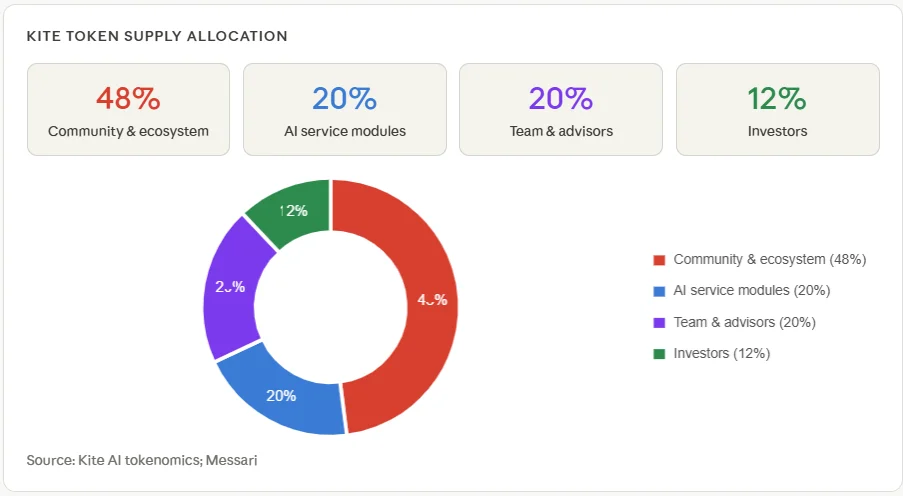
The KITE token launched on November 3, 2025. It hit $263M in trading volume in its first two hours. The token debuted simultaneously on OKX, Bitget, and HTX.
Risks and competitive landscape
Kite is not alone. Stripe launched its own Layer-1, Tempo, targeting programmable payments. Visa and Mastercard have both announced AI agent payments.
Adoption remains far from guaranteed. Most autonomous agent deployments today are experimental. Regulatory risk is real, stablecoin legislation is evolving rapidly in the US and EU.
What comes next
Kite’s mainnet launched in Q4 2025. Phase two focuses on growing the Agent App Store and Passport adoption. Phase three accelerates through ecosystem partnerships.
A cross-chain bridge via LayerZero is live. Liquid staking, a perpetuals DEX, and a borrow/lend protocol are planned. These additions would turn Kite from a payment rail into a full DeFi stack for AI agents.
“Agents will become as ubiquitous and impactful as the Web itself. Realising this requires a re-architecture of foundational digital infrastructure.”
— PayPal Ventures, investment thesis on Kite AI