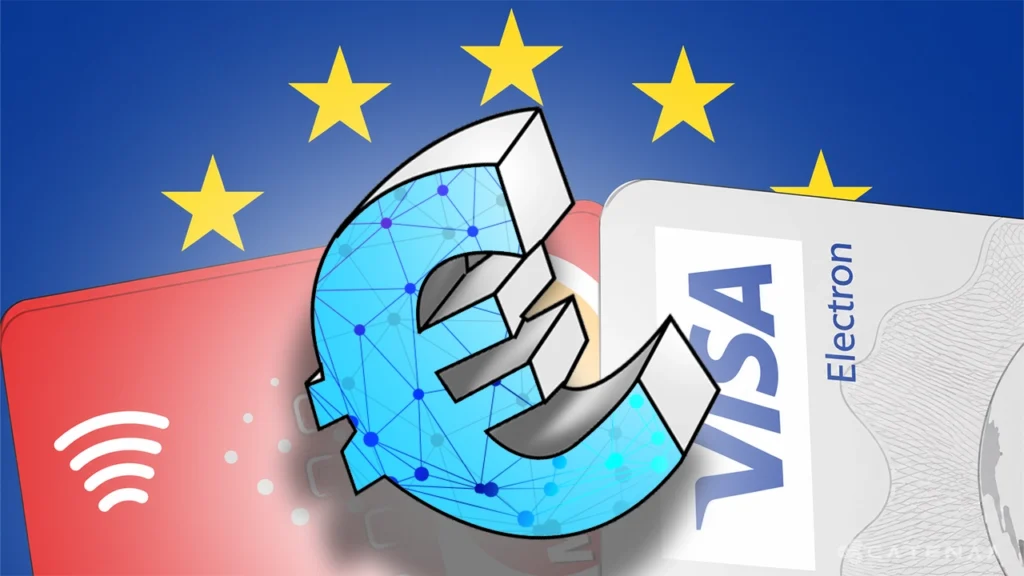


April 27, 2026 – The European Central Bank is building the digital euro on open, European-made technical rails. It aims to break the dominance of global card networks.
On April 24, 2026, the ECB signed agreements with three European standard-setting bodies. These deals let any payment provider use the existing open standards for free. The goal is a shared, non-proprietary foundation for digital euro transactions. As a result, this directly challenges the proprietary systems of Visa and Mastercard.
Three Standards, Three Layers of a New Payment Stack
The agreements stitch together three distinct layers of the payment process. First, for contactless tap-to-pay, the system will use the CPACE standard developed by ECPC. This handles near-field communication between a phone and a terminal. Next, for merchant acceptance and ATM transactions, Nexo standards will connect shop systems to their back ends. Finally, for account-based transfers, the Berlin Group’s framework will allow payments using aliases like a mobile phone number. Moreover, it supports balance checks and in-app purchases.
Crucially, this is not a theoretical exercise. Roughly 80% of the European market already uses the Berlin Group’s API standards under the PSD2 directive. By building on widely adopted infrastructure, the ECB aims to slash implementation costs. Consequently, this encourages early coordination among banks, fintechs, and merchants.

A Direct Hit on Visa and Mastercard
The strategic intent is surprisingly clear. Europe currently lacks a single open standard across payment terminals. In turn, this gap leaves the region dependent on proprietary systems run by international card schemes. By adopting open standards, a national card scheme could expand to point-of-sale environments outside its home market. It can do this without costly terminal upgrades. For instance, Wero, a European payment initiative, explicitly aims to reduce reliance on Visa, Mastercard, and PayPal. Therefore, this move makes it easier for new European providers to enter the market.
ECB Executive Board member Piero Cipollone framed it as a choice. “The open digital euro standards will provide a European free alternative to current proprietary standards,” he said. In other words, providers get the certainty they need to invest, innovate, and compete across the euro area.
Regulation Gates the Rollout
However, the technical deals mean little without a legal foundation. The benefits will only materialise once EU co-legislators adopt the digital euro regulation. This legal certainty confers legal tender status on the digital euro across the bloc. Meanwhile, the timeline remains tight. The Eurosystem aims to be ready for a potential first issuance by 2029. A pilot exercise could start in 2027. Yet all of this depends on legislation being passed in 2026.
A critical vote in the European Parliament is expected this summer. Joel Hugentobler, cryptocurrency analyst at Javelin Strategy & Research, cautioned that success depends on pilot testing and adoption. “This is progress, but not momentum yet,” he said. “Until legislation and distribution are dialled in, 2029 is anything but a certainty.”

Geopolitical Stakes: Digital Sovereignty in the Age of Stablecoins
Furthermore, the standards push is not just about payment fees. The broader context is a race for monetary sovereignty. The U.S. has already passed the GENIUS Act, creating a regulatory framework for dollar-pegged stablecoins. Consequently, the $288 billion stablecoin sector is dominated by dollar-denominated assets. This has sparked deep concern in Brussels. Specifically, EU policymakers fear that dollar-pegged tokens could tighten America’s grip on cross-border payments.
The digital euro is envisioned as that anchor. It is a sovereign, risk-free central bank liability. Similarly, it would function as a digital form of cash complementary to banknotes, not a replacement. The ECB has also confirmed it will allow blockchain-based transactions to settle in central bank money in 2026. This opens the door to exploring decentralised technologies, though privacy debates remain unresolved. By combining open standards with legal tender status, the ECB is betting on a uniquely European model. The technical pieces are now on the board. Ultimately, the final move belongs to lawmakers.




