

July 02, 2026 – The restart of Fable 5 and Mythos 5 shows how frontier AI access now depends on security proof, not only product demand.
In Summary
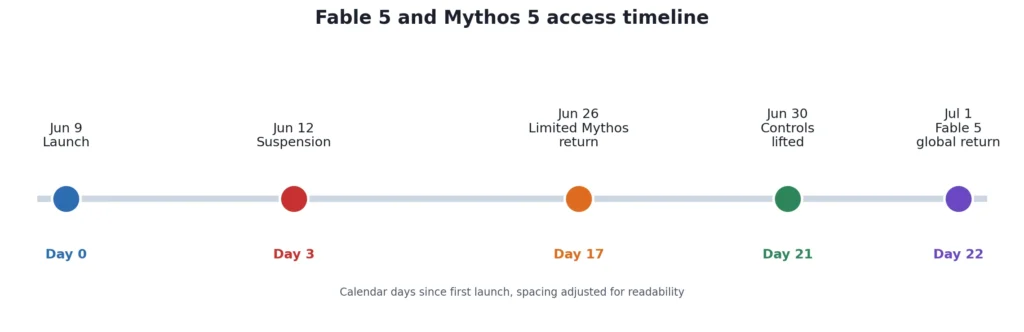
Export controls on Fable 5 and Mythos 5 were lifted on June 30.
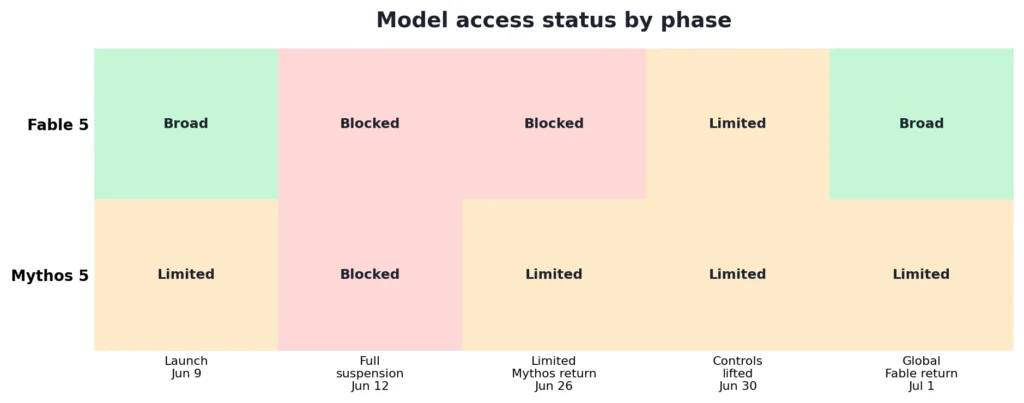
Fable 5 returned globally on July 1 across several user channels.
Mythos 5 access remains focused on vetted cyber defenders.
A new classifier blocks the reported bypass in over 99% of cases.
The case may shape future rules for the release of advanced AI models.
Anthropic AI models Fable 5 and Mythos 5 are back in focus. The U.S. government lifted export controls on June 30. That decision ended a short but important disruption for frontier AI users.
The company said Fable 5 would be available globally from July 1. It will return through Claude Platform, Claude.ai, Claude Code, and Claude Cowork.
The reversal matters because it sets a sharper test for AI deployment. Developers now need clear safeguards, audit trails, and government confidence.
What changed after June 12?
The access freeze started on June 12. The company said the order required it to restrict access by foreign nationals. Since it could not verify nationality in real time, it suspended both models for all users.
That original statement said the government cited national security authorities. It also linked the issue to a reported bypass of Fable 5 safeguards. The company disagreed with a full recall, but complied with the directive.
The commercial impact was immediate. Fable 5 had been positioned as a general model with Mythos-level capability. It also carried stronger safeguards for broader use.
Its launch on cloud infrastructure highlighted software engineering, knowledge work, vision, and long-running tasks. However, AWS later noted access became unavailable on June 12 for compliance reasons.
Why the model split matters
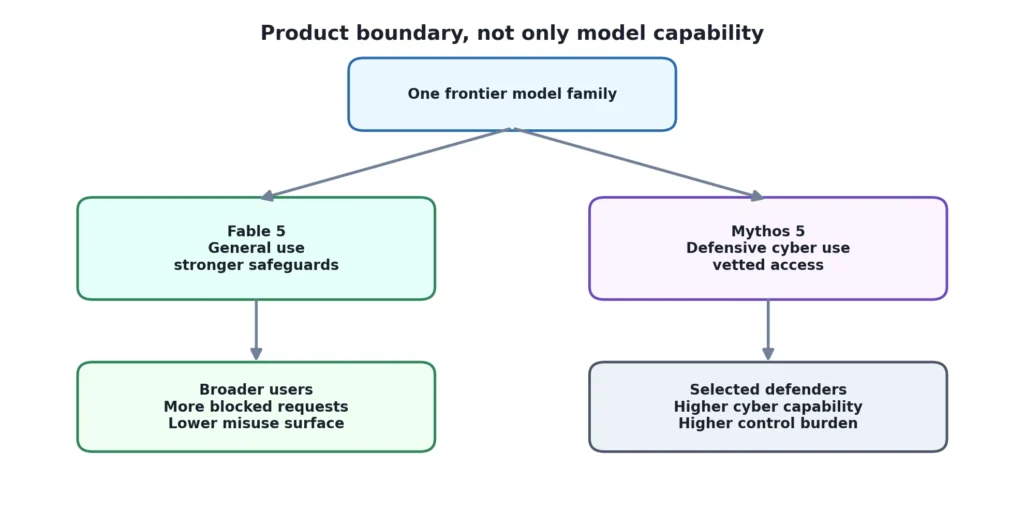
Fable 5 and Mythos 5 share the same underlying model family. Yet they serve different risk profiles. Fable 5 uses stronger safeguards for general users. Mythos 5 offers fewer restrictions for selected cyber defense partners.
That split gives policymakers a cleaner control lever. They can limit the riskiest capabilities without blocking every mainstream user. However, it also raises questions about access.
Banks, software firms, telecom operators, and public agencies need powerful tools for vulnerability discovery. At the same time, regulators fear misuse by hostile actors.
The government allowed a limited return of Mythos 5 on June 26. Later, the broader lifting of controls followed new safeguards and stronger government collaboration.
The safeguard tradeoff
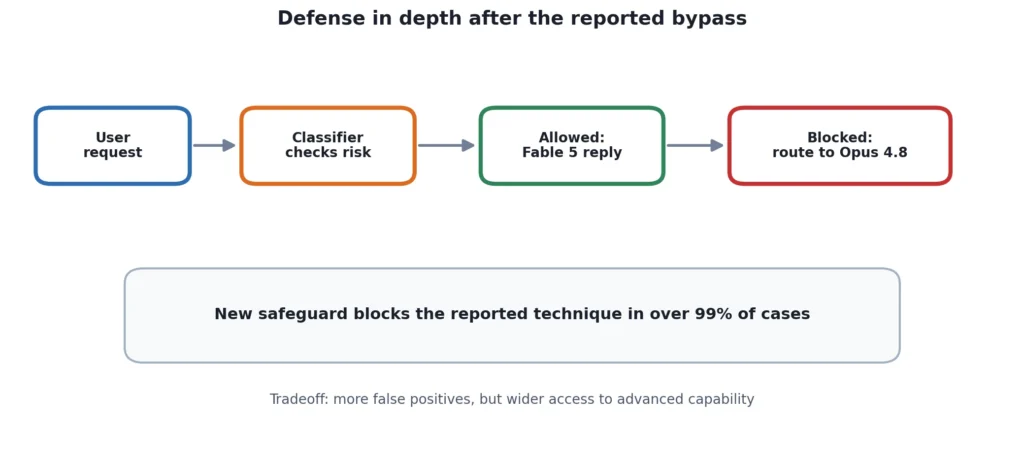
The main technical fix was a stronger safety classifier. The company said the new classifier blocks the reported technique in over 99% of cases. Blocked Fable 5 requests will route to Opus 4.8.
This creates a visible user tradeoff. More benign requests may face friction. Yet the company sees that cost as necessary for wider availability.
The approach resembles a bank’s risk filter. A strict filter blocks some good transactions. Still, it may prevent larger losses. In AI, the equivalent loss could be cyber misuse at scale.
Importantly, the company warned that perfect jailbreak resistance remains unlikely. Its earlier statement said no universal jailbreak had been found, but narrow jailbreaks remain possible.
A new policy template
This episode may become a template for frontier AI oversight. The June 2 executive order created a voluntary framework for covered frontier models. It also asked agencies to build cyber capability benchmarks.
The order says developers may provide government access before wider release. It also supports early access for trusted partners. Therefore, model launches may start looking like regulated product rollouts.
That does not mean every model needs a license. The order says it does not create mandatory preclearance. However, the Fable and Mythos case shows that informal pressure can still be powerful.
For investors, the key issue is deployment certainty. Frontier AI firms need predictable rules before they scale enterprise revenue. A surprise access halt can disrupt cloud partners, developers, and customers.
What comes next
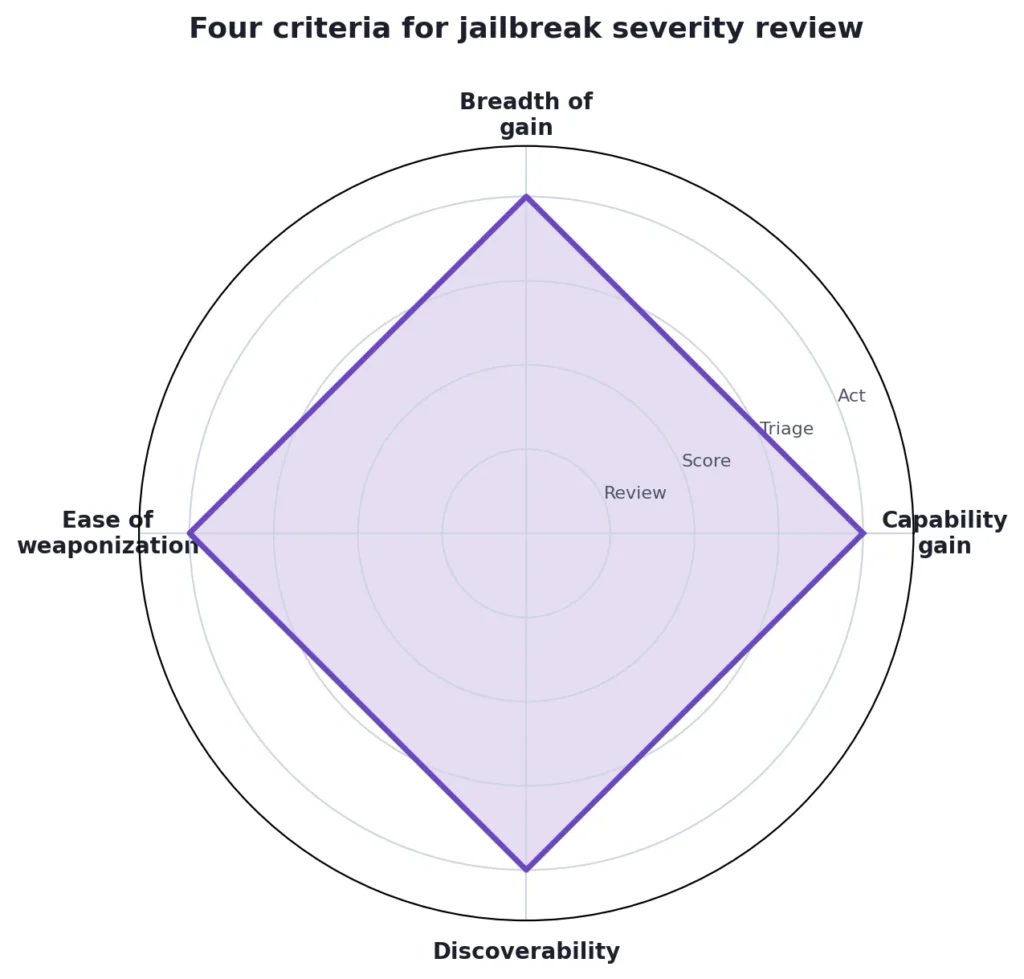
The next stage is standards. The company says it is working with major cloud and AI partners on a shared framework. That framework aims to score jailbreak severity based on capability gain, breadth, ease of weaponization, and discoverability.
The return of Fable 5 and Mythos 5 is not just a product update. It is a signal. Advanced AI access will depend on proof that capability and control can scale together.