


April 06, 2026 – Japan’s top crypto self-regulator has locked 31 digital assets into a fast-track compliance system. Here is what that means for exchanges, investors, and the future of regulated crypto markets.
In Summary
Japan’s JVCEA Green List covers 31 tokens as of April 2, 2026, fast-tracked via FSA delegated authority, bypassing lengthy individual reviews.
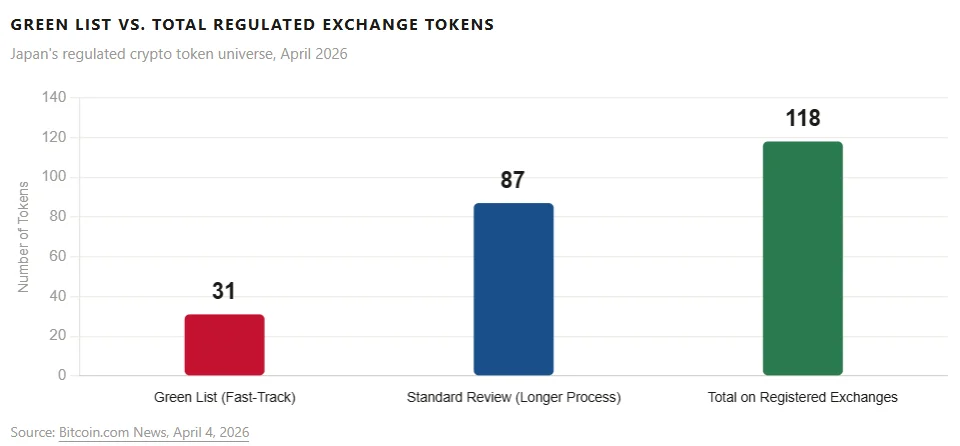
Of the 118 tokens available on registered Japanese exchanges, only 31 (26%) hold Green List status, signaling the highest tier of regulatory credibility.
Proposed 2027 reforms would cut the crypto tax rate from up to 55% to a flat 20% and reclassify digital assets as financial products under Japanese law.
JVCEA membership is technically voluntary but near-mandatory in practice; non-members face restricted listings, Travel Rule exclusion, and banking barriers.
Japan is reshaping how crypto assets are listed, traded, and taxed. Specifically, the Japan Virtual and Crypto Assets Exchange Association (JVCEA) maintains a curated “Green List” of approved tokens. As of April 2, 2026, the list covers 31 assets. Furthermore, Japan’s top financial watchdog, the Financial Services Agency (FSA), actively backs the framework. As a result, the Green List now stands as a cornerstone of Japan’s crypto regulation.

What Is the JVCEA Green List?
In essence, the Green List is an officially recognised registry of compliant crypto tokens. The JVCEA, Japan’s premier crypto self-regulatory body, curates and updates the list. Tokens that qualify earn fast-track listing approval on member exchanges. Consequently, they bypass the lengthy review process that unlisted tokens face. Speed delivers the commercial advantage. Above all, regulatory credibility delivers the strategic one.
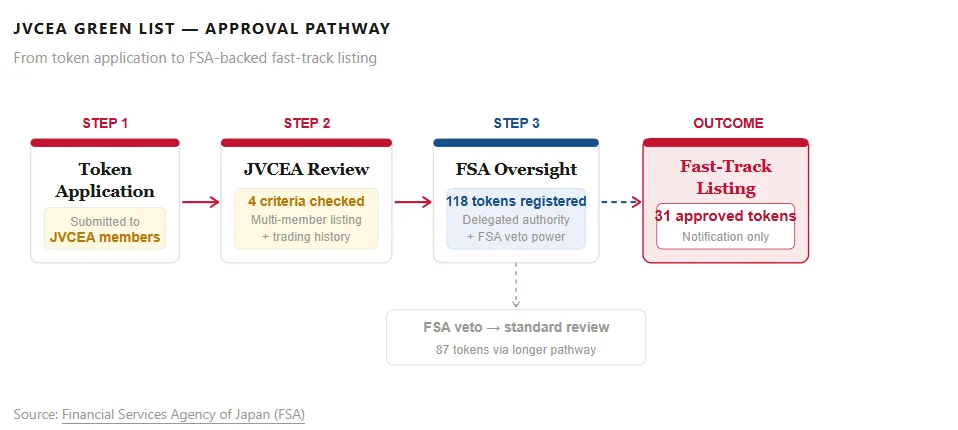
To make the Green List, a token must satisfy four eligibility criteria:
- It must be listed across multiple JVCEA member companies.
- It must have a sustained and verifiable trading history.
- It must not carry any imposed handling conditions from regulators.
- It must raise no concerns that would justify removal.
The 31 Approved Tokens: A Category Breakdown
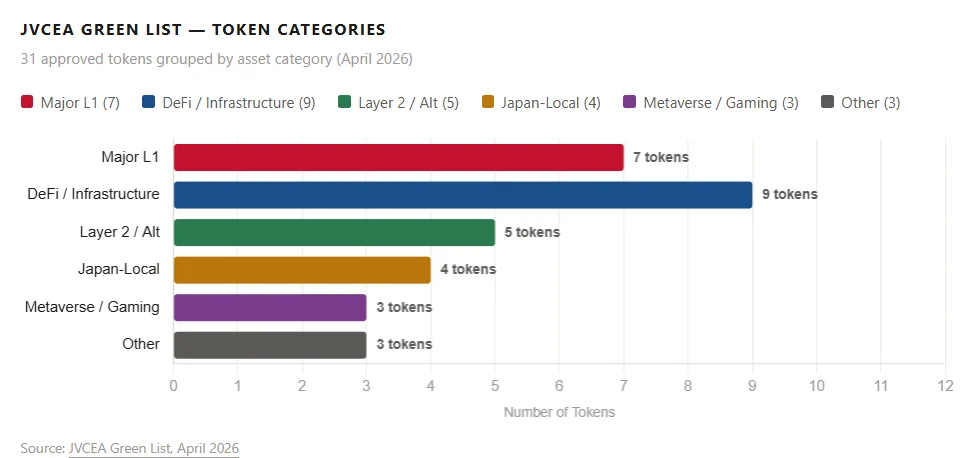
Together, the Green List spans five asset categories. Major Layer 1 cryptocurrencies dominate. Bitcoin (BTC), Ethereum (ETH), and Ripple (XRP) lead the group. Litecoin (LTC), Bitcoin Cash (BCH), Stellar (XLM), and Ethereum Classic (ETC) also make the cut. Meanwhile, DeFi and infrastructure tokens form the largest block by count. For instance, Polkadot (DOT), Maker (MKR), Algorand (ALGO), and Filecoin (FIL) all qualify. Finally, Japan-local tokens, including Mona Coin (MONA) and the ZPG family, round out the list.
Why JVCEA Membership Is Near-Mandatory
Joining the JVCEA is technically voluntary. However, Japan’s Financial Services Agency (FSA) strongly incentivizes membership. Exchanges seeking FSA registration must demonstrate robust self-regulatory compliance. Yet establishing that standard independently proves extremely difficult. Therefore, most exchanges adopt JVCEA standards to satisfy this requirement efficiently.
Exchanges that skip membership face three major barriers. First, they lose access to fast-track token listing pathways. Second, Travel Rule compliance networks exclude them entirely. Third, they struggle to secure banking relationships. In short, the costs of non-membership are steep.
“The FSA retains veto power. It can block any asset that poses emerging risks regardless of Green List status.”
118 Tokens on Regulated Exchanges: The Bigger Picture
The Green List, however, does not represent Japan’s full regulated token universe. As of April 2026, registered domestic exchanges trade 118 unique tokens. That means 87 tokens still follow the standard, slower review pathway. In contrast, the Green List concentrates on the most liquid and scrutinized assets. Consequently, retail investors treat Green List tokens as implicitly endorsed by regulators.
The JVCEA Approval Pathway
To understand the process, the diagram below traces how a token moves from application to fast-track exchange listing under Japan’s regulatory framework.
Japan’s 2027 Reform: Crypto Becomes a Financial Product
Japan’s parliament, the Diet, is currently reviewing sweeping crypto legislation. Specifically, the 2026 Tax Reform Proposals aim to reclassify crypto as a regulated financial product. As a result, digital assets would sit alongside stocks and bonds under the Financial Instruments and Exchange Act. Moreover, the proposals introduce a flat 20% tax rate on crypto gains. Currently, gains can be subject to up to 55% tax under the miscellaneous income rules. In addition, insider trading restrictions fall within the scope of these reforms. Consequently, enforcement will begin on January 1, 2027.
Together, these reforms mark a fundamental structural shift. Japan would treat crypto with the same legal seriousness as traditional capital markets. Indeed, the FSA-JVCEA framework already provides the regulatory scaffold for that transition. Therefore, the Green List becomes the mechanism that makes fast compliance possible at scale.
What This Means for Global Investors
The JVCEA Green List is more than an approved token registry. Rather, it signals which assets meet Japan’s highest compliance bar. For foreign blockchain projects, Green List status has therefore become a strategic priority. Moreover, it unlocks access to one of Asia’s most liquid regulated crypto markets. For investors, it provides a level of due diligence that few other markets offer.
Japan’s model is drawing global attention. Indeed, with 31 assets on the Green List, 118 tokens on regulated exchanges, and landmark 2027 reforms incoming, Japan is building one of the world’s most structured digital asset frameworks. As a result, regulators in the EU, UK, and Southeast Asia are watching closely.