

April 08, 2026 – The Office of the Comptroller of the Currency has cleared Coinbase to form a federally supervised trust company. The move consolidates U.S. crypto custody under one regulatory roof, and opens doors to payments.
In Summary
The OCC conditionally approved Coinbase National Trust Company on April 3, 2026.
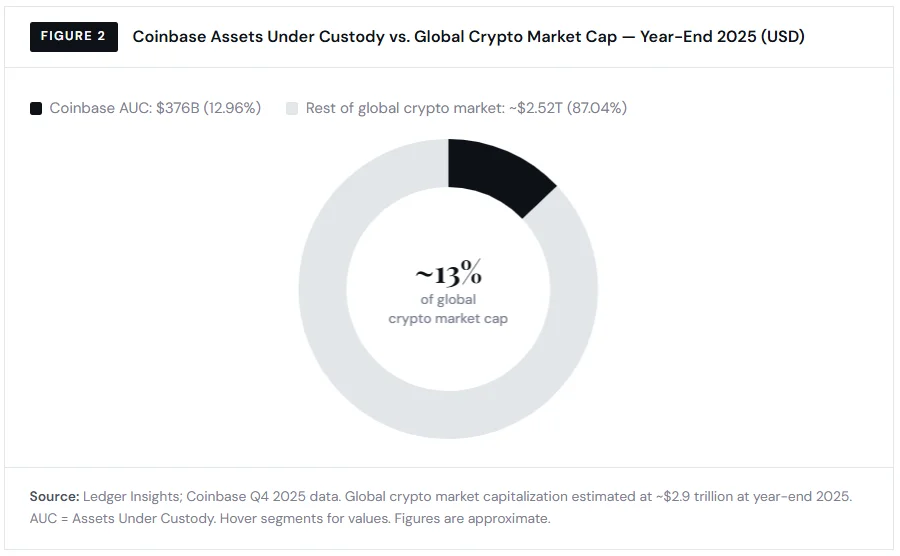
Coinbase holds $376B in crypto assets, nearly 13% of global market cap at year-end 2025.
The charter covers custody, staking, and fiduciary services. It excludes retail deposits and fractional reserve lending.
Six crypto firms now hold conditional OCC trust charters: Circle, Ripple, BitGo, Fidelity Digital, Paxos, and Coinbase.
Coinbase must meet OCC pre-opening requirements before the charter becomes fully operational.

The U.S. Office of the Comptroller of the Currency (OCC) has granted conditional approval to Coinbase. The approval establishes Coinbase National Trust Company under federal oversight. It represents one of the most consequential regulatory moves in U.S. crypto history.
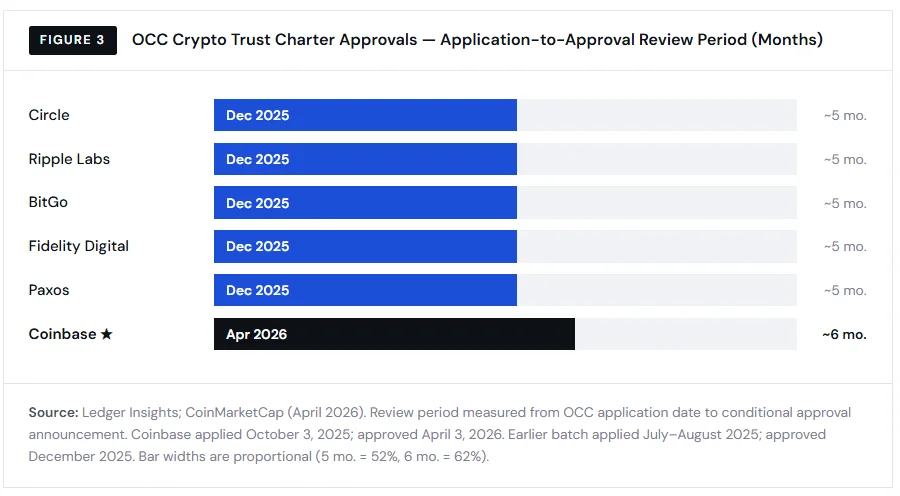
Coinbase filed its national trust charter application on October 3, 2025. The OCC took approximately six months to review the application. That timeline is slightly longer than the five-month review for earlier applicants. Analysts say the extra time reflects the scale and complexity of Coinbase’s custody operations.
What the Charter Actually Grants
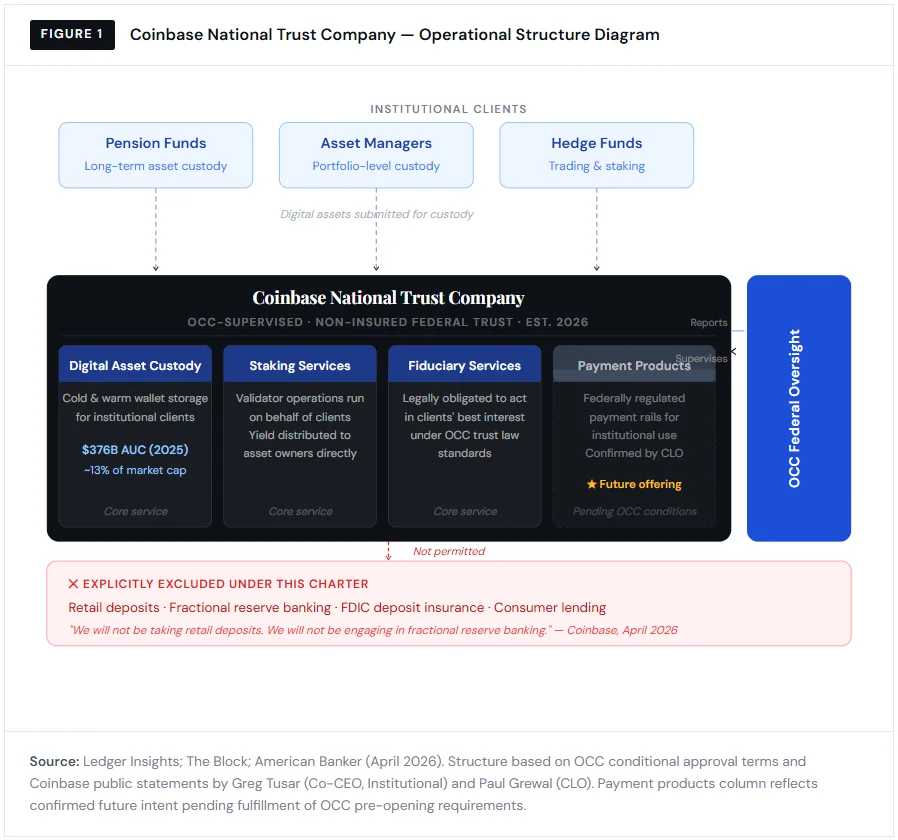
A national trust charter is not a commercial banking license. Coinbase will not accept retail deposits. It will not engage in fractional reserve banking. The charter applies to custody, staking, and fiduciary services only. It also creates a federal pathway for future payment products.
Previously, Coinbase operated under state-level regulation from the New York Department of Financial Services (NYDFS). The OCC charter replaces that patchwork with a single federal framework covering all 50 states. That shift is critical for institutional clients. Pension funds and asset managers increasingly require federally supervised counterparties.
“This charter is about bringing federal regulatory uniformity to the custody and market infrastructure business we have been building for years.”
— Greg Tusar, Co-CEO, Coinbase Institutional
How the Trust Company Operates
The trust company sits between institutional clients and the federal regulatory system. It is not a bank. It is a federally supervised non-insured custodian. Figure 1 shows its full operating structure, clients, services, oversight, and what is explicitly excluded.
The Scale Behind the Approval
The numbers underscore why this approval matters. Coinbase held $376 billion in crypto assets under custody at year-end 2025. That figure represents nearly 13% of total global crypto market capitalization. No U.S. exchange comes close to that custody footprint.
This scale makes federal oversight both logical and commercially valuable. Institutions want a custodian regulated at the federal level. The OCC charter gives Coinbase that credential directly.
The OCC’s Growing Crypto Approval Wave
Coinbase is not the first crypto firm to win OCC approval. In December 2025, the OCC approved five firms in a single batch: Ripple Labs, BitGo, Circle, Fidelity Digital Assets, and Paxos. Coinbase now joins that cohort as the largest exchange in the group.
Klaros Group partner Michele Alt assessed the broader trend in plain terms. “Collectively, these conditional approvals reflect the OCC’s leading role in defining how crypto activities will operate within the traditional bank regulatory system,” she told American Banker.
What Comes Next
Conditional approval is not the finish line. Coinbase must still satisfy OCC pre-opening requirements. The company cannot operate under the charter until those conditions are met. No firm timeline has been publicly disclosed.
Chief Legal Officer Paul Grewal has confirmed the firm intends to expand into payment products under federal supervision in addition to its existing custody business.
The regulatory logic is clear. Coinbase is building the infrastructure layer for institutional crypto. A federal trust charter removes the biggest structural objection, the absence of federal oversight for large allocators. Expect competitors to accelerate their own OCC applications in 2026.