


April 04, 2026 – The all-stock deal for stealth AI biotech Coefficient Bio signals a serious pivot. Anthropic is no longer just building models; it’s targeting the entire drug discovery pipeline.
In Summary
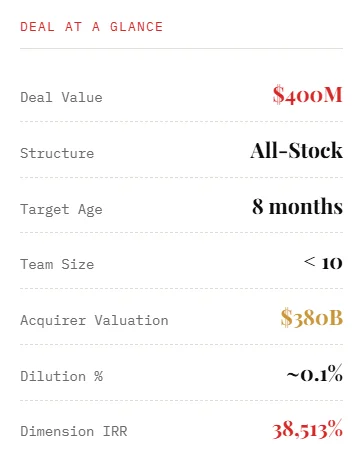
$400M for 10 people: Anthropic paid more than $40M per employee. The price reflects rare domain expertise, not headcount or revenue.
It’s a domain-native bet, not a talent hire: Coefficient Bio built biology-specific AI from the ground up. Claude for Life Sciences was a general model. This acquisition fills that gap.
The deal is financially immaterial to Anthropic: At a $380B valuation, $400M represents just 0.1% dilution. The real cost is integration risk, not capital.
Dimension VC made a 38,513% return in under a year: That figure underscores the premium the market places on specialised AI-biology talent and the velocity of this deal cycle.
The competitive race is accelerating: Google DeepMind, Nvidia, and OpenAI all have active drug discovery plays. Anthropic needed a credible biotech unit fast.
Watch for enterprise biopharma contracts: The acquisition’s real value will be measured by the number of signed deals with pharma companies, not by deal size alone.
Anthropic has acquired Coefficient Bio in a $400 million all-stock deal. The target is a stealth AI biotech startup. It had fewer than 10 employees. It was founded only eight months ago. The price tag is remarkable for those reasons alone.
The deal was first reported by The Information on April 3, 2026. TechCrunch and Eric Newcomer independently confirmed the transaction. Anthropic has not commented publicly on the deal value.
The Founders
Coefficient Bio was co-founded by Samuel Stanton and Nathan C. Frey. Both previously worked at Genentech’s Prescient Design unit. That was a computational drug discovery lab. Stanton holds a PhD in data science from NYU. Frey earned his PhD in materials science from the University of Pennsylvania.
Frey’s publication record spans more than 20 scientific papers. His journals include Science Advances and Nature Machine Intelligence. He won an ICLR Outstanding Paper Award in 2024. The winning work focused on generative modelling for drug candidate discovery.
“We want a meaningful percentage of all life science work in the world to run on Claude.” Eric Kauderer-Abrams, Head of Health Care Life Sciences, Anthropic (via CNBC, Oct. 2025)
What Coefficient Bio Built
The startup built an AI-powered platform for drug research workflows. This included the automatic drafting of drug R&D plans. It also managed clinical regulatory strategies. The platform could identify new drug candidates, too. All without ever leaving stealth mode.
Coefficient Bio described its ambition as building “artificial superintelligence for science.” That framing reflects a broader industry thesis. General-purpose AI is now capable of running specialised scientific tasks.
Strategic Context
In February 2026, Anthropic raised $30 billion in a Series G round. This valued the company at $380 billion post-money. Against that figure, the Coefficient Bio deal represents just 0.1% dilution. It is a rounding error at the corporate level.
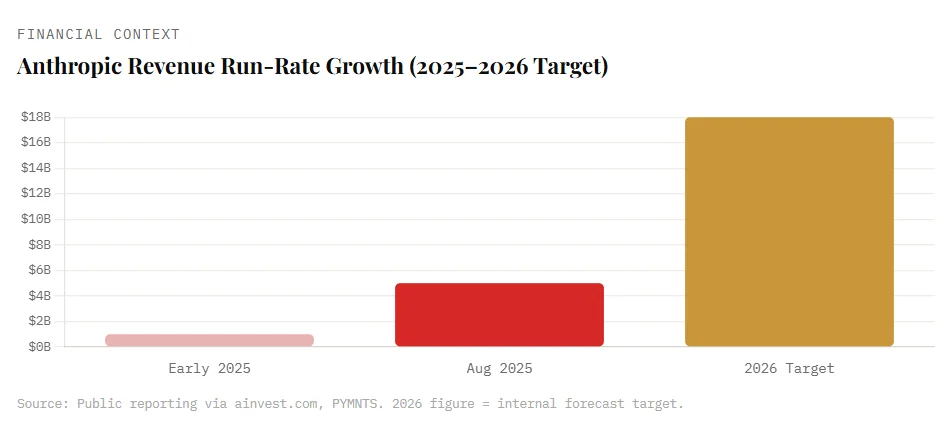
Anthropic’s run-rate revenue reached $5 billion by August 2025. That figure was roughly $1 billion at the start of 2025. Internal forecasts now target $18 billion for 2026. But spending is also accelerating fast. The company plans to spend $12 billion training models in 2026. Running those models costs another $7 billion.
The Life Sciences Race
Anthropic launched Claude for Life Sciences in October 2025. It integrates with platforms such as PubMed, Benchling, and 10x Genomics. The tool helped researchers with literature review and data analysis. But it was a general-purpose model adapted for science.
Coefficient Bio represents a deeper, domain-native approach. Its team brings protein design expertise. It adds biomolecule modelling experience. This is the difference between wearing a lab coat and actually growing up in the lab.
The Competition
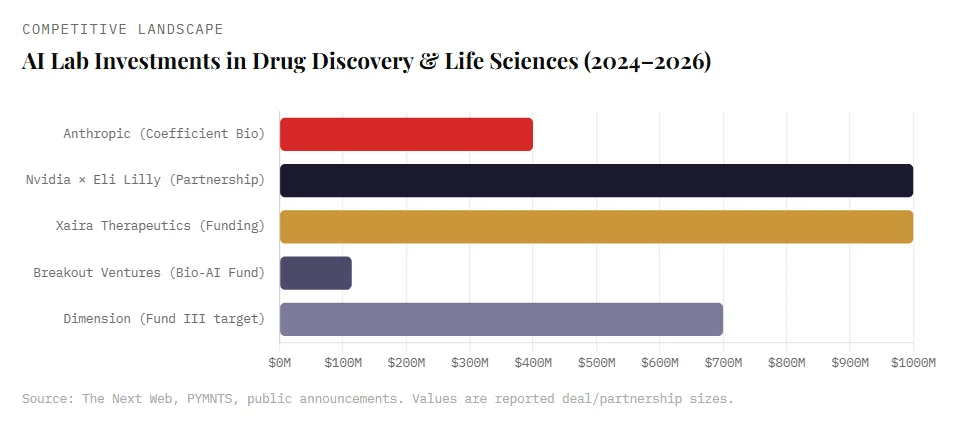
Anthropic is not the only frontier AI lab targeting biopharma. Google DeepMind spun off Isomorphic Labs. That unit is now running AI-designed drug candidates in clinical trials. NVIDIA announced a $1 billion partnership with Eli Lilly in January 2026. OpenAI has been working with Moderna on personalised cancer vaccines.
The competitive logic is clear. Whichever AI model becomes embedded in biopharma R&D will capture enormous recurring revenue. A single approved drug can generate billions over its lifecycle.
The Investor Angle
Venture firm Dimension held roughly half of Coefficient Bio at the time of the acquisition. Dimension was founded in 2023 by former partners of Lux Capital and Obvious Ventures. It focuses on technology-biology crossovers. The firm is now reporting an internal rate of return of 38,513% on the investment. That number is not a typo.
Dimension is reportedly raising a $700 million third fund. That signals strong LP conviction in the AI-biotech thesis. Breakout Ventures also closed a $114 million fund in March targeting the same space.
What to Watch
The Coefficient Bio team joins Anthropic’s Health Care Life Sciences group. Eric Kauderer-Abrams leads that division. He was hired in mid-2025 with an explicit mandate. He wants Claude to be the dominant AI model in biology. Success will be measured in enterprise contracts and product announcements. Without those, this remains a strategic bet.