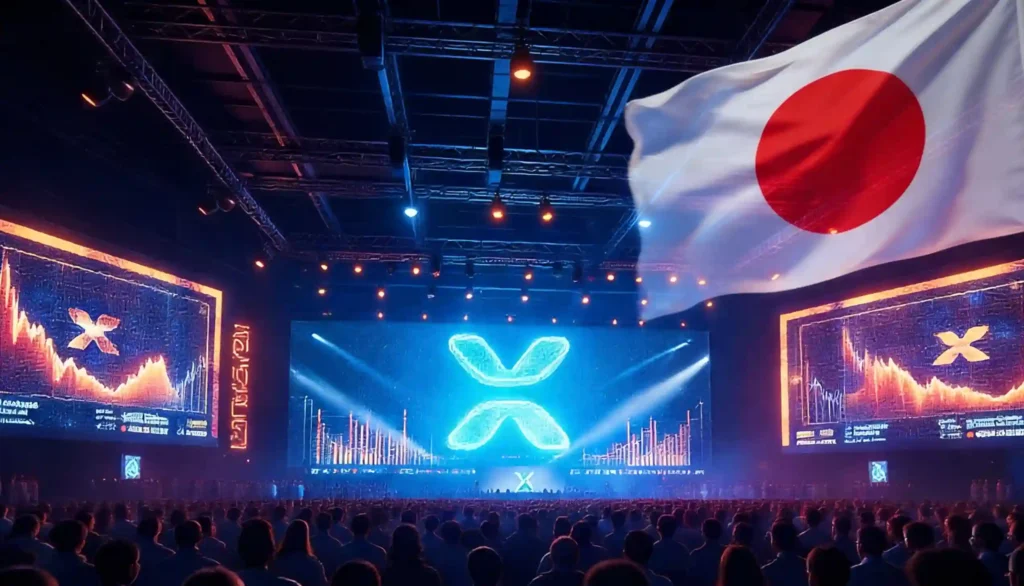


Catenaa, Wednesday, April 08, 2026- Ripple’s XRP Tokyo conference revealed a surge in institutional interest and on-chain stablecoin adoption, signaling potential price catalysts for XRP as whale accumulation reaches a 10-month high and market participants watch closely for regulatory developments.
The event provided a high-profile platform for Ripple to present its latest projections, including that on-chain stablecoin volume could surpass $33 trillion in 2026, a figure exceeding the combined GDPs of the United States and China. The company emphasized that modern fintechs no longer debate whether to adopt stablecoins but instead focus on the speed of integration to remain competitive. Ripple now holds more than 75 licenses across global jurisdictions and is positioning itself as a compliance backbone for institutional stablecoin deployment.
SBI Holdings, Japan’s financial heavyweight and Ripple partner since 2016, demonstrated real-world application by launching a 10 billion yen (~$64 million) blockchain bond earlier this year using XRP rewards. The bond, issued via Ripple’s platform, highlighted the growing integration of digital assets with conventional financial instruments. Analysts noted that this activity underscores Ripple’s claim that institutional adoption of XRP and stablecoins is accelerating and that large investors are actively adjusting positions in anticipation of market developments.
Market activity surrounding XRP reflects conference momentum. The asset has consolidated in a tight $1.28–$1.35 range, with exchanges reporting daily withdrawals exceeding 11 million XRP. Traders noted that supply compression coincides with the peak of XRP Tokyo hype. Technical analysts said a clean daily close above $1.35 could open a path toward $1.40–$1.60, driven by strong institutional interest, while failure to hold the $1.28 support level could prompt retracement to previous breakout lows. Spot XRP ETFs have collectively pulled in $41 million in year-to-date inflows, reflecting growing professional demand for regulated exposure.
The conference agenda included panels on stablecoin infrastructure, tokenization of real-world assets, and institutional blockchain adoption. Ripple emphasized that stablecoins are no longer just trading instruments but foundational infrastructure for cross-border payments and settlement. Presenters highlighted tokenized U.S. Treasuries, corporate bonds, and other real-world assets moving on-chain, indicating a shift toward on-chain yield and liquidity products that appeal to long-term institutional capital.
Regulatory clarity remains a critical variable for market participants. The CLARITY Act, which is advancing through the U.S. Senate, could influence both institutional allocations and speculative activity. XRP’s near-term scenarios appear contingent on legal outcomes and trading dynamics. Analysts outlined three paths: a bull case where a confirmed close above $1.35–$1.36 drives a move toward $1.50+, accelerated by tokenization announcements; a base case in which XRP consolidates between $1.30 and $1.40 pending regulatory updates; and an invalidation scenario where a break below $1.28 on rising volume revisits previous lows.
Institutional sentiment was evident in commentary from SBI Holdings CEO Yoshitaka Kitao, who stated that XRP “will be very expensive” if Ripple secures favorable legal resolution. Market observers interpreted the statement as a signal that XRP’s long-term valuation could rise substantially, particularly as regulatory uncertainty diminishes. Ripple executives reiterated that the company is building infrastructure to support professional capital and long-term participation, reinforcing its positioning as a compliance-oriented gateway for institutional stablecoins.
Outside of XRP-specific discussions, the conference also showcased emerging blockchain products, including tokenization platforms and institutional-grade custody services. Panels stressed that Japan continues to serve as a leading hub for crypto integration with traditional financial systems. Analysts said that XRP Tokyo serves as both a symbolic and functional demonstration of the maturation of crypto markets, highlighting that regulatory-compliant infrastructure and institutional adoption are becoming the primary drivers of value rather than short-term speculative trading.
Traders also drew attention to ancillary markets, such as Bitcoin Layer 2 projects and presales, as investors seek diversified exposure to blockchain-enabled financial products. Despite XRP’s current $82 billion market capitalization, observers note that scaling large capital inflows will require both technical infrastructure and regulatory clarity to sustain higher valuations over time.
XRP Tokyo’s outcomes suggest that Ripple is effectively positioning itself at the intersection of compliance, institutional adoption, and high-volume stablecoin markets. With whales actively consolidating positions and multiple legal and regulatory catalysts on the horizon, XRP’s market trajectory may be determined as much by global policy and institutional deployment as by typical retail-driven volatility.
The conference demonstrated the growing sophistication of blockchain finance and emphasized Ripple’s central role in enabling secure, compliant, and scalable digital asset adoption globally.