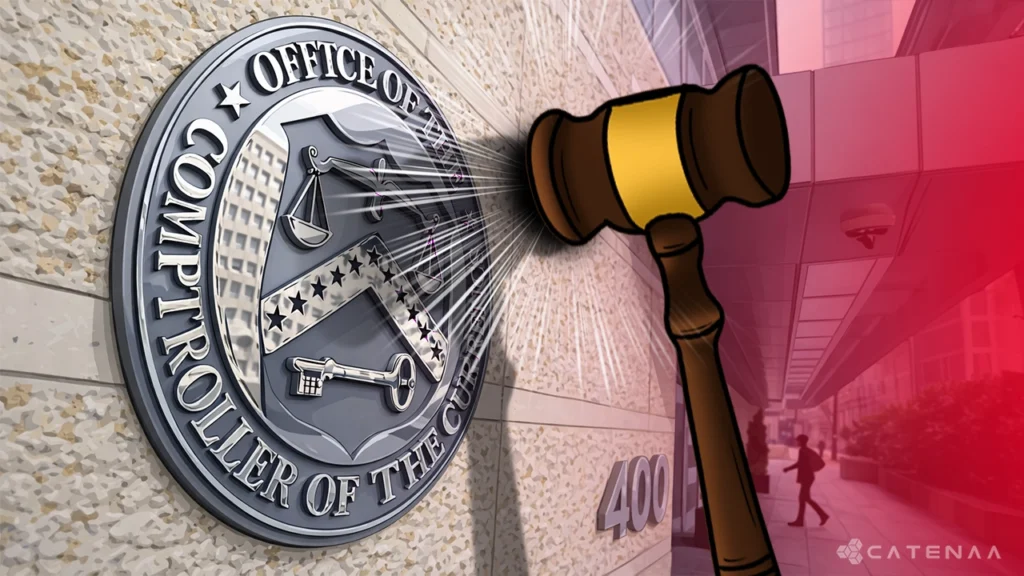


Catenaa, Wednesday, March 11, 2026- The Bank Policy Institute, representing JPMorgan Chase and Citigroup, announced plans to sue the Office of the Comptroller of the Currency over national trust charters granted to crypto firms.
The suit challenges approvals for institutions such as Circle, Ripple, Paxos, Crypto.com, World Liberty Financial, and ZeroHash, claiming they operate under lighter regulatory standards than traditional banks.
OCC Chairman Jonathan Gould, a former crypto industry executive, has eased approval rules, allowing crypto firms nationwide operations with oversight below traditional banking standards. Critics describe the approach as a two-tier system that favors new entrants while legacy banks remain subject to rules dating to the 1930s. The BPI argues the policy increases systemic risk and violates statutory boundaries. The American Bankers Association also urged slower approvals, citing risks to financial stability.
Kraken received a Federal Reserve master account via the Kansas City Fed, drawing BPI criticism for creating unfair advantages. Gould defended crypto charters, emphasizing innovation and competitiveness, while pointing to $2 trillion in digital custody activity. Stablecoins now total $250 billion globally, with Tether at $140 billion and USDC at $60 billion. Crypto trust banks focus on institutional clients, payment processing, and custody, bypassing retail deposits and FDIC insurance.
Internationally, Singapore, Hong Kong, Japan, South Korea, the UK, Germany, France, and the UAE have established regulatory frameworks for crypto banking and tokenized assets. China maintains a ban, while its digital yuan pilot settles tokenized transactions. U.S. crypto firms seek parity with traditional banks via Fed master accounts and correspondent banking access. Congress is reviewing stablecoin legislation under the GENIUS Act, with dual SEC and CFTC oversight creating market uncertainty.
Traditional banks have invested heavily in blockchain and tokenization, including JPMorgan’s $1 trillion Onyx network, Goldman Sachs’ $10 billion tokenized debt, and Bank of America, Citi, and Morgan Stanley initiatives. The lawsuit may escalate to the Supreme Court, testing the OCC’s authority to reinterpret national banking charters. Banks demand aligned capital and leverage requirements, while political and lobbying pressures intensify ahead of 2026 midterm elections.
The BPI lawsuit seeks an injunction against OCC approvals, citing the National Bank Act. Precedents include the 1999 Gramm-Leach-Bliley law and a 2018 fintech charter ruling.
The case underscores tensions between legacy banking oversight and the accelerating crypto financial ecosystem.




