

April 09, 2026 – The move extends TRON’s $86 billion USDT pool to a permissionless multichain network. It could reshape how stablecoin liquidity flows across DeFi.
In Summary
TRON is now live on 150+ chains via Hyperlane’s free and open framework.
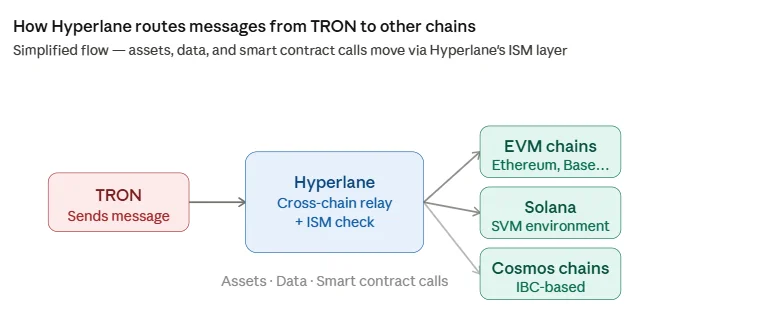
Hyperlane moves data, assets, and smart contract calls, not just tokens.
Developers can build cross-chain apps without a central gatekeeper.
Security rules are set per app, using custom validator sets.
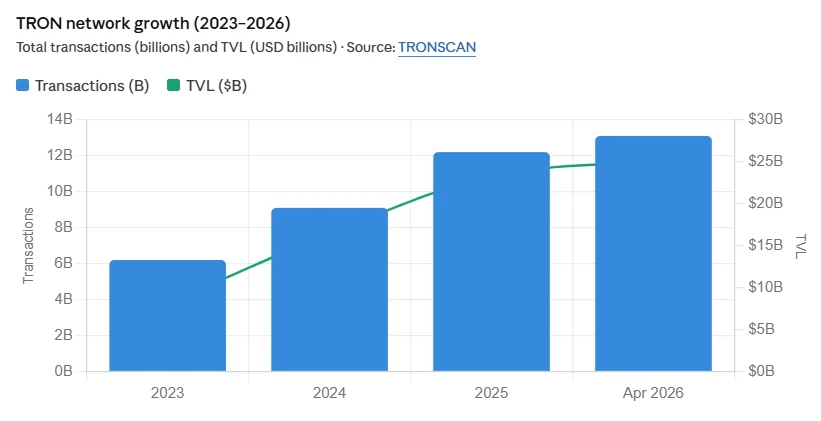
TRON handled $7.9 trillion in USDT volume in 2025, per Messari.
TRON’s stablecoin liquidity is going multichain. On April 8, TRON DAO announced its link to Hyperlane, a free and open cross-chain messaging system. As a result, TRON is now live on over 150 blockchains at once.
The move matters for one clear reason. TRONSCAN data shows TRON holds over $86 billion in USDT. Until now, that pool has mostly stayed on one chain. So, this link opens it up to the wider multichain world.

What Hyperlane actually does
Most cross-chain bridges only move tokens. Hyperlane, however, does more. It also moves data and runs smart contract calls across chains. This lets builders create richer app designs.
Moreover, it is fully open. Developers can link TRON to any supported chain with no central gatekeeper. As a result, they can build and launch cross-chain apps much faster.
In addition, the system uses Interchain Security Modules, or ISMs. These let each app set its own rules for how messages are checked. So, security is not one-size-fits-all; it is set at the app level.
Why stablecoin liquidity matters here
TRON handled roughly $7.9 trillion in USDT transfers in 2025, according to Messari. Daily volumes also often exceeded $20 billion. That makes TRON a key rail for dollar-based transfers.
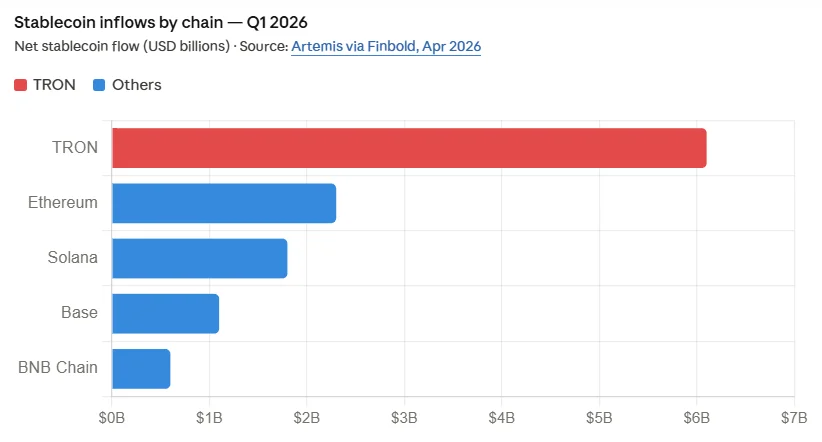
Furthermore, in Q1 2026, TRON led all chains in net stablecoin inflows. Artemis data cited by Finbold puts TRON’s net flow at +$6.1 billion. By contrast, Ethereum came in well below that figure.
Still, until now, that liquidity was mostly chain-native. Therefore, this Hyperlane link gives DeFi apps on other chains direct access to TRON’s deep USDT pool for the first time.
“TRON settles more stablecoin volume than almost any chain in crypto, but most of that liquidity has stayed on one network. Developers on any chain can now easily tap into TRON’s stablecoin depth directly.”
— Jon Kol, Co-Founder, Hyperlane
New use cases the link makes possible
The TRON–Hyperlane link opens up a wide range of new app types. For example, builders can now create cross-chain stablecoin transfers and cross-chain deposits. Multichain voting and native asset launches are also now possible.
Additionally, Hyperlane Warp Routes handle token bridging between TRON and other networks. The system also supports EVM-based chains, Solana, and Cosmos-based chains. That covers a large share of active DeFi users today.
Context: TRON’s legal and tech tailwinds
The timing of this news is worth noting. In March 2026, the SEC settled its case against TRON and founder Justin Sun. As a result, large investors now have more trust in the network.
Meanwhile, a network upgrade, GreatVoyage-v4.8.1, went live in February 2026. It improved support for AI tools and made it easier to run Ethereum apps on TRON. Both changes set the stage for wider use.
Finally, DefiLlama data puts TRON’s stablecoin market cap above $86.7 billion. Of that total, USDT makes up 97.9%. So, TRON’s value as a settlement layer is clear and growing.
What this means for builders and users
For builders, the key gain is speed and control. They can now launch cross-chain apps without going through a central bridge operator. Also, they can set their own security rules per app.
For users, the benefit is simpler access to TRON’s deep USDT pool from other chains. For instance, stablecoin transfers, DeFi deposits, and cross-chain payments all become easier.
Overall, Hyperlane has moved over $10 billion since it launched in 2022. Adding TRON’s large stablecoin base should help that number grow much faster going forward.