

April 05, 2026 – The brokerage giant’s entry into spot crypto marks a turning point for institutional adoption. Here’s what the data reveals about its market impact.
In Summary
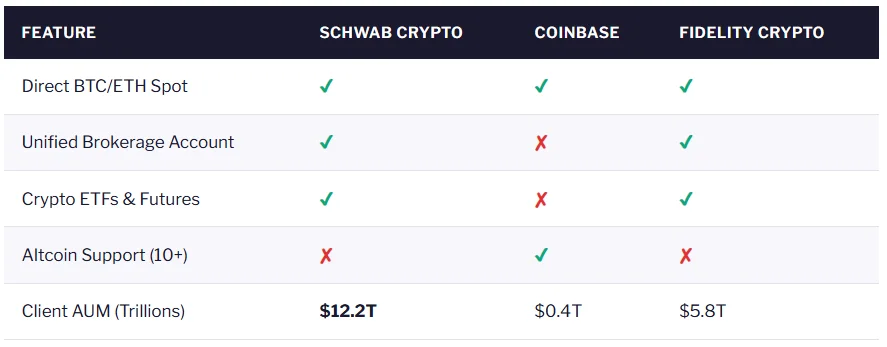
Schwab manages $12.2 trillion in client assets. Its crypto entry dwarfs existing players.
The rollout targets H1 2026. It starts with BTC and ETH only.
New York and Louisiana residents are excluded at launch.
Pricing below 50 basis points could disrupt crypto-native exchanges.
86% of institutional investors now plan digital asset allocations.
Charles Schwab is preparing to launch Schwab Crypto, a direct trading service for Bitcoin and Ethereum. The platform will operate through Charles Schwab Premier Bank, SSB. It represents one of the largest traditional finance entries into spot crypto trading to date.
The firm confirmed to CoinDesk it remains on track for a first-half 2026 launch. CEO Rick Wurster outlined a phased rollout strategy. Internal employee testing comes first. A limited client pilot follows. Broader access expands afterwards.

Why This Matters for Institutional Crypto
Schwab’s move is not simply another brokerage adding crypto. The firm manages more than $12 trillion in client assets. That figure exceeds the entire cryptocurrency market capitalization. It signals a structural shift in how mainstream investors access digital assets.
Schwab already offers crypto ETFs, futures, and related equities. Direct spot trading adds true asset ownership. Clients will manage crypto alongside stocks and bonds in one account. This unified approach removes friction that deterred traditional investors.
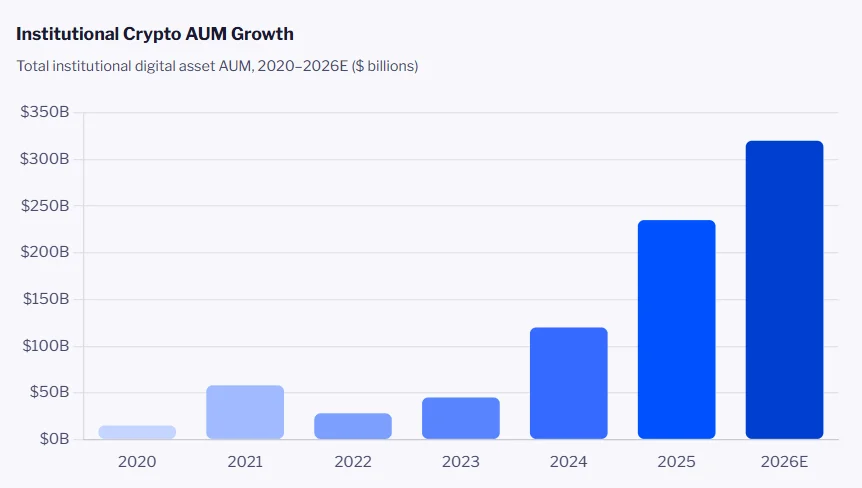
Institutional digital asset AUM surpassed $235 billion by mid-2025, per CoinLaw research. Institutions now control roughly 65% of global crypto investments. This trend accelerates as firms like Schwab lower the barrier to entry.
The Competitive Landscape Shifts
Schwab’s entry intensifies pressure on multiple fronts. Crypto-native exchanges face a new rival with massive distribution. Traditional brokerages must accelerate their own crypto plans. Morgan Stanley, for instance, plans BTC, ETH, and SOL trading through E*Trade.
Bloomberg ETF analyst Eric Balchunas flagged fees as the key battleground. Schwab already offers commission-free stock and ETF trading. Pricing crypto below 50 basis points could significantly undercut exchanges. This matters because Coinbase charges spreads of roughly 1.5% for retail trades.
Regulatory Clarity Fuels Confidence
The timing is not accidental. Federal agencies have confirmed banks may offer custody and trading services. The GENIUS Act introduced the first federal stablecoin framework. This regulatory clarity removes a major obstacle that previously held Schwab back.
However, state-level hurdles remain. New York’s BitLicense requirement excludes residents at launch. Louisiana faces similar restrictions. Schwab is pursuing approvals in both states. The phased approach reflects a compliance-first strategy.
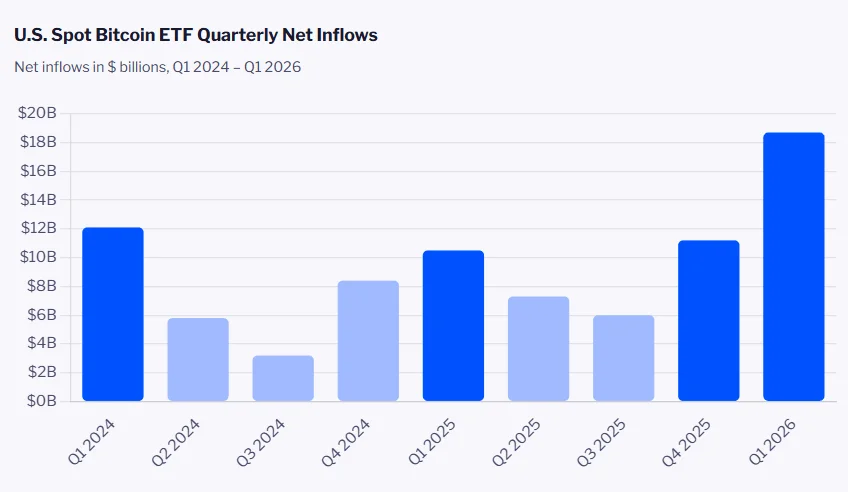
U.S. spot Bitcoin ETFs have accumulated over $128 billion in AUM and $65 billion in cumulative net inflows since their January 2024 approval. Q1 2026 alone saw $18.7 billion flow in. BlackRock’s IBIT leads with roughly 45% market share, per industry data.
What It Means for Bitcoin and Ethereum
BTC currently trades near $67,094. ETH hovers around $2,050. Both remain well below their all-time highs. Bitcoin is down roughly 47% from its $126,080 peak. Ethereum has fallen nearly 59% from its record.
Schwab’s entry could act as a demand catalyst. The firm’s millions of retail and institutional clients gain frictionless access. Analysts project that even a small percentage allocation from Schwab’s asset base would inject billions into the market.
“Schwab’s entrance could accelerate mainstream adoption by placing crypto within a trusted financial platform.”— Industry Analyst Commentary
The Bottom Line
Schwab’s crypto launch marks a defining moment. It represents the convergence of traditional finance and digital assets at an unprecedented scale. The question is no longer whether institutions accept crypto. The question is how fast they can build before competitors do.
Investors should watch the fee structure closely. Pricing decisions will determine whether Schwab captures market share from crypto-native platforms. The phased rollout also means full impact may not materialize until late 2026.