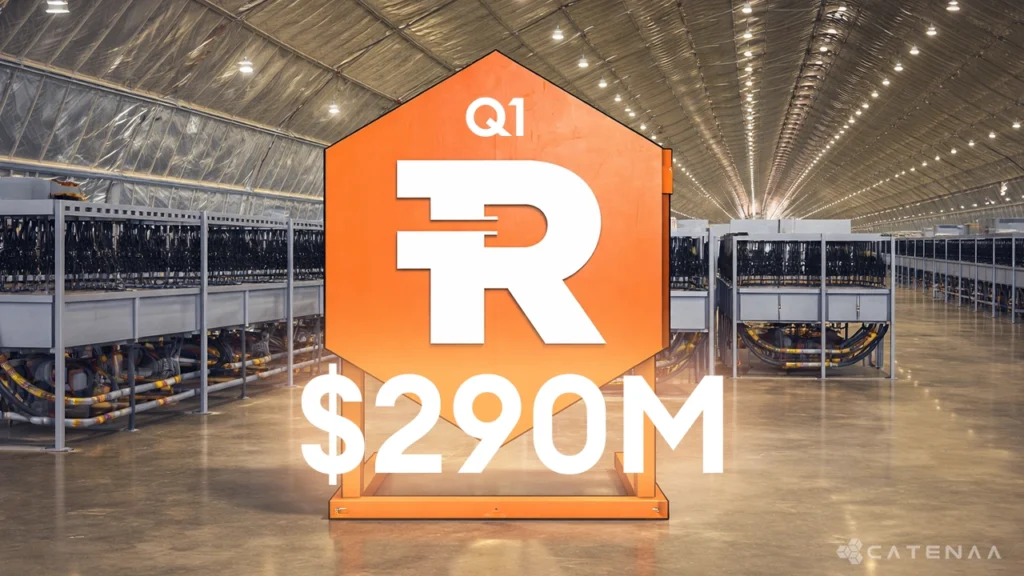


Catenaa, Tuesday, April 07, 2026- Riot Platforms sold $289.5 million worth of bitcoin in the first quarter of 2026 as the mining firm rebalanced its holdings and shifted toward AI and high‑performance computing infrastructure while maintaining substantial reserves, according to its production and operations update.
Riot sold 3,778 coins at an average price of $76,626 each. By the end of March, the company held 15,680 bitcoins valued at about $1.1 billion, including 5,802 coins pledged as restricted collateral. Riot did not fully explain the sale strategy, but the move fits a broader trend among miners liquidating assets to strengthen balance sheets and support infrastructure expansion.
Miner Sales Become Industry Theme
The lion’s share of bitcoin miners has adjusted trading strategies over recent months. Marathon Digital Holdings sold 15,133 bitcoins for roughly $1.1 billion in March. Core Scientific offloaded 1,900 coins in January, saying it plans to divest all holdings. These sales came as miners pursue AI compute projects and data center builds that promise steadier cash flows.
Riot’s own production showed a slight decline. The company mined 1,473 BTC in the first quarter of 2026, a 4 percent drop from the 1,530 BTC in Q1 2025. Despite the lower output, Riot’s hashpower capacity expanded. Its deployed hashrate climbed 26 percent to 42.5 exahashes per second, and average operating hashrate increased 23 percent to 36.4 exahashes per second.
Revenue trends reflect the sector’s growth trajectory. Riot reported record annual income in 2025 of $647.4 million, a 71.8 percent increase from the previous year. Higher sales and infrastructure investments have increasingly defined miner strategies as industry conditions evolve.
Strategic Shift and Liquidity Posture
The bitcoin sales signal a shift in how miners view volatility and long‑term holdings. Selling large blocks of BTC at strong prices can reduce exposure to sharp price declines while funding capital expenditures on AI and high‑performance computing systems.
Mining companies are responding to market conditions that favor operational flexibility. Liquid assets allow firms to pursue power contracts, financing for data centers, and computing expansions without relying solely on revenue from block rewards and transaction fees.
Expanding hashpower capacity despite production dips suggests investments are aimed at next‑generation operations rather than legacy mining rigs. Firms are racing to capture opportunities in AI compute where demand and pricing may offer higher long‑term returns than traditional mining profits.
This approach affects investor expectations. Firms that balance bitcoin holdings with income‑producing infrastructure may attract capital more consistently in a risk‑off environment. Wall Street and institutional money are watching these developments closely, seeking signs that miners can sustain growth and navigate market cyclicality.
Some crypto analysts view Riot’s sale as prudent risk management. Selling BTC at elevated levels can provide liquidity while preserving operational cash flow.
One institutional strategist said that diversifying revenue beyond pure mining could lower dependence on volatile bitcoin prices. The strategist pointed out that AI leases and high‑performance computing contracts create recurring revenue streams that stabilize earnings.
Other observers see the sales as indicative of broader market recalibration. They note that as bitcoin prices rise and fall, miners may prefer cashing in portions of inventory to fund expansion rather than holding all assets for potential future price gains.
A trader specializing in digital assets said balance sheet strength matters more now than in prior cycles. The trader said investors are rewarding companies with diversified business models over those that rely solely on mining margins.
Some experts emphasized that the restricted bitcoin tied up as collateral remains a strategic buffer. It ensures borrowing capacity and supports financing deals while preserving core holdings for future growth.
High‑performance computing proponents said expanding hashpower capacity positions Riot for the next phase of infrastructure services, enabling transition from block reward dependency toward broader digital compute applications.
Riot Platforms’ first quarter highlights a sector at an inflection point. The company has shown that strategic asset sales and capacity investments can coexist. By reducing vulnerability to price swings and reinvesting in computational infrastructure, Riot is positioning itself for long‑term relevance beyond pure bitcoin mining.
The miner’s choice to retain a large bitcoin holding while monetizing a portion at favorable prices reflects a nuanced approach. Firms that balance inventory management with calculated expansion may be better positioned to attract diversified institutional capital.
Expanding hashrate capacity even amid modest declines in production suggests emphasis on future growth sectors. As AI and high‑performance computing demands escalate, miners with scalable infrastructure may tap new revenue streams.
Investor focus will likely remain on how efficiently Riot deploys capital from bitcoin sales. Maintaining liquidity while investing sustainably could define success in a market that increasingly values adaptability and diversified earnings.
Riot Platforms, founded as a bitcoin mining company more than a decade ago, listed on Nasdaq in 2018. Early industry success came from capturing rewards during bull markets and establishing low‑cost power contracts in Texas and other regions.
Bitcoin halvings, which reduce miner block rewards approximately every four years, have historically squeezed margins and pushed firms toward innovation and consolidation. The industry’s pursuit of cheap power evolved into data center builds and broader compute offerings.
The advent of AI and high‑performance computing opportunity has drawn miners into adjacent technology markets. Building infrastructure for compute services, cloud contracts, and AI workloads offers new pathways for revenue beyond the traditional cycle of mining and HODLing bitcoin rewards.
Miners now compete not only with each other for hashpower efficiency but also with cloud providers and data center operators for computing contracts. Riot and peers see this transition as a chance to leverage existing power advantages into next‑generation computing services.
Mining rigs that once ran constantly during bull cycles now coexist with servers rated for diversified computing. Revenue diversification remains central to how miners pitch their long‑term strategies to investors.
The Q1 shift marks a notable moment in which miners acknowledge that holding only bitcoin is no longer the sole path to growth. Strategic sales and infrastructure investment points toward a broader evolution in how crypto mining companies operate in a changing market.