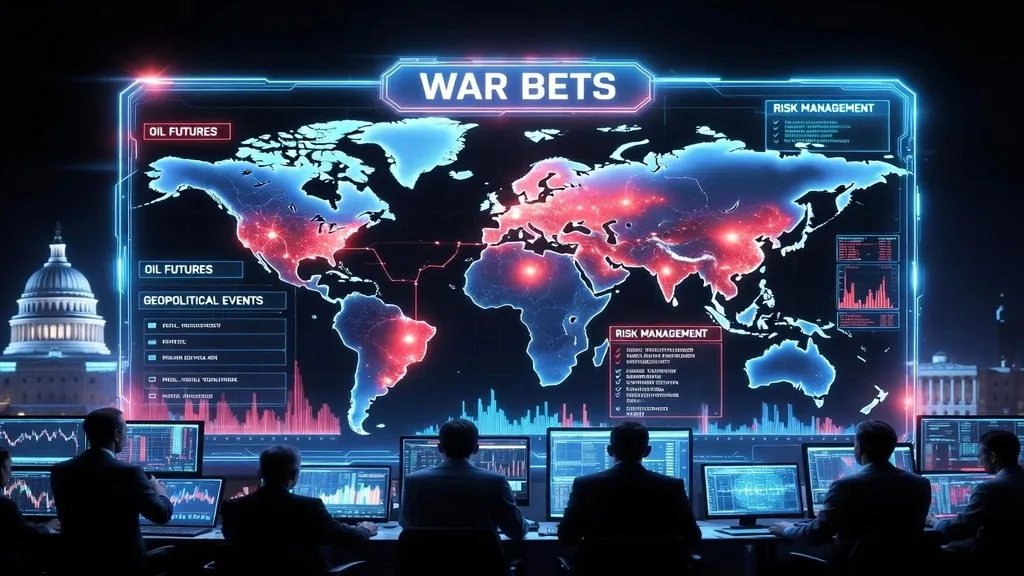


Catenaa, Tuesday, April 07, 2026- US House Democrats early today pressed federal regulators to act against offshore prediction markets offering wagers tied to military operations, raising concerns over legality, national security, and the rapid expansion of a loosely regulated financial segment.
A group of Democratic lawmakers has asked the Commodity Futures Trading Commission to explain why it has not acted against platforms enabling bets on events such as US military actions and rescue missions abroad. The request follows controversy over contracts linked to American airmen in Iran, which were later removed after public backlash.
Lawmakers argue that existing rules already prohibit contracts tied to war, terrorism, or unlawful activities. They also point to legal authority allowing the CFTC to pursue offshore platforms if their activities affect US commerce.
The issue has intensified as prediction markets such as Polymarket and Kalshi gain traction, attracting millions of users and large trading volumes. Some contracts have drawn scrutiny for appearing to anticipate geopolitical developments, raising fears of insider trading.
The CFTC has not issued a formal response but faces a deadline set by lawmakers for clarification on enforcement actions.
Prediction markets allow users to trade contracts based on real-world outcomes, from elections to economic data and geopolitical events. These platforms operate similarly to financial exchanges, where prices reflect perceived probabilities.
In early 2026, monthly trading volumes exceeded $20 billion, signaling rapid growth and increasing systemic relevance.
The CFTC has asserted exclusive jurisdiction over such markets in the US, positioning them as derivatives rather than gambling. However, offshore platforms complicate enforcement, especially when they restrict US users but still influence domestic markets.
Recent incidents involving bets on military events have pushed the debate beyond financial regulation into ethical and national security territory.
The dispute highlights a deeper regulatory dilemma. Prediction markets are no longer fringe platforms but emerging financial infrastructure influencing real-world decision-making.
Data from these markets is increasingly used by traders and institutions to gauge geopolitical risk, including movements in energy markets.
This creates a feedback loop where bets on events may shape expectations and potentially behavior. Lawmakers warn that allowing wagers on sensitive events could incentivize manipulation or misuse of privileged information.
At the same time, enforcement against offshore platforms may prove difficult without international coordination. A crackdown could also shift activity further into decentralized or unregulated spaces.
Analysts note that regulators face a choice between integrating prediction markets into formal oversight or pushing them into opaque environments. Some see parallels with early online gambling and derivatives markets, where regulatory delays allowed risks to build.
Others argue prediction markets offer value as forecasting tools, aggregating public sentiment into measurable probabilities. Still, concerns persist over insider access and moral hazards tied to betting on human lives.
Industry leaders have acknowledged risks, with some expecting federal investigations into misconduct as the sector grows.
Prediction markets trace their roots to academic experiments in the late 20th century, designed to test whether crowds could forecast outcomes more accurately than experts. Early platforms focused on elections and economic indicators, operating in limited or experimental settings.
The concept evolved rapidly with the rise of internet-based trading and blockchain technology. Crypto-native platforms enabled global participation, pseudonymous trading, and near-instant settlement. This removed traditional barriers but also weakened regulatory oversight.
By the early 2020s, platforms like Polymarket and Kalshi expanded into mainstream visibility. They introduced contracts tied to politics, corporate events, and global crises. The appeal lay in their simplicity, allowing users to buy “yes” or “no” positions on real-world outcomes.
Regulators initially struggled to classify these markets. Supporters framed them as financial derivatives that improved information discovery. Critics compared them to gambling, citing risks of addiction, manipulation, and ethical concerns.
Tensions escalated as evidence emerged of large trades placed before major geopolitical developments, raising suspicions of insider activity. Lawmakers began calling for stricter enforcement, particularly on contracts involving violence, war, or government actions.
Legal battles further complicated the landscape. Courts have reinforced the CFTC’s authority over prediction markets, limiting state-level intervention while placing greater responsibility on federal oversight. At the same time, offshore platforms continued to operate in regulatory gray zones.
The current push by lawmakers reflects a turning point. As prediction markets grow in scale and influence, the question is no longer whether they should be regulated, but how far that regulation should extend across borders, technologies, and ethical boundaries.