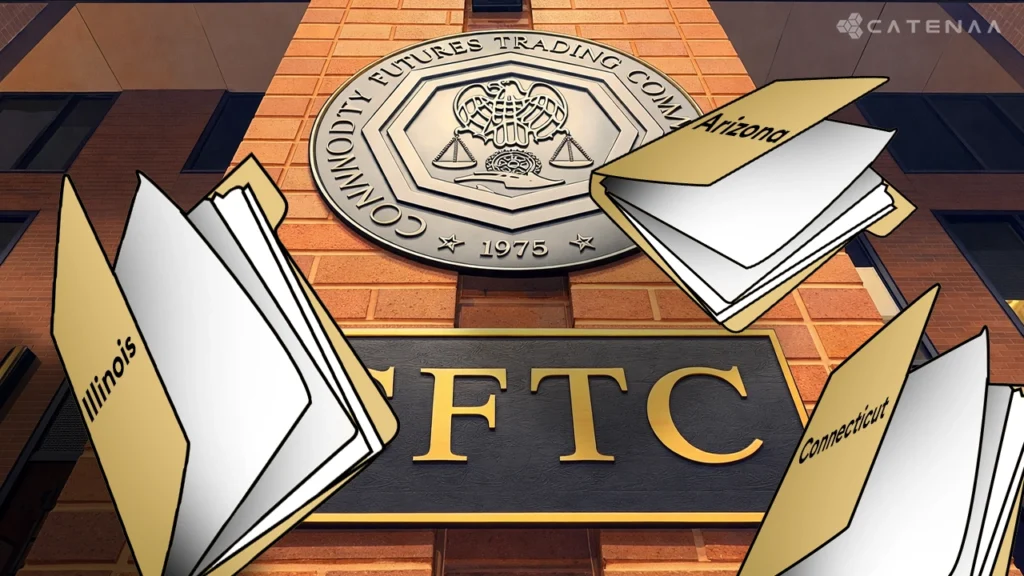


Catenaa, Tuesday, April 07, 2026- The Commodity Futures Trading Commission filed lawsuits against Illinois, Arizona, and Connecticut on Thursday, asserting its exclusive federal jurisdiction over prediction markets after states attempted to regulate and shut down several platforms, including Kalshi, Crypto.com, and Polymarket.
The lawsuits, filed in U.S. District Court for the Northern District of Illinois, claim state regulators issued cease-and-desist letters that conflicted with federal oversight. The CFTC argues Congress granted it sole authority under the Commodity Exchange Act to regulate derivatives on prediction markets and that state actions violate the Supremacy Clause of the U.S. Constitution.
Illinois, led by Attorney General Kwame Raoul, has moved to enforce local gaming laws against prediction-market platforms, while Arizona and Connecticut reportedly pursued similar enforcement. The federal agency seeks permanent injunctions preventing states and future officials from enforcing conflicting regulations against federally regulated designated contract markets, or DCMs.
Over the past year, several states have moved to apply local gaming and gambling rules to prediction markets, citing concerns about consumer protection and sports-related bets. The CFTC maintains these markets are derivatives subject to exclusive federal oversight, warning that fragmented state regulation could increase fraud and manipulation risks.
CFTC Chair Michael Selig emphasized that the agency will defend market participants from state interference. Previous filings included supporting Crypto.com’s prediction-market operations against Nevada’s regulatory challenge, but Thursday’s actions mark the first time the agency has directly sued multiple states over jurisdiction.
States counter that federal enforcement favors companies generating high profits without basic consumer protections. Illinois officials argue that some platforms facilitate risky trading practices and insider trading opportunities, exposing residents to potential financial harm. The state vows to continue defending consumer rights in court.
Prediction Market Regulation
The litigation underscores growing tension between state and federal authority in emerging financial products. A ruling in favor of the CFTC could limit state-level oversight, clarifying that prediction markets fall solely under federal regulation. Conversely, a decision favoring states could trigger a patchwork of state rules, creating compliance challenges for platforms and potential confusion for users.
The outcome will likely influence investment strategies, platform operations, and the structure of derivatives tied to prediction markets. Institutional and retail participants may adjust engagement based on the perceived regulatory risk. Investors and startups may prioritize jurisdictions aligned with federal guidance to reduce uncertainty.
Legal experts note that the CFTC’s reliance on the Supremacy Clause strengthens its argument, but courts may consider states’ consumer protection interests. Analysts highlight that previous federal rulings have favored uniform regulation to minimize market manipulation and cross-border inconsistencies.
Financial industry observers suggest the case could establish precedent for oversight of other emerging derivatives markets, including those linked to cryptocurrency and alternative financial instruments. Venture and institutional investors may view the CFTC’s aggressive enforcement as a stabilizing force, ensuring that federally regulated platforms operate under consistent rules.
Market strategists caution that a pro-state ruling could invite litigation in other sectors, challenging federal agencies’ jurisdiction and creating uncertainty for nationwide financial operations. A mixed outcome could see some states implementing limited oversight while federal rules remain dominant in key derivatives markets.
The CFTC lawsuits highlight the delicate balance between federal authority and state-level regulation. Platforms offering prediction markets now face legal uncertainty as courts weigh exclusive federal oversight against state consumer protection mandates.
The broader financial industry watches closely, as the case may define the boundaries of jurisdiction for all U.S.-based prediction markets and potentially other digital asset derivatives. Market participants will need to monitor developments closely and adjust strategies in anticipation of possible court rulings or legislative clarifications.
While the litigation unfolds, the CFTC asserts that its intervention will protect the integrity of federally regulated DCMs. At the same time, states argue that consumer protection and local oversight remain essential to prevent exploitation of residents. The outcome is poised to shape the regulatory landscape for prediction markets nationwide for years to come.
Prediction markets allow participants to bet on the outcome of events, often functioning as derivatives with underlying financial risk. The Commodity Exchange Act gives the CFTC authority to regulate derivatives nationwide, aiming to maintain market integrity and protect investors from fraud.
In recent years, online platforms expanded access to prediction markets, drawing federal attention for compliance with derivative regulations. Some states began enforcing gaming laws, citing consumer protection concerns, particularly around sports-related events. The resulting legal tension between federal and state authority has intensified as markets grow and attract mainstream investors.
Prior cases have generally favored federal regulation for derivatives to prevent inconsistent rules across states. The current lawsuits against Illinois, Arizona, and Connecticut represent a significant escalation in the CFTC’s efforts to establish clear jurisdiction and protect federally regulated market participants from conflicting state actions.