

| Core Objective: Create clarity around token types and avoid confusion that leads to mispricing and regulatory risk. |
By now, you know what tokenisation is, how it works, and the infrastructure behind it. But here’s where many investors stumble. They assume all tokens are the same. They are not. And confusing one type with another can cost you money, or land you in regulatory trouble.
Think of it this way. A concert ticket, a share certificate, and a gym membership card are all pieces of paper. But each gives you a very different right. Tokens work the same way. The label matters far less than what the token actually represents.
Let’s break down the three main types.
1. Asset-Backed Tokens
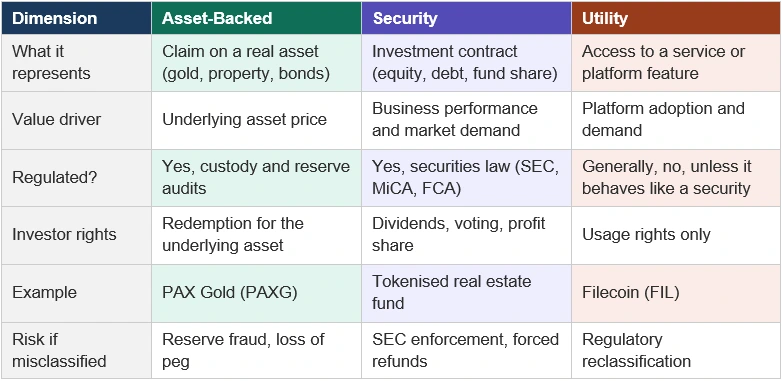
Asset-backed tokens represent ownership or a claim on a real-world asset. This could be gold, real estate, fine art, or government bonds. Their key feature is that something of intrinsic value backs them. This provides stability that purely speculative cryptocurrencies often lack.
A well-known example is PAX Gold (PAXG). Each token represents a specific quantity of gold held in a secure vault and tracks its market value. Stablecoins like USDC, backed 1:1 by US dollars, also fall into this category.
2. Security Tokens
Security tokens function like digital versions of traditional financial instruments. They represent ownership rights to an investment or real-world asset, such as equity, funds, or debt. They are regulated as securities under applicable law.
In the United States, regulators apply the Howey Test to determine whether a security is a security. If a digital asset involves an investment of money in a common enterprise, with an expectation of profits from others’ efforts, it is likely classified as a security. The EU’s MiCA framework takes a different but complementary approach, dividing crypto assets into clear categories with specific licensing rules.
3. Utility Tokens
Utility tokens serve a completely different purpose. They act like keys or vouchers that provide access to a specific product or service within a platform. They don’t represent ownership. Their value depends on demand for the ecosystem they serve.
Think of them as digital arcade tokens, useful inside the arcade but not an investment. Examples include Filecoin (FIL) for decentralised storage and Basic Attention Token (BAT) for digital advertising.
Token Type Comparison
Why Does Classification Matter?
This isn’t academic. The SEC’s 2025 guidance makes clear that tokens sold with promises of profit, driven by a central team’s efforts, will be treated as securities regardless of what they’re called. Regulators globally adopt a substance-over-form approach. If a token functions like a security, it will be treated like one, no matter the label.
For investors, this means one simple rule: look at what the token does, not what the issuer calls it. A token labelled “utility” that promises returns from property rental income? That’s a security in disguise.
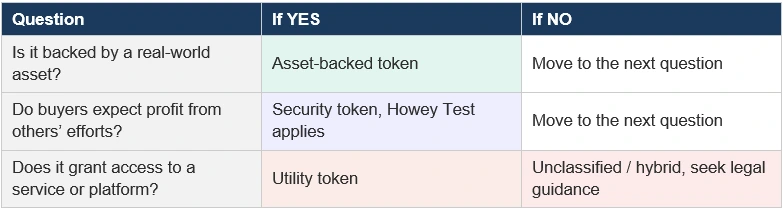
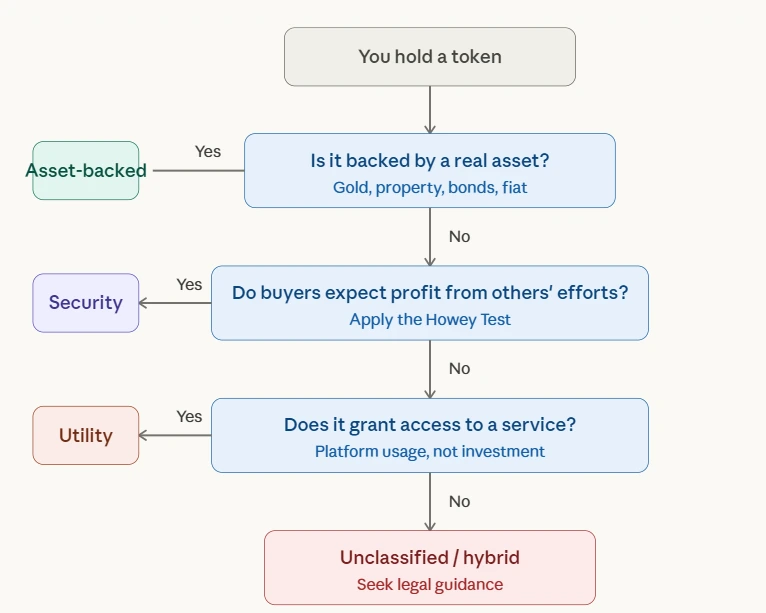
Quick Classification Framework
Use these three questions to classify any token:
It’s also worth noting that some tokens blur these lines. The EU’s ESMA guidelines recognise “hybrid tokens” that combine characteristics from multiple classifications. When this happens, if a token displays features of a financial instrument, that classification takes precedence. In other words, regulators will always prioritise substance over labels.
| Reader Takeaway: Before buying any token, ask three questions: What does it represent? What rights does it give me? And who regulates it? Misunderstanding token types leads to mispricing, unexpected losses, and regulatory risk. In the tokenised world, classification isn’t just a label; it’s your first line of defence. |